Regardless of how the Russia–Ukraine war or a potential confrontation between the Kremlin and NATO might unfold in the short and long terms, the objective of Western governments therefore should be to encourage Belarus to adopt a more neutral stance, and to ensure that Belarusian neutrality becomes sustainable over an extended period of time.
The following recommendations are intended to help Western policymakers achieve these goals:
1. Reduce Russia’s ability to use Belarus through a strategy to deter the Kremlin
Neighbouring countries such as Latvia, Lithuania and Poland are strengthening their border infrastructure, which may reduce opportunities for the exploitation of irregular migration to put pressure on NATO border states, but should also limit Russia’s capacity for escalation more broadly. However, parts of this border and its military infrastructure remain outdated in the context of modern warfare, especially in the case of drone warfare. Therefore, NATO must accelerate its development of effective and credible deterrence capabilities and defences, including air and missile defences.
Expanding defences along the borders with Belarus in this way does not necessarily escalate tensions. On the contrary, it can create opportunities for a more honest dialogue. More importantly, it may alter Russian and Belarusian perceptions of the West as a weak actor – which, in turn, increases the Lukashenka regime’s sense of the need to take Western interests into account and to be more cautious about aligning itself fully with Russia.
An alternative strategy centred on risk avoidance would not actually reduce the number of risks. Without a credible level of deterrence by both punishment and denial, it is unrealistic to expect non-aggressive behaviour from the Kremlin. If relations between the West and Russia were to reach the stage of genuine negotiation, the reduction of Russia’s military presence in Belarus should be one of the West’s demands – both to protect against a repetition of February 2022’s invasion of Ukraine and to prevent a scenario in which Belarus is used to launch attacks against NATO countries.
2. Rebalance Belarusian foreign policy through conditional engagement and some sanctions relief
Western policymakers must accept that ‘the West cannot achieve all its goals at once’. This realization will be difficult, but some progress in distancing Belarus from Russia and easing domestic repression could be achieved through conditional dialogue with the current regime. If the Trump administration succeeds in proving this, it will be less risky for other Western states to follow.
Western policymakers must accept that ‘the West cannot achieve all its goals at once’.
Despite scepticism over the prospects for success and the general unpopularity of engaging with autocratic regimes, such a policy is still more likely to produce results than the available alternatives, which offer no prospect of positive outcomes – at least in the foreseeable future. Western sanctions policy towards Belarus is often perceived as a failure, both by those who would like to see the sanctions strengthened and by those who would prefer them weakened.
Belarus remains subject to a substantial set of sanctions and restrictions, whose conditional removal would not strengthen Russia’s war machine. For example, the opening of two border crossings on the Belarus–Poland frontier in November 2025 benefits the Polish economy with little or no effect on that of Russia. In essence, this is the path the Trump administration has sought to pursue in its talks with Lukashenka: servicing several Belarusian Boeing aircraft or lifting sanctions on Belarusian potash fertilizers would not increase Russia’s war capabilities. Through measures such as renewing contacts with the Lukashenka regime, restoring full diplomatic relations at ambassadorial level, reopening closed border crossings and transport routes, allowing Belarusian athletes to compete internationally and lifting certain economic sanctions, the West could obtain concessions from Minsk in the areas of security and repression reduction. If so, that would represent a tangible success for Western policy.
The use of irregular migration, for example, is an area of security where the Kremlin’s influence is clearly weaker than in issues related to Ukraine. Consequently, the Lukashenka regime may have far greater room to make concessions on migration. Progress on that issue could also create openings for further reciprocal concessions elsewhere.
One step could involve the reintroduction of confidence-building measures between Belarus, NATO member states and, potentially, Ukraine. These measures could include regular information exchanges regarding military capabilities and major activities, invitations for observers to military exercises and restricting military operations near shared borders. The regime’s concerted efforts to show transparency over the Zapad-2025 exercises showed that these ideas are far more realistic than it may have seemed even six months ago.
The format of confidence-building initiatives can remain minimal at first. What matters is that they facilitate the establishment of contacts that could prove crucial in a crisis. As one analyst interviewed for this paper noted, ‘intelligence already provides a general picture of what each army is doing’.
Western support for Belarusian peace initiatives and ‘good offices’ in the security sphere also offers potential. There is an obvious contradiction in relying on Lukashenka for such services: his regime remains Europe’s most repressive governments and is partly responsible for the war in Ukraine. Yet, if these efforts serve the wider interests of the West and Ukraine as well as Belarus’s longer-term future, it would be short-sighted not to allow the regime a chance to atone.
The goal is to channel the regime’s willingness to offer good offices into specific areas of interest to the West and Ukraine. Lukashenka could demonstrate his readiness to play a constructive role by, for example, granting amnesty to all individuals sentenced for pro-Ukrainian activities in Belarus, including the so-called ‘railway partisans’ who sabotaged Belarusian railway infrastructure in an effort to disrupt Russian military deliveries in 2022.
The goal is to channel the regime’s willingness to offer good offices into specific areas of interest to the West and Ukraine.
Any participation by Western representatives in international conferences on regional security and negotiations held in Belarus should be conditioned on steps that enhance European security and incentivize an end to political repression within Belarus. But Western officials need not be concerned that engaging with Lukashenka will require frequent personal meetings. Once a general agreement is reached, he is likely to permit other officials to interact directly with Western counterparts, rather than seeking to cultivate personal relations at head of state level.
3. Engage with those in the regime willing to pursue a neutral (or ‘pro-Belarus’) security policy
Critics of engagement with the Lukashenka regime may fairly point out that similar efforts have previously failed and that these efforts followed a pattern: eventually, fearing for his grip on power, Lukashenka resorts to mass repression internally, to which the West responds by refreezing relations. Therefore, although normalization serves the interests of both the West and the pro-democratic segment of Belarusian society, a perception that the West is being deceived by Lukashenka lingers. This time, however, there is reason to believe that the outcome can be different. For the next few years, Lukashenka may have little need to repress society on a large scale, while the time when he is no longer president is getting closer due to his advancing years. For the latter reason alone, the West needs to be proactive in engaging the full spectrum of Belarus’s political class.
Although normalization serves the interests of both the West and the pro-democratic segment of Belarusian society, a perception that the West is being deceived by Lukashenka lingers.
Support for the democratic movement – such as political and financial backing for civil society and political opposition (whose situation has deteriorated significantly following the US decision to sharply reduce international assistance) – should be maintained. But Western governments also need to establish channels of communication with the ruling elite in Belarus, which is likely to inherit power from the 71-year-old Lukashenka in the not-too-distant future. In addition, there must be a defined proposal outlining what support might be available if Belarus commits to a transformation. If the West seeks a lasting shift in Belarus’s role in regional security, its offer must be credible to Belarusian policymakers, who will risk a great deal by changing the status quo in Belarusian domestic politics and relations with Russia.
4. Make greater use of Western soft power to shift public and elite attitudes
The West’s use of its soft power should likewise be increased, including through extra financial support for independent Belarusian media and the Belarusian services of major Western outlets to counter Russian disinformation. As an example, Chatham House surveys consistently demonstrate a strong link between patterns of media consumption and attitudes towards Russia’s war against Ukraine.
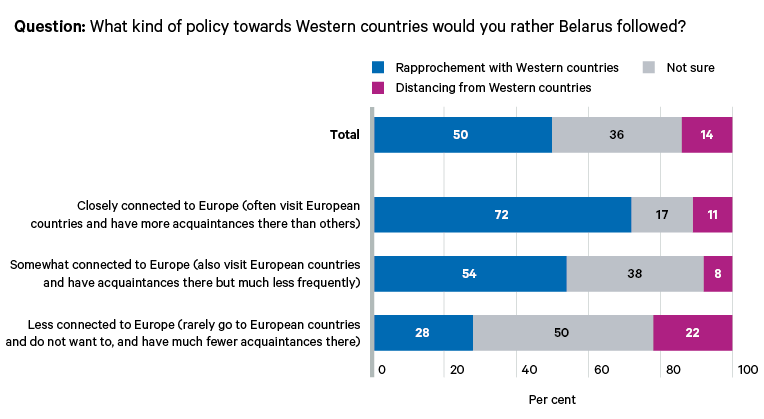
The West also needs to foster interpersonal connections between Belarusians and neighbouring countries. Ways to achieve this could include increasing the number of visas issued to Belarusians and restoring transport links between Western countries and Belarus. Survey data show that Belarusians who travel to Western countries or have relatives and other personal ties there are the most pro-Western in their views.
Among the population as a whole, survey data make clear that only a small fraction supports further distancing from the West (Figure 3). This suggests that by bringing the majority of society closer to the West through adept use of soft power, Western states can further weaken Russia’s influence and make Belarus even less willing to participate in the Kremlin’s aggressive actions against its neighbours.