The CEP’s expected decision to postpone the election shifts the policy debate from whether the original timetable can be maintained to how the additional preparation time should be used, and under what conditions a revised electoral calendar should be established.
The CEP itself had not treated the electoral calendar as unconditional: the calendar it published in July 2026 explicitly stated that implementation depended on an acceptable security environment and sufficient financing, although neither condition was clearly defined.
A revised calendar alone will not resolve any of the underlying constraints. The task is not just to determine when elections should occur, but to untangle processes that have already started and to set the minimal thresholds for each of those processes, with a timeline and benchmarks against which to measure progress.
The following options are available:
Postpone elections indefinitely
The CEP’s expected decision to delay the elections provides more time to address outstanding electoral preparations, but a long delay or an open-ended postponement carries its own political risks. Without a clear and widely understood pathway towards elections, prolonged uncertainty could further weaken public confidence in the electoral process and deepen divisions over the political transition. Continued uncertainty over when the transitional government will end and an elected government will return may also weigh on economic confidence and investment.
Move quickly to establish a new date
While elections are essential to restore constitutional government to Haiti, rushing to meet a specific and fast-approaching date would be unrealistic and potentially dangerous. Establishing a new date that is too close to the original one will not give the CEP and government enough time to address the issues of voter and candidate registration, organizational challenges and insecurity that led to the original postponement. Citizens’ confidence in the electoral process will only be further eroded if another election date has to be cancelled.
Establish a firm, realistic election date and timeline
A revised electoral timetable must be realistic and there must be accountability for progress. The CEP, Haitian authorities, political and civil society actors and international partners will need to coordinate to identify specific conditions, targets and benchmarks for the remaining stages of the electoral process, as well as a timeline for achieving them. A new election date should provide political predictability, but should also reflect a realistic assessment of the time required to meet the necessary conditions.
A longer time horizon before elections will also allow for closer coordination between Haitian society and the international community. Coordination should include agreement on and communication of a set of commitments for the processes, steps and benchmarks necessary for credible elections. Those commitments should include, at least, a framework for voter registration, candidate registration and vetting, an agreement on a framework for fielding registration and voting centres, the timing and focus for voter education programmes, security thresholds, and the role of international assistance and observation at the invitation of Haitian authorities.
All those efforts should be led and owned by Haitians. But ensuring that goals and dates are met – after elections have already been postponed twice under transitional governments – will require international assistance and oversight.
The last of the three options above would still present a number of problems to be considered. These include:
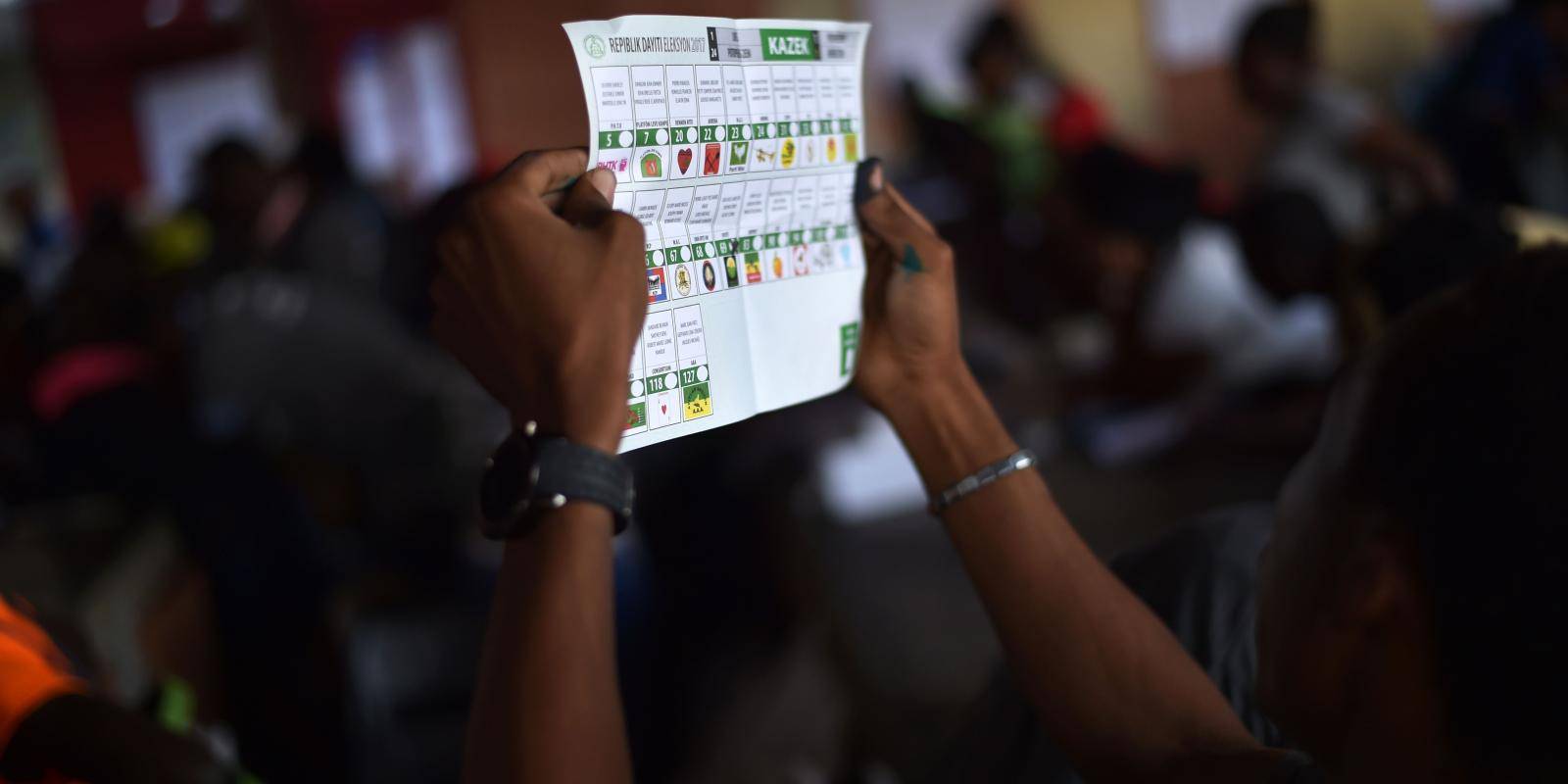
- Registration totals and representative participation. Any postponement of the election date will have to bring a dramatic increase in voter registration beyond the 12 per cent of qualified voters reported on 13 October. There are three possible answers to this problem:
- Conduct a broad effort on voter education and mobilization to expand the current CEP registration process.
- Return to the original National Identification Office (ONI) civil registry, rather than creating an entirely new voter database, and adjust for those who have been displaced, are deceased or have emigrated.
- Create a hybrid model that is based on the CEP voter registry, while allowing Haitians to vote with their ONI biometric ID cards on election day regardless of the CEP registration.
Whatever numerical target is set, the issue of the representativeness of those registered voters remains. Current patterns of voter registration show uneven territorial concentrations and low levels of youth registration. The CEP acknowledges that security, displacement, documentation requirements and physical access have created an unrepresentative national sample of potential voters. All sections of the population must have a say in Haiti’s future for elections to be credible.
- National security and the electoral process. Elections cannot be delayed to a fixed date until the GSF and PNH restore full security in Haiti. But having both operations in place creates a dilemma around sequencing and temporary distortion. Waiting for those forces to gain comprehensive territorial control would delay political participation indefinitely. Proceeding while gangs can still determine which candidates are able to stand and where they can travel risks embedding security inequalities and gang influence directly into the electoral process.
The minimum-security threshold will need to be clear on how to secure the electoral process, alongside its other mission objectives. Among other issues, the threshold should focus on ensuring that voters have access to registration and voting sites, that those sites are protected, that transportation corridors are secure, that the movements of candidates are protected, and that security forces are on alert during the vote, the counting process and afterwards.