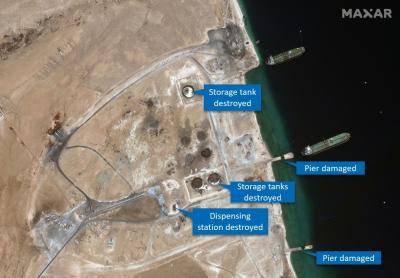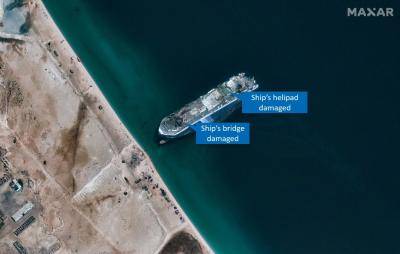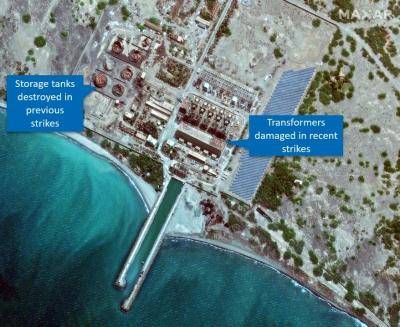
The ceasefire agreement between Israel and Hamas announced on 9 October, 2025, has major implications for Middle East security. Among them is how it will affect the conflict between Israel and the Houthi forces that control much of Yemen. Satellite images from Maxar published here for the first time reveal the extent of some of the damage caused by recent Israeli airstrikes on Yemen. Analysis suggests that despite a pause following the Gaza ceasefire agreement, the Israel–Houthi conflict may well resume.
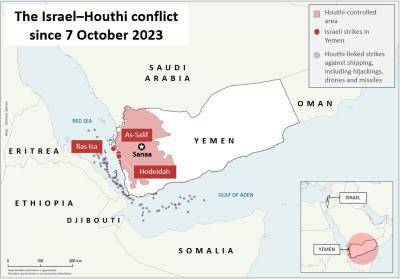
Map shows the Houthis’ strikes in the Red Sea and Israel’s airstrikes on Yemen, including on Sanaa. Map credit: Damien Symon.
The Houthis, backed by Iran, began attacking Israel and international shipping in the Red Sea shortly after the Hamas assault on Israel on 7 October, 2023, saying they were acting in support of Palestinians. The Red Sea attacks have disrupted international shipping lanes, targeting commercial vessels with hijackings, drones and missile strikes. The Houthis have also launched hundreds of missiles and drones against Israel, with more than 80 ballistic missiles and more than 40 drone attacks aimed at Israel since March this year, according to the Times of Israel.
In response, the United States, Britain, supported by their allies, attacked Houthi forces between January 2024 and May 2025. Israel has also carried out air raids on Houthi-controlled areas in Yemen since July 2024 and, more recently, targeted senior Houthi figures in the capital Sanaa. Between July and September this year, the Israel Defence Forces (IDF) undertook airstrikes against Yemen’s Houthi-controlled Red Sea ports in Al Hudaydah governorate and the capital Sanaa which is also under Houthi control. Israel’s attacks are reported to have killed several dozen people, including Ahmed al-Rahawi, the Houthi self-proclaimed prime minister, and several other Houthi ministers on 28 August.
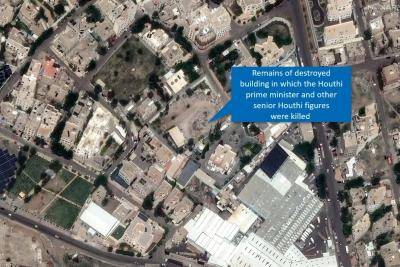
Image taken 15 September, 2025: On 28 August, 2025, Israel Defence Forces’ strikes killed Houthi prime minister Ahmed al-Rahawi along with other Houthi ministers gathered in a building in Sanaa, the Yemen capital. ©2025 Maxar Technologies.
After a Houthi drone attack in September on Eilat, the Israeli Red Sea resort, Israel Katz, the Israeli defence minister, wrote on X: ‘The Houthi terrorists refuse to learn from Iran, Lebanon and Gaza, and will learn the hard way. Whoever harms Israel will be harmed sevenfold.’
The impact of Israel’s attacks
Israeli airstrikes have damaged Yemen’s infrastructure and temporarily reduced its ability to import weapons from Iran, according to Itay Bar-Lev, an Israeli analyst and managing director of The Intel Lab. He added that trying to defeat the Houthis with long-distance airstrikes alone is unlikely to succeed. ‘The Houthis operate a decentralized force embedded in rugged mountainous terrain with diverse smuggling routes for resupply,’ he said. ‘Damaged facilities can resume operations within a month. Previous [US] campaigns failed to achieve decisive effects or meaningfully degrade Houthi capabilities.’
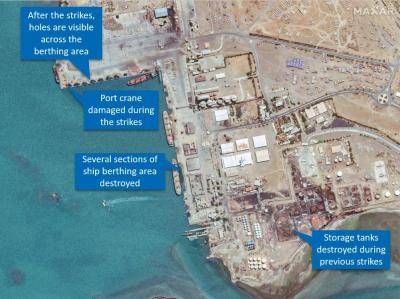
Image taken 11 July, 2025: The port of Hodeidah, Yemen, has been the target of repeated Israeli air strikes over the summer, with the most recent in September. The Israel Defence Forces claim strikes were to impede Iranian weapon deliveries to the Houthis. ©2025 Maxar Technologies.
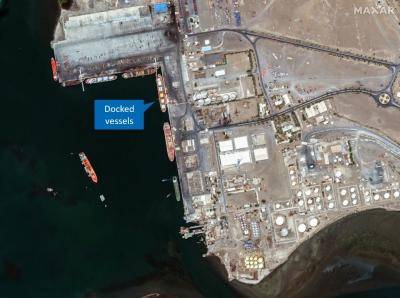
Image taken 22 May, 2023: Hodeidah before recent Israeli air strikes. ©2025 Maxar Technologies.
Farea al-Muslimi, a research fellow at Chatham House’s Middle East and North Africa Programme, said: ‘Israel’s airstrikes will not weaken the Houthis but will instead destroy the few remaining lifelines of aid and food for ordinary and in-need Yemenis.’
Yemen, with a population of more than 40 million, was already one of the poorest countries in the world following the Saudi-Emirate intervention in 2015 and the Houthis’ subsequent coup. Since May this year, Israel has repeatedly struck Yemen’s three Red Sea ports under Houthi control, Hodeidah, As-Salif and Ras Isa – 70 per cent of all imports and 80 per cent of all humanitarian aid going into Yemen pass through these ports, according to the United Nations.
Will the conflict continue?
Since the ceasefire was announced, Houthi attacks on Israel and the Red Sea have ceased. Houthi leader Abdul-Malik al-Houthi said Yemen will be monitoring Israel’s compliance with the Gaza ceasefire. If it holds, Al-Muslimi believes the Houthi halt of their attacks will persist, for two reasons. ‘First, the Houthis have already achieved their primary objectives through previous attacks on the Red Sea and Israel – namely, projecting power regionally and globally. Second, like Hamas, they are seeking to de-escalate and avoid a direct confrontation with Israel,’ he said.
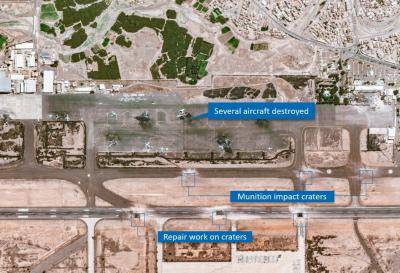
Image taken 11 May, 2025: Israel has repeatedly struck sites – including the airport, presidential palace, power stations and government departments – in Sanaa, the Yemeni capital, that it claims are associated with the Houthis’ internationally unrecognised government. The airstrike in May on the international airport destroyed the departures hall, passenger jets of the national carrier Yemenia and cratered the runway. The IDF also hit the Al-Dailami military base next to the airport. ©2025 Maxar Technologies.
Bar-Lev, however, believes that Israel’s attacks on Yemen and the Houthis are likely to resume. The long distance and lack of intelligence make a decisive victory – such as the one Israel achieved over Hezbollah in 2024 – unlikely. Instead, Israel ‘will pursue a protracted campaign of strategic strikes,’ he said.