Will the new world order put the brake on trade?

As the Pax Americana fades, policymakers are prioritizing economic security – emerging countries could be the big losers, writes David Lubin.

The World Today

Published 16 March 2026 — 5 minute READ

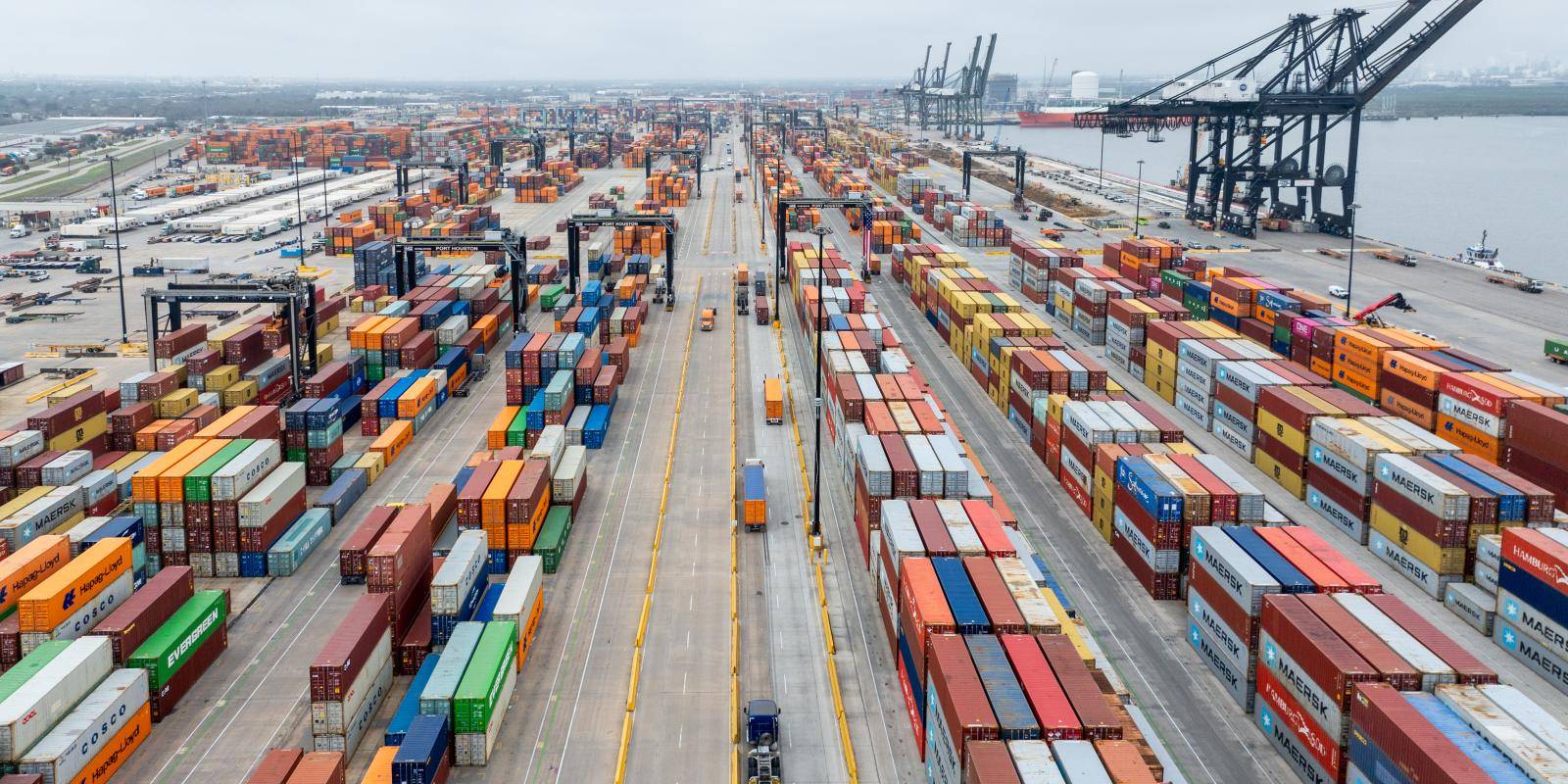
Image — Houston Port of Authority in Texas, the largest port by tonnage in the US. Global trade could fall sharply as America steps back from the rules-based international order, argues David Lubin. Photo: Brandon Bell/Getty Images.

Canada’s Prime Minister Mark Carney and the White House don’t, as a rule, agree on much these days. But they do agree on one thing, namely the need for economic policy to prioritize the domestic drivers of GDP growth, rather than trade. In his explosive Davos speech in January, in which he described a ‘rupture’ in the international order, Carney suggested that ‘building a strong domestic economy … should be every government’s immediate priority’. In the same week, Howard Lutnick, the US Commerce Secretary, made a similar point in the Financial Times, when he declared ‘prosperity begins at home.’

Neither Carney nor Lutnick are saying anything we haven’t heard before. ‘Economic security’ as a theme in global policy-making is now a familiar phenomenon, and protectionism has been visibly on the increase for at least the past decade. Data from Global Trade Alert, the world’s best source of policy changes affecting global trade and investment, shows that policy initiatives that are harmful to trade have, since 2012, increasingly outnumbered those that seek to liberalize trade. 

But the evident unwillingness of the US to uphold the international order it nurtured in the decades after the Second World War could, if history is any guide, accelerate the decline in global trade growth over the coming years. And this process could well feature a vicious circle: weakening trade growth will beget more protectionism which will beget weakening trade growth. If that happens, the biggest losers will be emerging and developing countries, which are mostly what economists call ‘small, open economies’: those whose economic fortunes depend especially on the ability to integrate with a much larger global market.

Hegemonic stability

The historical foundation for this pessimistic outlook is that global trade growth tends to flourish best under conditions of ‘hegemonic stability’, where an international order is governed by a single great power. In the past 200 years the world has seen two bursts of global trade growth. One was in the second half the 19th century when, under the umbrella of the Pax Britannica, global exports rose from just around 5 per cent of global GDP in the 1840s to over 15 per cent by the end of the century. Another burst was in the latter decades of the 20th century during the Pax Americana, when global exports rose from the depressed levels in the aftermath of the Second World War to reach 25 per cent of global GDP on the eve of the 2008 financial crisis.

What is it about a global hegemon that creates space for cross-border trade flows to thrive?

What is it about a global hegemon that creates space for cross-border trade flows to thrive? One convincing answer is provided by Fernando Broner and others in a 2025 paper, which emphasizes how hegemons generate what the authors call ‘alignment’ – that is, how countries within the order tend to share views about the basic goals of economic policy. That alignment, be it enthusiastic or grudging, will be based on the valid expectation that openness to trade can be a reliable path to faster GDP growth.

In the post-Cold War 1990s, those peak years of the Pax Americana, alignment took the form of the ‘Washington Consensus’. The term was coined in 1989 by the British economist John Williamson to describe a market-oriented turn in economic policymaking that he both noted – new reforms were then taking hold in countries such as Chile, Turkey and Mexico – and encouraged.

The basic message was that countries should reduce their barriers to international trade and investment, keep budget deficits low, minimize government involvement in the economy and give market forces more of a role in deciding how to deploy labour and capital in a globally integrated marketplace. It was the ‘alignment’ captured by the Washington Consensus that allowed the world’s trade-weighted average tariff to fall from 14.1 per cent in 1990 to 3.8 per cent in 2021.

Global trade alert measures (2012-2026)

content continued

Post ‘Washington Consensus’

One might hope that even without the Pax Americana, liberal-minded countries might rally around each other to preserve as much of the open trading order as possible. And there are plenty of examples to keep that hope alive. A prominent one is the coalition that is tentatively being established between the European Union and the 12 members of the CPTPP, a trading group formed out of the ashes of the Trans-Pacific Partnership that President Trump walked away from in 2017.

Indeed, the EU has displayed some remarkable energy in responding to Pax Americana’s end. Trade agreements have been signed recently with Mercosur, the South American trading bloc, and India, for example, alongside a strategic partnership with Vietnam. Free trade agreements among countries eager to keep trade alive will certainly help to slow any decline in global trade growth. But they are unlikely to reverse that decline for a couple of reasons.

The EU has displayed some remarkable energy in responding to Pax Americana’s end.

The first is China, whose economic model has for years been based on the pursuit of global manufacturing dominance to enhance the country’s geopolitical heft. If Beijing were to decide to make the Chinese economy a more significant source of global demand, rather than endlessly seeking to dominate supply, then China could start to take over the informal role traditionally played by the US as the global economy’s ‘importer of last resort’.

Although there is a near consensus among China’s trading partners that it ought to import more and export less, Beijing’s commitment to dominate global manufacturing means that it is unlikely to change its approach in the near future. As a result, China’s trading partners are, on balance, more likely to keep raising tariffs and non-tariff barriers to protect their domestic markets. The EU’s decision to impose anti-dumping duties on Chinese steel imports in January this year is just one recent example of this trend.

The second reason is that the spread of protectionism influences the intellectual climate in which policymakers find themselves. Measures that limit international trade become a more natural part of the implicit menu of options from which governments select their policies. Protectionism can feed on itself.

Growing protectionism

One example of this was the Mexican government’s announcement late last year that it was to introduce tariffs on certain foodstuffs, including dairy and meat products, with the aim of supporting local production of these goods. It is tempting to see some symbolism in the fact that Mexico, an early and enthusiastic adopter of the Washington Consensus, now resorts to a trade policy designed to shield domestic producers from international competition. It seems to hint that trade-growth pessimism won’t go out of fashion soon.

History shows that global trade tends to grind to a halt when the world goes into recession.

Indeed, the European parliament’s decision to refer the Mercosur agreement to the European Court of Justice reflects a growing protectionist bent among some EU members. The decline of ‘hegemonic stability’ won’t necessarily lead to a 1930s-style collapse of global trade, though it’s possible to imagine such an outcome were global economic activity to decline sharply. 

History shows that global trade tends to grind to a halt when the world, or large chunks of it, goes into recession. And the trade patterns that will emerge in the new global order will inevitably be shaped by what that order ends up looking like.


content continued 2

One hypothesis is that the Trump administration’s revival of the Monroe Doctrine, by which the US asserts unfettered freedom of action in the Western Hemisphere, might lead to an international order loosely based on regional spheres of influence. It is conceivable, in that world, that the definition of ‘alignment’ could acquire regional, rather than global, characteristics, as smaller powers decide that life is easier when aligned with a regional hegemon. 

One shouldn’t take this argument too far, of course. It seems absurd to think that Brazil, for example, would stop selling soya beans, oil or iron ore to China, which took around 30 per cent of its exports last year; or that Vietnam, which sells a third of its exports to the US, will see all its trading relationships shift to Asia.

Yet sometimes it is worth bearing in mind the difference between the direction of travel and the destination. A policy pendulum may tilt without reaching its extreme. In such a way, it is possible to imagine a move towards regionalization without that being the only defining characteristic of a new world economic order. 

What we are heading towards may not be fully described as deglobalization; but national and regional priorities are likely to become increasingly visible as security, rather than efficiency, continues to preoccupy policymakers.

To read more from the spring issue of The World Today click here