




Executive Summary and Recommendations
That corruption is a destructive and complex practice is openly acknowledged in Nigeria, yet it remains ubiquitous in the functioning of society and economic life. The consequences of corruption for the country and its people are, moreover, indisputable. Acts of diversion of federal and state revenue, business and investment capital, and foreign aid, as well as the personal incomes of Nigerian citizens, contribute to a hollowing out of the country’s public institutions and the degradation of basic services. All the same, corruption is perhaps the least well understood of the country’s challenges.
It has been estimated that close to $400 billion was stolen from Nigeria’s public accounts from 1960 to 1999,1 and that between 2005 and 2014 some $182 billion was lost through illicit financial flows from the country.2 This stolen common wealth in effect represents the investment gap in building and equipping modern hospitals to reduce Nigeria’s exceptionally high maternal mortality rates – estimated at two out of every 10 global maternal deaths in 2015;3 expanding and upgrading an education system that is currently failing millions of children;4 and procuring vaccinations to prevent regular outbreaks of preventable diseases.
Corruption tends to foster more corruption, perpetuating and entrenching social injustice in daily life
Corruption tends to foster more corruption, perpetuating and entrenching social injustice in daily life. Such an environment weakens societal values of fairness, honesty, integrity and common citizenship, as the impunity of dishonest practices and abuses of power or position steadily erode citizens’ sense of moral responsibility to follow the rules in the interests of wider society.
Nigeria has sought to tackle corruption through ‘traditional’ legal and governance-based measures, emphasizing the reform of public procurement rules and public financial management, anti-corruption laws and the establishment of various agencies tasked with preventing corruption and punishing those who engage in it. This focus on transparency and legal sanctions is critically important, but innovative and complementary approaches are needed to foster a comprehensive shift in deeply ingrained attitudes to corruption at all levels of society.
President Muhammadu Buhari has shown sincerity in his commitment to lead anti-corruption efforts in Nigeria, including through strengthening whistleblowing incentives and protections, high-profile investigations of prominent individuals for large-scale theft of public funds, and the recovery of billions of naira by Nigeria’s anti-corruption agencies. These efforts are essential, but cannot by themselves foster a sustainable, comprehensive reversal of long-established assumptions and practices in the absence of a decisive shift in public apathy and a collective will to achieve collective behavioural change. Nigeria’s ongoing anti-corruption efforts must now be reinforced by a systematic understanding of why people engage in or refrain from corrupt activity, and full consideration of the societal factors that may contribute to normalizing corrupt behaviour and desensitizing citizens to its impacts. This holistic approach would better position public institutions to engage Nigerian society in anti-corruption efforts.
Understanding why certain practices persist in Nigeria, and how they can be changed
This report aims to diagnose what drives corrupt behaviour in Nigeria, and the types of beliefs that support practices understood to be corrupt. Its findings are based largely on a national household survey jointly developed by the Chatham House Africa Programme and the University of Pennsylvania’s Social Norms Group (PennSONG), in collaboration with Nigeria’s National Bureau of Statistics as well as a network of academics and practitioners from Nigerian universities and NGOs. The findings present new evidence of the social beliefs and expectations that influence some day-to-day forms of corruption in Nigeria. Fuller details of the survey and associated research are given in the body of the report, as well as in the annex to the main text.
The research project conducted as the basis for the report explores corruption in Nigeria as a collective practice – one that is primarily an aggregate of individual behaviours that are sustained by particular social beliefs and expectations.
How people think and act is often dependent on what others think and do. Corruption is difficult to curb because it is motivated by many factors, including expectations about how other people are likely to behave. Efforts to change the beliefs of a few individuals are not in themselves enough to induce a sustainable change in collective behaviour. That requires a systematic approach that is context-specific – and that, crucially, is undertaken, owned and sustained by a critical mass of local actors who want to forge a ‘new normal’.
The report examines corruption in Nigeria from the perspective of the social norms that serve as embedded markers of how people behave as members of a society and have a strong influence on how they choose to act in different situations. These social influences determine accepted forms of behaviour in a society, and act as indicators of what actions are appropriate and morally sound, or disapproved of and forbidden.
Disapproval of a practice, and the social consequences of failing to adhere to community expectation – such as gossip, public shaming, or loss of credibility and status – have a powerful influence on the choices people make. Equally powerful are the approval, social respectability and esteem attached to behaviour that is evaluated within one’s community as right or acceptable.
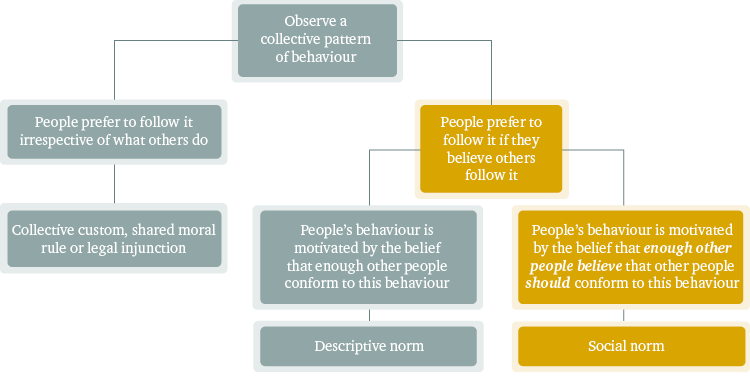
In the context of anti-corruption in Nigeria, understanding these underlying social drivers helps to identify which forms of corruption are underpinned by social norms, and which practices are driven by conventions, local customs or circumstances (as shown in figure 1). Identifying the specific social drivers of specific collective practices is critical to designing targeted and effective policy interventions to change those practices. This is because not all collective practices, regardless of how pernicious, are driven by a social norm.
Figure 1: Identifying different behaviours: What is a social norm?
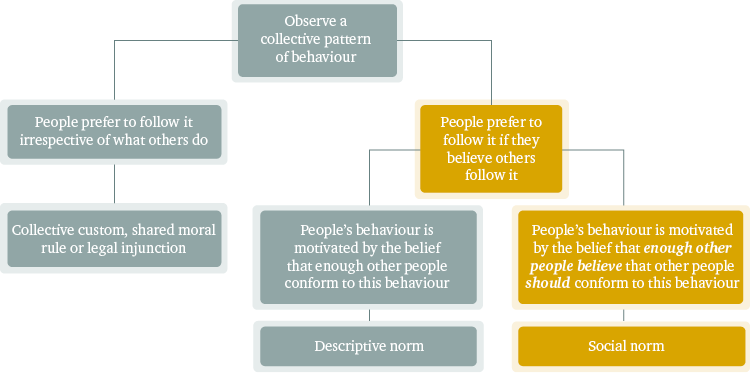
Figure 1: Identifying different behaviours: What is a social norm?
Key findings and critical challenges
- Social norms of corruption are limited to specific contexts and sectors in Nigeria. Social norms exist around specific sectors and practices, for example, law enforcement and bribery, but are not as widespread as people may assume. The findings of this research project show that social norms drive the solicitation of bribes by law enforcement officials, whereas the giving of bribes is influenced more by circumstances and by people’s beliefs about what other people are doing. There are thus opportunities for targeted interventions to address the specific beliefs and expectations that motivate corrupt behaviour in specific sectors and practices.
- If the environment or options change, behaviour will change. A clear majority of respondents in Nigeria’s rural and urban areas know when a practice is illegal, and think that others know this too. But individuals may engage in a practice that they know is wrong because they observe others doing so, or as a rational response to a situation. In many of the scenarios analysed in this study, corrupt behaviour was rationalized as a response to the choices and pressures that people face.
- Collective action is sometimes impeded because people have misconceptions about what other people really think. Survey respondents frequently underestimated the extent to which fellow citizens believe corruption to be wrong. If people were aware of how commonly held their personal beliefs are, they would be more motivated to act collectively against corruption. Anti-corruption efforts may have the greatest chance of success if they stem from a shared sense of responsibility and urgency – and thus foster collective grassroots pressure. President Buhari is certainly not alone in his high-profile stance on corruption; a significant number of Nigerians agree that it is morally unacceptable. The crucial step is translating this shared belief into an effective and sustainable coalition for collective social action.
Anti-corruption efforts may have the greatest chance of success if they stem from a shared sense of responsibility and urgency – and thus foster collective grassroots pressure
- In Nigeria, the social contract between government and the people is very local and not national. There is a deep-seated lack of confidence in official institutions, or in the universal application of a fair and neutral rule of law. This severely weakens the consolidation of a Nigerian national identity based on common and equal citizenship. Instead, less effective social contracts are forged particularly around ethnic or religious identities – an arrangement that fuels intercommunal distrust – and increasingly fragmented social identities impede the construction of a national social contract that could form the basis of collective action to overcome corruption.
- The true costs and consequences of corruption are hidden within the normal interactions of daily life. People tend to engage in certain forms of corruption as a practical response to obstacles and inefficiencies in Nigeria’s administrative and economic systems. Clear information is needed on how individuals’ seemingly innocuous routine interactions can collectively impose a heavy cost on society as a whole, damaging the public institutions Nigerians are supposed to rely on to provide security and essential administration and social services.
- Tough talk and fear-based messaging cannot substitute for authenticity and exemplary behaviour. As long as the Nigerian government’s interactions with citizens continue to be marred by extortionate behaviour and expectations of bribery, the state deprives itself of the moral basis to lead in addressing the country’s corruption problem. Routinely abusive behaviour by public officials is an obstacle to building public trust and stimulating collective action. Instead, it fosters public cynicism, apathy and a sense that different rules apply to different groups. Government-led anti-corruption campaigns will only be perceived as sincere if they are self-examining and self-correcting.
Policy approaches to influence collective action against corruption
- Changing incentives in contexts where corruption is a rational response or is environmentally driven. Administrative and institutional reform could remove some opportunities for officials to exert the leverage that encourages or forces citizens to engage in corrupt practices. It should be less costly and more efficient to abide by the law.
The procedure for complying with penalties for traffic violations is, for instance, needlessly complicated and time-consuming, and penalties are sometimes unclear or disputable, creating opportunities for extortion by law enforcement agents. Online and mobile technologies should be used to simplify the direct payment of official fines, the adjudication of disputed penalties, the handling of complaints and the safe reporting of demands for corrupt payments. Clear information on how to report corrupt behaviour by state agents, and how to follow up cases, should be made widely available in accessible formats and local languages.
- Reducing official fine rates would erode the scope for state agents to solicit petty bribes from citizens in return for escaping official penalties. Relative to the real income level and average living costs of most Nigerians, official fines are very costly, creating a strong incentive to pay a lesser sum in the form of a bribe. There must be clear and enforceable negative sanctions for corrupt behaviour, and equally clear and meaningful positive incentives not to engage in corruption.
- Targeting sectors and communities with information on the human costs of corruption. Anti-corruption campaign messages should be reframed to resonate in affected communities, contexts or sectors by using pertinent and positive norms, values and expectations. Showing how these are undermined by corruption can help render the drivers of corrupt behaviour socially unacceptable. Messages about the cost of corruption will be more effective if they seem relevant to a specific audience, rather than generic and unfocused.
Local design and applicability is key. Respected local figures – such as religious and community leaders – who exert social influence can help to convince people to accept evidence of the cost of corruption and overturn notions that a corrupt route is a more efficient way of doing things.
Messages targeted to engage Nigeria’s large youth population will be vital in inculcating a lower tolerance of corruption in the next generation. Social and community media can be effectively used to spread social norms messaging among the youth population, and over time this can have a positive influence on opinions and attitudes in wider society. Television and community radio can also show the true human and moral costs of corruption to the futures and life chances of young people. Age-appropriate interventions could, moreover, be integrated into citizenship and civic education programmes in primary and secondary schools nationwide.
- Reframing the approach to anti-corruption messaging and interventions. Research suggests that the way in which messages about problematic behaviours are framed is critical to the effectiveness of social campaigns. Official anti-corruption campaigns in Nigeria have tended to use tough, intimidating and sometimes aggressive language; but such messages often fail to be sustainable or convincing because the behaviour of the government and its agents is perceived as unchanged or hypocritical.
- Highlighting and empowering trendsetters (both real and fictional) to drive behavioural change. Leadership on anti-corruption can only be successful if it is by example. The behaviours and actions of Nigerian political actors play a major role in setting social trends, forging public trust and inspiring positive behaviour. As key trendsetters, political actors and officials must measure up to higher standards of integrity, honesty and transparency in order to send a powerful signal regarding the government’s commitment to changing negative social norms and regaining public trust.
Trendsetters tend to show high levels of autonomy, and are willing to disregard the norms to which most members of the community conform. In cases where negative norms are widespread but people believe that different practices would leave everyone better off, trendsetters from public, private or civic sectors can help shift people’s behaviour in beneficial directions.
Behavioural interventions should thus be targeted towards trendsetters who can be persuaded to abandon certain practices and persuade others to follow. Where trendsetters cannot be identified, the media may be used to exemplify alternative lifestyles and behaviours and thus encourage change. Education entertainment (‘edutainment’) has been used successfully by governments and international organizations to promote behavioural changes and disseminate useful information.
- Using trendsetters and social marketing strategies to overturn the false beliefs that tend to drive corrupt practices. Where people would like to see change but wrongly fear that others do not share their beliefs, trendsetters can play a key role by being willing to incur the cost of violating a norm. In taking this step first, a trendsetter reassures other citizens that they are not alone in believing a norm should be abandoned.
The evidence of the survey that informs this report is that many people in Nigeria already regard corrupt behaviour as morally unacceptable. Trendsetters and social marketing strategies to spread information about what people really think and believe can play a crucial role in helping to stimulate the collective development of social sanctions to curb corrupt practices.
Social marketing strategies that urge people to act in keeping with their personal aversion to corrupt practices can be highly influential, and can generate critical mass support for social change. There is also scope to boost public awareness of the laws governing the behaviour of public officials and setting out their responsibilities towards citizens. Accountability channels – such as confidential text-message hotlines – can allow citizens to make complaints and report corrupt acts by officials without jeopardizing their personal safety.
- Integrating behavioural insights into anti-corruption strategies. Behavioural drivers influence the attitudes that people adopt towards corruption, and the choices they make about how to act. Nigeria’s anti-corruption agencies should therefore systematically integrate an informed understanding of behavioural drivers as part of the long-term approach to their mandates.
The findings of this report highlight important options for the trial of interventions to shape positive social norms, and for monitoring their impact over the long term
The findings of this report highlight important options for the trial of interventions to shape positive social norms, and for monitoring their impact over the long term. For instance, there is scope for smaller exercises to identify trendsetters for behavioural change and to design interventions using this tool within specific sectors such as the Nigeria Police Force and other branches of law enforcement.
A careful understanding of the factors that drive relevant behaviours should be a critical component of government actions to reduce corruption. It is recommended that an interagency unit be established in Nigeria to review and hone anti-corruption messaging, and to advise how behavioural lessons can be practically, ethically and most effectively applied at all stages of policymaking – from diagnostics to design, implementation and evaluation – rather than as a separate approach that produces ‘behavioural policies’ as add-ons.