Chatham House – International Affairs Think Tank logo Chatham House – International Affairs Think Tank

Popular searches:

  • Internship
  • China
  • Belarus
  • Brexit
  • Iran
  • Russia
  • Covid-19
Sign in Support us Search

Main navigation

  • Topics
    Back

    Topic Themes

    • Defence and Security
      Back

      Defence and Security

      • Arms Control
      • Drugs and Organized Crime
      • European Defence
      • Peacekeeping and Intervention
      • Terrorism
      • North Atlantic Treaty Organization (NATO)
    • Economics and Trade
      Back

      Economics and Trade

      • Drugs and Organized Crime
      • Brexit
      • BRICS Economies
      • China's Belt and Road Initiative (BRI)
      • International Finance System
      • International Trade
      • Investment in Africa
      • World Trade Organization (WTO)
      • G7/G8 and G20
    • Environment
      Back

      Environment

      • Agriculture and Food
      • Circular Economy
      • Clean and Renewable Energy
      • Climate Policy
      • Energy Access and Governance
      • Managing Natural Resources
    • Health
      Back

      Health

      • Access to Healthcare
      • Health Strategy
      • Coronavirus Response
      • World Health Organization (WHO)
      • United Nations
    • Institutions
      Back

      Institutions

      • World Trade Organization (WTO)
      • World Health Organization (WHO)
      • African Union (AU)
      • European Union (EU)
      • G7/G8 and G20
      • North Atlantic Treaty Organization (NATO)
      • United Nations
    • Major Powers
      Back

      Major Powers

      • China's Belt and Road Initiative (BRI)
      • America's International Role
      • China's Relations
      • US Domestic Politics
      • US Foreign Policy
    • Politics and Law
      Back

      Politics and Law

      • Brexit
      • US Domestic Politics
      • Democracy and Political Participation
      • Demographics and Politics
      • Human Rights and Security
      • International Criminal Justice
      • Refugees and Migration
      • Gender and Equality
      • Disinformation
    • Society
      Back

      Society

      • Drugs and Organized Crime
      • Brexit
      • Circular Economy
      • Human Rights and Security
      • Refugees and Migration
      • Civil Society
      • Digital and Social Media
      • Future of Work
      • Gender and Equality
      • Radicalization
      • Disinformation
    • Technology
      Back

      Technology

      • Digital and Social Media
      • Future of Work
      • Radicalization
      • Cyber Security
      • Data Governance and Security
      • Technology Governance
      • Disinformation
    View Topics A-Z
  • Regions
    Back

    Regions

    • Africa
      Back

      Africa

      • Angola
      • Central Africa
      • East Africa
      • Horn of Africa
      • Nigeria
      • Southern Africa
      • West Africa
    • Americas
      Back

      Americas

      • Canada
      • Central America and Caribbean
      • South America
      • United States of America
    • Asia-Pacific
      Back

      Asia-Pacific

      • Afghanistan
      • China
      • India
      • Japan
      • Korean Peninsula
      • Pakistan
      • South Asia
      • Southeast Asia
      • The Pacific
    • Europe
      Back

      Europe

      • Central and Eastern Europe
      • France
      • Germany
      • Turkey
      • United Kingdom
      • Eurozone
    • Middle East and North Africa
      Back

      Middle East and North Africa

      • Egypt
      • Gulf States
      • Iran
      • Iraq
      • Israel and Palestine
      • Libya
      • Maghreb
      • Syria and the Levant
      • Yemen
    • Russia and Eurasia
      Back

      Russia and Eurasia

      • Central Asia
      • Russia
      • South Caucasus
      • Ukraine
    View Regions A-Z
  • Events
  • Publications
    Back

    Publications

    • Books
      Books in the Chatham House Library.
    • International Affairs Journal
      Display copies of International Affairs at an event in Hamburg, Germany.
    • Journal of Cyber Policy
      A close up of the cover of the Journal of Cyber Security.
    • The World Today Magazine
      The World Today - Cover Oct/Nov 2020
  • Become a Member
    Back

    Become a Member

    • Associate Membership
      Nathan Robinson, editor of Current Affairs, speaks at our primer on Democratic Socialism.
    • Corporate Membership
      Amal Clooney speaks at our members event on the use of sanctions to protect journalists.
    • Individual Membership
      A member takes the opportunity to ask the panel a question at our event on the digital revolution.
    • Gift Membership
      Sir David Attenborough and HRH Queen at CH Prize
  • Leadership Academy
  • About us
    Back

    About us

    • Annual Reviews
      A guest tries on a virtual reality headset at our 2018 "Reinventing the Building" event.
    • Careers
      Woman offers a high five to co worker
    • Chatham House Rule
      Speakers at an event listen to a question
    • Contact us
      Woman with laptop and mobile phone
    • Our Departments
      Three guests at a Chatham House event
    • Our Funding
      A detail of the Chatham House front door
    • Our Governance
      Her Majesty The Queen's signature
    • Our History
      Sketch of Ghandi at Chatham House
    • Our Mission and Values
      Guests at the 2018 Reinventing Fashion event
    • Our People
      Robert Bosch Stiftung Academy Fellowship
Support us
Sign in Go to sign in

US–EU Trade Relations in the Trump Era

Which Way Forward?

This paper recommends a framework for strengthening US–EU trade relations and achieving successful trade talks in the current era of protectionism. 

Research Paper 8 March 2019 ISBN: 978 1 78413 313 9

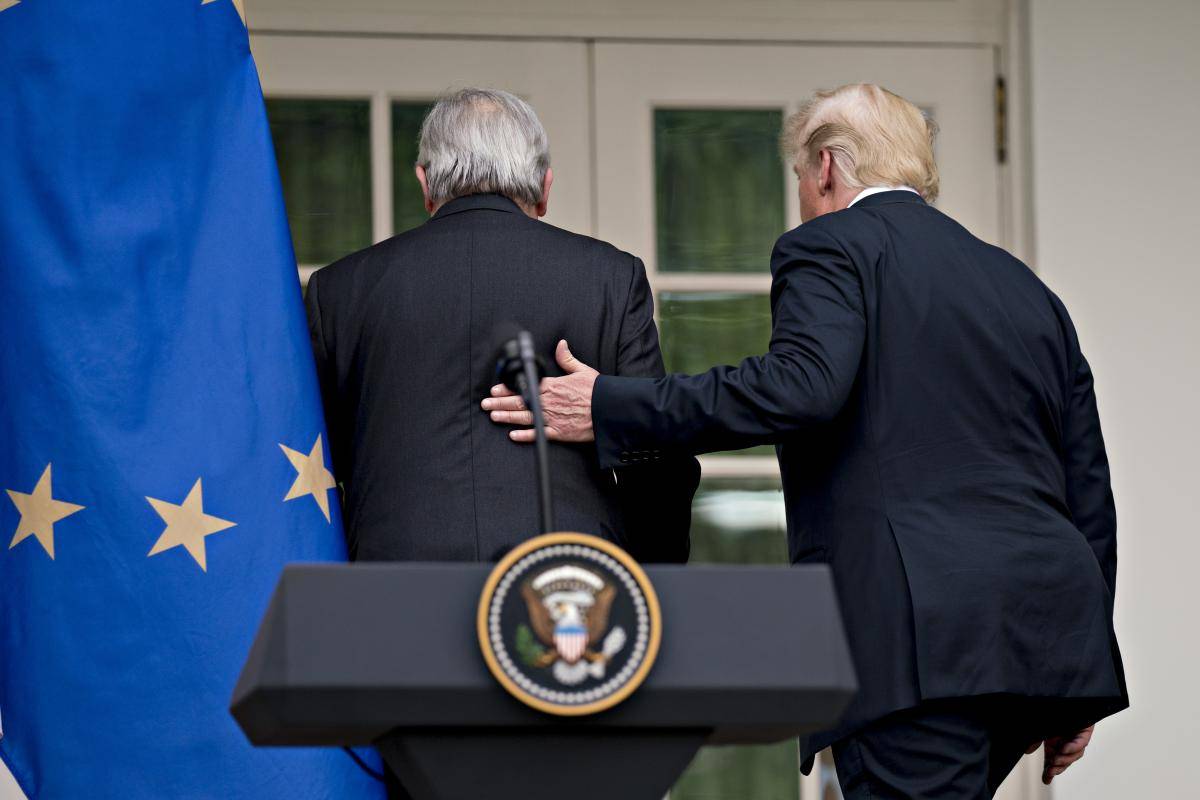
US President Donald Trump and President of the European Commission Jean-Claude Juncker walk away after the conclusion of a joint statement in the Rose Garden of the White House in Washington, DC on 25 July 2018. Photo: Getty Images

Marianne Schneider-Petsinger

Senior Research Fellow, US and the Americas Programme

  • Email Marianne
  • Twitter

Topics

  • International Trade

Regions

  • United States of America
  • Eurozone

Departments

  • US and the Americas Programme
Download PDF

You are viewing: Summary

You are viewing: US–EU Trade Relations in the Trump Era

US–EU Trade Relations in the Trump Era
  • Summary
  • 1. Introduction: Recent Episodes in Transatlantic Economic Relations
  • 2. Drivers of Trump’s Trade Policy Towards Europe⌄
    • Trade balance and perceived unfair trade practices
    • Competing views within the Trump administration
    • The US preference for bilateral deals and a transactional approach
    • The EU as a primary target – and the risks of collateral damage
  • 3. Prospects for US–EU Trade Talks in the Trump Era⌄
    • Limited scope
    • Parallel negotiating tracks
    • Can the EU speak with one voice?
    • Lessons from other trade negotiations
    • Transatlantic cooperation beyond a bilateral trade deal
  • 4. Conclusion: The Way Forward on Transatlantic Trade Cooperation⌄
    • Fold ‘quick wins’ into a longer-term deal
    • Apply lessons learned from TTIP
    • Avoid the risk of further transatlantic division
    • Adopt a common approach for systemic global trade problems
    • For the EU: adopt a balanced approach to engaging with Trump
  • About the Author
  • Acknowledgments
Loading, please wait

Summary

  • Although the US and the EU remain each other’s largest trade and investment partners, there has latterly been some turbulence in transatlantic economic and political relations. A major source of friction have been the US tariffs on imports of steel and aluminium, introduced by the Trump administration in the name of national security, and the EU’s retaliatory tariffs. President Trump’s threat to impose tariffs of up to 25 per cent on imports of automobiles and automotive parts is on hold for now, but remains another source of tension. The EU and its member states also regard the Trump administration’s attitudes and actions towards the rules-based international trading architecture – especially the WTO – as a great challenge.
  • A key driver of President Trump’s trade policy towards the EU and its member states – Germany in particular – is the large US trade deficit in goods. Trump and his team see the EU as both adversary and potential ally. Not only has the EU become a primary target of US trade action; it is also vulnerable to collateral damage in the US’s trade war with China. All the same, the US recognizes the EU as a potential partner in tackling unfair trade practices – widely understood to implicate China – and to reform the global trading system.
  • Tensions over trade have been somewhat reduced since July 2018, when President Trump and European Commission President Juncker stepped back from the brink of a trade war. Subsequent steps by both the US and the EU have opened the door for future trade talks. For now, however, the two sides’ negotiating objectives diverge fundamentally in their potential scope – especially on whether to include agriculture and the automobile sector.
  • While the US administration has an interest in agreeing a US–EU trade deal to showcase President Trump’s deal-making abilities ahead of the US presidential election in 2020, the EU is interested in achieving a swift agreement primarily to forestall the potential imposition of automotive tariffs.
  • Although new trade talks will not be a revival of the TTIP negotiations, many of the sticking points encountered during those negotiations are likely to resurface. Instead of a single-track undertaking, future US–EU trade talks might be more productively conducted via parallel tracks where each issue is addressed according to its own timetable.
  • Critical to the success of future transatlantic trade negotiations will be whether the EU is able to speak with one voice when dealing with the US. Other recent US trade negotiations (in particular the new United States–Mexico–Canada Agreement – the successor to NAFTA) will also have an impact on US–EU talks. And beyond the pursuit of a bilateral free-trade agreement, the most significant issue for US–EU cooperation will be their capacity and willingness to work together, and with like-minded partners, to address global challenges of common concern.
  • Building on a simulation exercise on US–EU trade talks in an era of protectionism, convened by Chatham House in September 2018, this paper concludes with a set of policy recommendations. A multifaceted approach aimed at both the transatlantic market and the global trading system could provide the best way forward in the current political and economic environment.
Back to top
Next chapter

Subscribe to our emails

To receive the latest content and events on the areas that interest you.

Follow us on social

  • Follow us on Facebook
  • Follow us on Twitter
  • Follow us on Instagram
  • Subscribe to our YouTube channel
  • Follow us on LinkedIn
  • Follow us on Medium
  • Follow us on SoundCloud
  • Subscribe to our shows on Podcasts
  • Follow us on Flickr
  • Take an RSS feed of our content

Popular links

  • Careers
  • Chatham House Rule
  • Library
  • Press Office
  • Simulation Centre
  • Undercurrents Podcast
  • Venue Hire

Chatham House is a world-leading policy institute with a mission to help governments and societies build a sustainably secure, prosperous and just world.

Footer

  • Accessibility
  • Privacy Notice
  • Cookie Settings
  • Staff Access
  • Terms of Use

© Chatham House 2021