
President Donald Trump has upended hopes of a quiet August in Washington. New tariffs on imports from countries including Switzerland and India, and Trump’s surprise summit with President Vladimir Putin last Friday, showcase the president’s ability to seize and re-seize the initiative, to grab the headlines, and to create chaos and revel in it.
This approach is not just part of his communications strategy. It is fundamental to his approach to international relations. For other national leaders, existing in a state of perpetual anticipation of this behaviour has costs – chief among them being the loss of any initiative.
With the coming months promising continued disruption and with leaders’ week at the United Nations just weeks away, policymakers should learn from this hectic summer – and stop letting the president’s ‘surprise’ announcements take them off guard. A new approach is needed to regain the initiative and recognize that seeking the president’s favour may be a useful tactic, but it does not represent a strategy.
Shifting deadlines and detail-free agreements
When it comes to Trump’s trade policy, there are few guarantees – even for those who announce agreements. Back in April, it was thought the president’s ‘Liberation Day’ tariffs would set norms for a new era of international trade. But the structure announced that day has been in constant flux. It seems that the flux itself is the new normal.
A 90-day suspension of tariffs was followed by a series of announced trade deals with half a dozen major economic partners. But the texts made public have been as much framework as trade deal. The written EU deal released on 21 August describes itself as a ‘first step in a process that can be expanded over time’. Negotiations have continued with Tokyo over points as central as which sectors are covered by which levies. That feeds the sense that when the Trump administration announces ‘final’ tariff rates they are not final at all. The deadline for a comprehensive agreement with Beijing continues to be postponed, even as the White House announces deals and arrangements with different sectors and firms. Brazil and India were hit with 50 per cent levies – for reasons which seem to be entirely political in Brazil’s case.
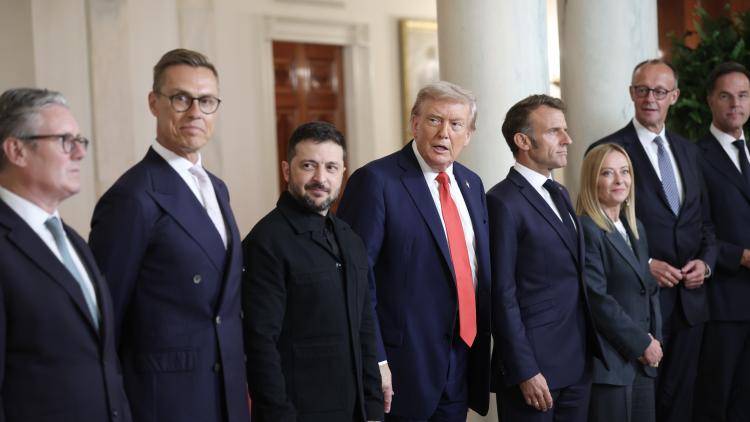
Trump’s treatment of India – which he, like American presidents for three decades before him, had previously sought to court – reflects his embrace of chaos, his rejection of divides between politics and economics, and his quest for short-term wins. In this case, the desired win is a peace deal between Ukraine and Russia. The White House policy on that war has been every bit as chaotic as on trade.
Observers first convinced themselves that a Trump-enforced defeat for Ukraine was inevitable. More recently, some began to believe that President Trump had a change of heart. On 14 July the president threatened to impose 100 per cent secondary tariffs on countries buying Russian oil, were a peace deal not agreed in 50 days.
On 7 August, he announced 50 per cent tariffs on India – though not China and Turkey, Moscow’s other largest customers. After his 15 August summit with Vladimir Putin, he reversed himself again, endorsing Putin’s negotiations-before-ceasefire approach and taking 100 per cent tariffs off the table – again without lifting the levies against India.
As the world watches to see where Ukraine talks go next, and attention turns toward New York’s UN General Assembly meeting in September, observers are likely to see that even the driest areas of international relations can supply fertile ground for the president’s desire to dominate the global stage.
International organizations
The US has already withdrawn from the Paris climate accords, the World Health Organization and global family planning funding, the UNHRC and the UNRWA – following the shock shutdown of the US Agency for International Development (USAID) and the disappearance with it of more than 80 per cent of US development assistance. But international organizations are likely to find that their relationships with the administration are still not settled.
Administration officials have already sent Congress a proposal for 2026 spending that includes dramatic cuts to the IMF budget and no money at all for the UN’s core budget, most UN agencies, or the OECD. Meanwhile the administration is yet to release a promised review and recommendation on every single treaty and international organization in which the United States participates. That now hangs over the UN General Assembly in September like a gun displayed in the first act of a Chekhov play.
The lessons for policymakers
So far, national leaders have sought to manage the continual uncertainty by following an approach summed up by former Putin spokesman Sergei Markov, in advance of the Alaska summit: ‘I think it’s some kind of possibility of Putin to give small gift to Donald Trump to keep Donald Trump in the peace process’.
Some leaders have used gifts to gain some measure of favour with the president – and protect themselves from the worst effects of sudden changes in policy. UK Prime Minister Keir Starmer invited the president to a second state visit by hand delivering a letter from the King; Qatar donated a Boeing 747 aircraft to serve as Air Force One. This approach makes sense for a president who has described even EU concessions in tariff negotiations in terms of gifts.