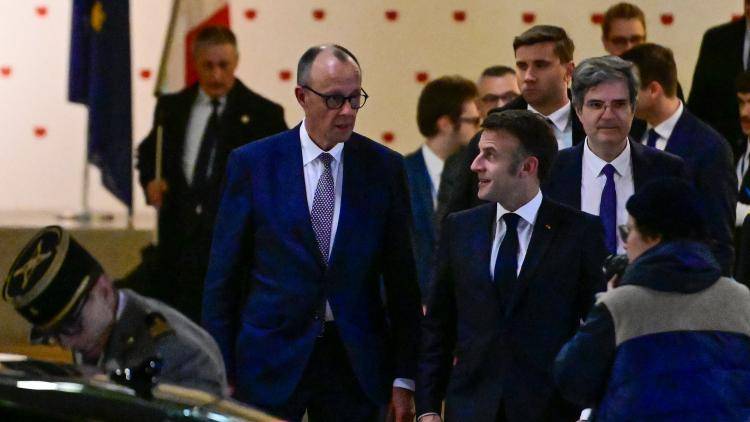
German Chancellor Friedrich Merz was in London this week where he met with UK Prime Minister Keir Starmer and signed a landmark UK–Germany friendship treaty. His visit follows that of French President Emmanuel Macron last week. These back-to-back visits symbolize and reinforce a return of the E3 group – France, Germany and the UK – as the driving force of European security. Despite Brexit, this configuration has the potential to tie the complex European security architecture together.
Revitalizing the bilateral relationship
The UK–Germany Kensington Treaty is first and foremost is a significant upgrade to the bilateral relationship. Before Brexit, Germany largely structured its relationship with the UK primarily via the EU, with the exception of its foreign and security policies. After Brexit, Berlin firmly prioritized the cohesion of the EU single market and the UK–Germany relationship consequently suffered in terms of overall trade, wider economic links, personal contacts and government-to-government ties. The UK dropped from Germany’s third most important trading partner in 2016 to ninth in 2024 – even school exchanges from Germany to the UK have fallen by more than 80 per cent since Brexit.
Attempts to counter this decline and revitalize the relationship began under the previous German government. Thanks to the close links between the German SPD and the UK Labour Party, Starmer and then German chancellor Olaf Scholz tasked their foreign ministries with negotiating a broader friendship treaty in August 2024.
Although the finalization of these negotiations was suspended due to the collapse of the Scholz-led government in November 2024, it was clear from the outset that the new German government, in which the SPD continued as a junior partner, wanted to finalize the treaty quickly. In addition, since becoming chancellor, Friedrich Merz has emphasized the UK’s role as a security partner with whom he wants Germany and the EU to stand ‘shoulder to shoulder’, in particular on Russia’s war against Ukraine, and transatlantic relations.
Main aspects of the friendship treaty
The new bilateral treaty has two main motivations. On the one hand, it has the characteristics of a broader friendship treaty with a political structure for deeper bilateral coordination, such as regular summits every two years. It also includes six pillars of cooperation: diplomatic cooperation on broader geopolitical issues; defence and security; internal security and coordination on combating illegal migration; economic ties, science and research cooperation; fostering people-to-people contacts; and cooperation on energy and climate policy.

In the last four areas in particular, the German government was careful to coordinate the treaty with the EU Commission, so that the bilateral framework complements rather than conflicts with the EU–UK relations.
The post-Brexit Windsor framework – which eased the tension between the EU and the UK on Northern Ireland – followed by the recent EU–UK reset have also provided space for the German government to pursue a deeper bilateral relationship with the UK without worrying it would undermine EU unity.
On the other hand, the treaty’s clear centre of gravity is foreign, security and defence policy cooperation. In addition to regular summits, the two governments commit themselves to close coordination in multilateral forums like NATO, the UN and the G7, while emphasizing their respective support for a positive EU–UK relationship.
The pillar on defence, which incorporates and extends last year’s UK–Germany Trinity House Agreement, is the most substantial of the treaty. It includes structured cooperation on defence industrial projects, such as a deep precision strike capability, defence exports coordination, cooperation on NATO’s eastern flank and in the North Sea, as well as a bilateral mutual defence clause on top of existing NATO commitments. Among the treaty’s list of so-called ‘lighthouse projects’, the defence projects stand out as the most concrete.
Anchoring the E3 as a central pillar of European security
The treaty reinforces the gradual normalization of UK–Germany relations with a special emphasis on defence and security. But it also anchors the bilateral relationship into the wider European framework of the E3 format. Unusual for a bilateral treaty, it explicitly mentions the aim to intensify trilateral cooperation between the UK, Germany and France. Thus, the treaty completes the triangle of previous bilateral treaties between the three countries, including the defence-focused UK–France Lancaster House Treaty and the broader France–Germany Elysée and Aachen treaties. As a result, the three major European powers are now linked through respective bilateral treaties.