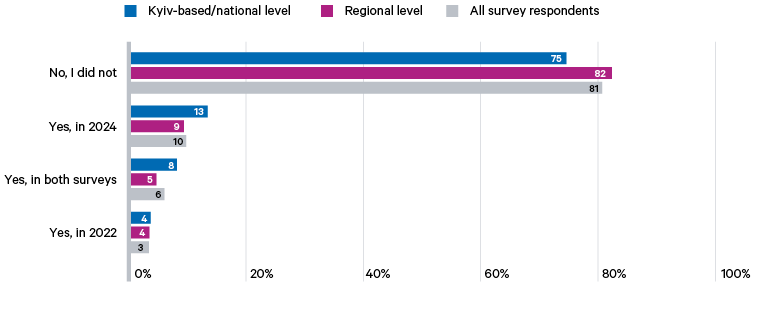
Methodology
To conduct the latest iteration of its survey of CSOs, Chatham House partnered with 11 Ukrainian organizations and coalitions. These were: the International Renaissance Foundation; ISAR Ednannia; the Alliance of Ukrainian CSOs; the National Network for Development of Local Democracy; RISE Ukraine; the EU–Ukraine Civil Society Platform; the Network of Recourse Centres for Local Democracy; the Ukrainian Climate Network; the Ukrainian Women’s Congress; the League of the Strong; and the Women Leaders Coalition for Ukraine’s Future.
The March 2025 survey, conducted via SurveyMonkey in Ukrainian and made up of 21 structured questions and one ‘open’ question, was circulated to 7,000 registered CSOs. Of these, 1,112 responded, with 675 providing complete answers – a response rate of 16 per cent. (This is a lower response rate compared to 2022 and 2024.) We have analysed only complete responses for this research paper.
The geographical distribution of CSOs that completed the survey was quite diverse, consisting of Kyiv-based groups operating exclusively or mainly at the national level (20 per cent), regional-level groups (51 per cent), and groups working at both the national and regional levels (30 per cent). For each of the structured questions, respondents were asked to pick from a range of responses, with a specific instruction (choose one answer; choose three answers; choose all relevant answers) depending on the question. For several questions, there was also a blank text field to be filled out in the participant’s own words for ‘other’ responses.
Most of the questions were repeated from the 2022 and 2024 surveys. This year, we added new questions related to the expectations around a possible ceasefire and its implications for recovery. We also took a deeper dive into the question of foreign aid, given the restructuring of USAID and the possible risks that this presents for future development assistance to Ukraine. Specific questions were added on this topic, asking how funders can support the transition of the Ukrainian humanitarian sector to focus more on development work, and how best to increase direct support to local CSOs and improve the sustainability of aid.
Chatham House’s team travelled to Kyiv to host a public discussion of the preliminary survey findings on 1 April 2025. This event, organized by the GIZ ‘Strengthening Communities in South and East Ukraine Through Localized Action (EMPOWER)’ programme, gathered a range of regional community leaders who provided humanitarian assistance, rapid recovery support and aided local self-governance in areas dealing with the direct consequences of the 2022 Russian invasion.
The full list of structured responses to the survey is provided below.
Full list of structured questions and results




![Question 1. Where does your organization primarily work? [choose one]](https://www.chathamhouse.org/system/files/styles/reader_large/private/reader-content/publication-36670/file-62200/OEBPS/image/REP-103-where-does-organization-work.png?itok=tYvCj3_L)

![Question 2. Are you already involved in recovery efforts to repair the damage caused by the Russian invasion? [choose one]](https://www.chathamhouse.org/system/files/styles/reader_large/private/reader-content/publication-36670/file-62200/OEBPS/image/REP-103-involved-in-recovery-efforts.png?itok=mk39hp9N)

![Question 3. If YES, what kind of activities have you been conducting since 24 February 2022? [multiple choice]](https://www.chathamhouse.org/system/files/styles/reader_large/private/reader-content/publication-36670/file-62200/OEBPS/image/REP-103-what-kind-of-recovery-activities.png?itok=-YSdYia2)

![Question 4. How would you describe your activities related to recovery? [choose one]](https://www.chathamhouse.org/system/files/styles/reader_large/private/reader-content/publication-36670/file-62200/OEBPS/image/REP-103-describe-recovery-activites.png?itok=oCFCxotI)

![Question 5. How does your CSO currently finance recovery projects? [multiple choice]](https://www.chathamhouse.org/system/files/styles/reader_large/private/reader-content/publication-36670/file-62200/OEBPS/image/REP-103-how-are-activities-financed.png?itok=XN6tIIIr)

![Question 6. Please select three priorities for recovery that should begin even while the war is ongoing? [choose three]](https://www.chathamhouse.org/system/files/styles/reader_large/private/reader-content/publication-36670/file-62200/OEBPS/image/REP-103-priorities-for-recovery.png?itok=heDXJPjL)

![Question 7. What are the most pressing social challenges that should be addressed by the combined efforts of the government, business and civil society? [multiple choice]](https://www.chathamhouse.org/system/files/styles/reader_large/private/reader-content/publication-36670/file-62200/OEBPS/image/REP-103-pressing-social-challenges.png?itok=MU2u4enY)

![Question 8. What are the three top risks for rebuilding Ukraine? [choose three]](https://www.chathamhouse.org/system/files/styles/reader_large/private/reader-content/publication-36670/file-62200/OEBPS/image/REP-103-top-three-risks.png?itok=la44Oyn4)

![Question 9. How would you rate the inclusion of civil society in planning reconstruction to date? [choose one]](https://www.chathamhouse.org/system/files/styles/reader_large/private/reader-content/publication-36670/file-62200/OEBPS/image/REP-103-inclusion-of-civil-society.png?itok=m5CZCFC5)

![Question 10. How would you rate the efficiency of existing formats for involving civil society in recovery? [rate each format]](https://www.chathamhouse.org/system/files/styles/reader_large/private/reader-content/publication-36670/file-62200/OEBPS/image/REP-103-efficiency-of-formats-for-inclusion.png?itok=zIU21LYR)

![Question 11. What are the three main obstacles to stronger engagement of civil society in reconstruction at present? [choose three]](https://www.chathamhouse.org/system/files/styles/reader_large/private/reader-content/publication-36670/file-62200/OEBPS/image/REP-103-three-obstacles-to-engagement.png?itok=1e4qNaXk)

![Question 12. What three models of effective engagement of civil society in recovery would you propose at present (under martial law) at national level? [choose three]](https://www.chathamhouse.org/system/files/styles/reader_large/private/reader-content/publication-36670/file-62200/OEBPS/image/REP-103-three-models-of-engagement-national.png?itok=iMKRA2A4)

![Question 13. What three models of effective engagement of civil society in recovery would you propose at present (under martial law) at regional level? [choose three]](https://www.chathamhouse.org/system/files/styles/reader_large/private/reader-content/publication-36670/file-62200/OEBPS/image/REP-103-three-models-of-engagement-regional.png?itok=rzhMI2LR)

![Question 14. How could external funders facilitate civil society engagement? [choose three]](https://www.chathamhouse.org/system/files/styles/reader_large/private/reader-content/publication-36670/file-62200/OEBPS/image/REP-103-how-external-funders-facilitate-engagement.png?itok=UUKuye26)

![Question 15. What is the main value added of civil society engagement in Ukraine’s recovery? [choose three]](https://www.chathamhouse.org/system/files/styles/reader_large/private/reader-content/publication-36670/file-62200/OEBPS/image/REP-103-civil-society-value-add.png?itok=ClU52kez)

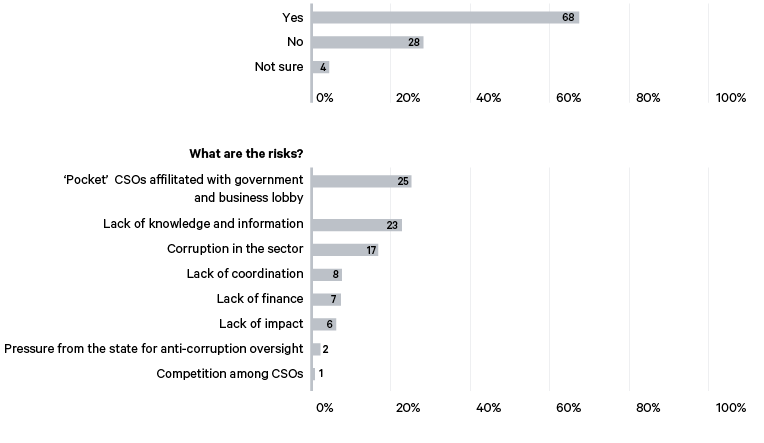

![Question 17. Which elements of societal resilience should be prioritized during wartime? [multiple choice]](https://www.chathamhouse.org/system/files/styles/reader_large/private/reader-content/publication-36670/file-62200/OEBPS/image/REP-103-elements-of-societal-resistance.png?itok=CFafa9xt)
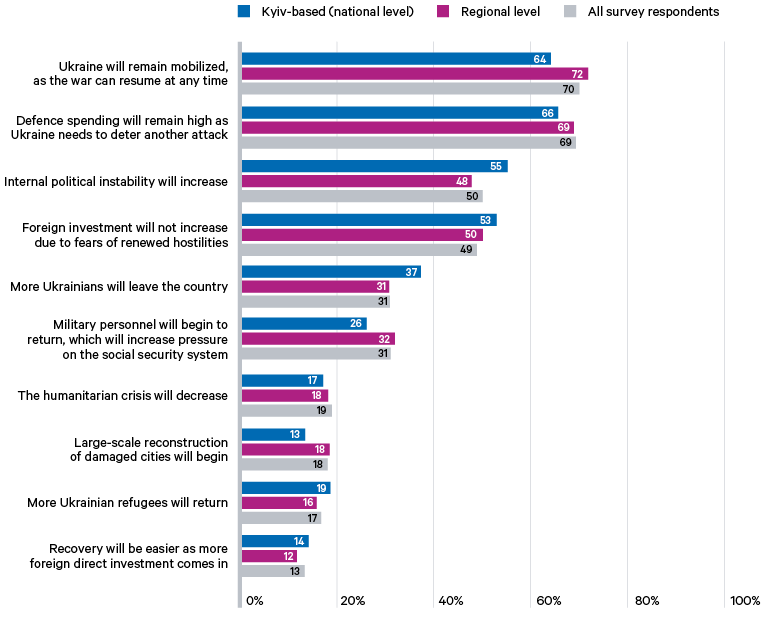
![Question 18. What are the implications of a ceasefire on recovery (without a final peaceful settlement) for the internal situation in Ukraine? [multiple choice]](https://www.chathamhouse.org/system/files/styles/reader_large/private/reader-content/publication-36670/file-62200/OEBPS/image/REP-103-implications-of-ceasefire.png?itok=eQTPkB48)


![Question 20. Have you or members of your organization had the opportunity to upskill to manage recovery projects? If NO, please select the appropriate option. If YES, please indicate who offered this training [choose one]](https://www.chathamhouse.org/system/files/styles/reader_large/private/reader-content/publication-36670/file-62200/OEBPS/image/REP-103-upskill-for-recovery-projects.png?itok=JT7vfheK)