Encouraging CSOs to provide support functions to recovery projects
Civil society wants to expand cooperation with local government in supporting community livelihoods and participating in the delivery of recovery projects. Local self-government bodies, especially those in smaller localities, see CSOs as allies and resource generators. Commitment among CSOs to contribute to recovery planning at all levels of government remains high.
The wider roll-out of the European Code of Conduct on Partnership (ECCP) would be complementary to the current recovery planning, especially as public investment reform will start at the local level. Support for the ECCP has not increased in the survey: only around a quarter of CSOs support its application. But the sector is largely unaware of the ECCP, which was developed only in 2014.
Through the ECCP, the European Commission mandates that stakeholder consultation for public investment should include the most vulnerable, marginalized communities, alongside business and public authorities. This provision forms part of all EU cohesion policy instruments that allocate EU budget to the EU member states. A wartime condition contained within it currently eases the demand on Ukraine regarding the ECCP; the EU’s Ukraine Facility documents only mention this instrument briefly. But civil society and all levels of government in Ukraine could use wartime to familiarize themselves and other recovery actors with this new EU practice ahead of accession talks.
CSOs are also willing to join or run project offices that assist local authorities in tasks like drafting funding proposals, attracting donors and managing reconstruction. Survey respondents see this as one of the most efficient ways to cooperate with local government (see Annex, Q10). With limited sources of funding available for recovery, CSOs can play an indispensable role in assisting communities, especially smaller ones, in attracting financial support from both larger and smaller donors.
Using CSOs for co-delivery of social services
Regional CSOs are also eager to participate in social service delivery. Ukraine decentralized its system in 2017 and devolved the provision of social services to the community level. But, to take the example of mental health, Ukraine lacks both medical and service delivery capacity at that level. Our survey shows that 40 per cent of CSOs currently work in providing mental health support (see Annex, Q3). In most cases, these groups are involved in non-clinical forms of support, although some groups do employ therapists to assist in crisis situations. CSOs could potentially contribute to resocialization, and community activities could be effective in helping people to overcome stress and isolation – for example, by connecting individuals to social peer groups, facilitating volunteering, cultural and sporting activities, or offering education and learning.
Despite civil society being willing and able to take on these roles, non-state suppliers rarely get access to government contracts. Only 14 per cent of Chatham House survey respondents at the regional level receive recovery funding from local budgets, with funding from external donors much more prevalent (see Figure 4, above, and Annex, Q5). But with risks to the continued availability of external aid in Ukraine – notably from recent budget cuts at USAID and the possibility of other development assistance being withdrawn if UN aid agencies fail to secure donations – the development of a domestic ecosystem for social services is key for the long-term financial viability of many CSOs. Among larger charities, Caritas advocates that, especially given high levels of internal migration and displacement, state funding allocations should follow individual citizens rather than being earmarked for social institutions broadly. In other words, money should be more effectively channelled directly to those in need.
Social service reform could lead to a more cost-efficient and needs-based system. One possible change would be to exempt CSOs from value-added tax (VAT) for social service procurement, as is the case for state providers. Redirecting national subsidies for communities that have a shortage of local resources to support specific vulnerable groups could cover current service delivery gaps.
Directing a larger portion of external funding to Ukrainian CSOs and community groups
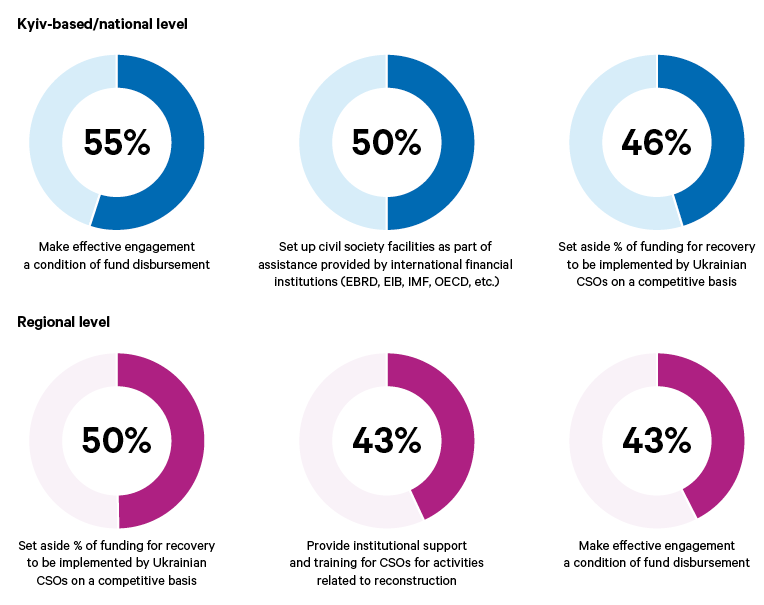
External donors have the potential to help expand inclusion in the recovery framework. This effort would be in line with the EU’s own work to engage citizens in early-stage policy planning. The financing of local-level projects that support community hubs, urban planning and development of recovery strategies is an example of how this idea is already being put into practice.



![Figure 8. CSOs want greater access to external funding, but approve of the strict conditions often attached (Question: How could external funders facilitate civil society engagement? [Choose three])](https://www.chathamhouse.org/system/files/styles/reader_large/private/reader-content/publication-36670/file-62200/OEBPS/image/REP-103-cso-external-funding-access.png?itok=g0Jlgr47)