Risks of internal instability
Nations under threat require a strong community of citizens who share values and principles for organizing their public affairs. Ukrainians highly value justice and freedom. Opinion polling shows that the demand for justice, identified as key to stability by 40 per cent of the population, comes right after the desire for peace. Ukrainians also understand that unity was a rare commodity before the war, and want to avoid similar problems in the future. History offers dark examples of loss of statehood due to divisions exploited by external enemies. A combination of distant and recent historical experience is creating concerns about how to bring society together and ensure that polarization does not rip apart the country’s social fabric.
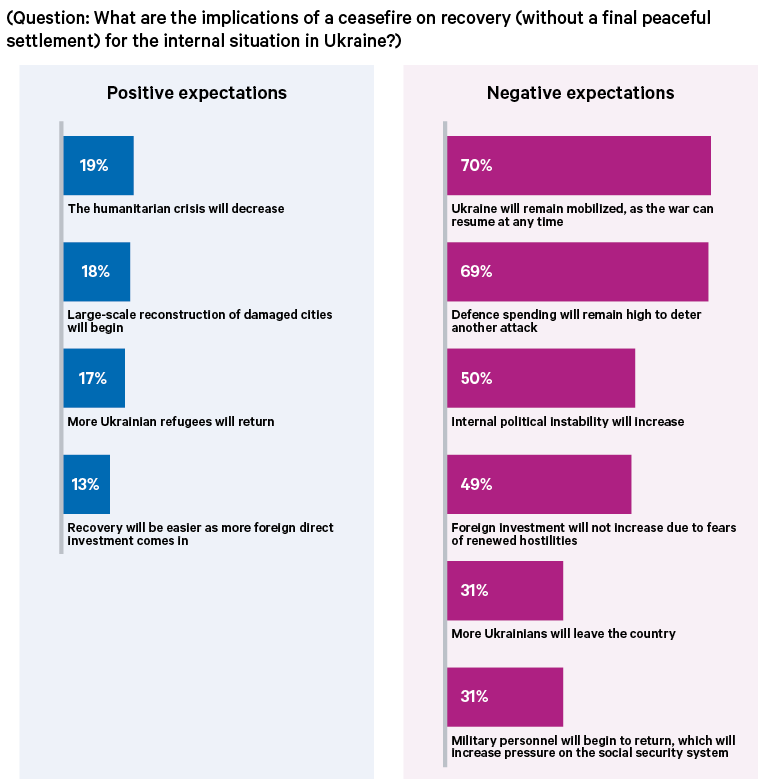
Social tensions due to a variety of factors – different experiences of war, rising poverty, economic hardship, and populist politics fuelled by Russian information warfare – may seriously weaken post-war Ukraine. Fifty per cent of respondents to the 2025 Chatham House survey fear that a ceasefire may increase internal instability (see Figure 3 and Annex, Q18). The Kremlin will do everything possible to create chaos and undermine the capacity of Ukrainian leaders to govern democratically. As part of the current push for an end to the war, Putin wants to force Ukraine into a premature, unprepared election to jeopardize the legitimacy of its leadership and create fractures.
Displacement and population loss
Ukraine faces an acute crisis of human resources. The demographic situation is alarming: Ukraine has lost nearly 10 million people in the past 30 years. The number of people needed to replenish the labour force is estimated at 4.5 million.
One of the preconditions for future economic growth is to ensure that Ukraine can attract its displaced nationals back to the country and engage its vast diaspora worldwide. This will be difficult. A third of Chatham House survey respondents believe that, once travel restrictions for men are lifted, the number of additional Ukrainians wanting to leave the country will outnumber those seeking to return (see Figure 3 and Annex, Q18). Current estimates show a decline in the intention to return compared to the first year of war; fewer than half of Ukrainian refugees now declare such plans.
If it is to achieve the economic growth necessary for a durable recovery, Ukraine must prioritize investing in its people at home and create strong incentives for those who want to return.
Declining health and well-being among citizens
Veterans are one of the social groups that survey respondents associate with both resilience and societal cohesion. Nationwide, more than 60 per cent of the survey respondents see the successful integration of former soldiers into civilian life as key to strengthening resilience (see Annex, Q17). An even higher 89 per cent identify this as the most critical social issue related to recovery (see Annex, Q7).
Rebuilding lives for IDPs is also extremely important. Many lack employment, live in temporary housing and, if not supported, risk coming back to occupied territories where they will continue to face great danger. War has caused the general level of poverty to rise to a staggering 35.5 per cent. IDPs are disproportionately more highly impacted by the economic deprivation resulting from the conflict.
A protracted war will damage the mental health of civilians and combatants alike. Research indicates that mental health has a greater impact on overall life satisfaction than either income or physical health. Our survey indicates that Ukrainians understand the need to provide an effective response: 39 per cent of CSOs nationwide said that mental health should be a priority for the recovery, with even more expressing the same preference at the local level (see Annex, Q6).
Due to both the prolonged war and growing awareness about this issue, the number of people reporting mental health concerns is rising. Estimates suggest that as much as 40–50 per cent of the population may need mental health support of various intensity, with IDPs, the elderly and young people the groups most in need of support. A 2024 national mental health survey showed 44 per cent of respondents reporting unsatisfactory mental health, compared to just 13 per cent in the 2023 survey. Many people report exhaustion, a state of tension and fear as negatively impacting them. Interestingly, people believe that all Ukrainians need mental health support, which suggests that stigma around the issue is decreasing.
All conflicts are, of course, different, but studies into combat stress elsewhere offer insights into what to expect in post-war Ukraine. Research from the UK indicates that, after 42 days of active combat, one-third of soldiers may have a mental breakdown and one-third will not recover.
The psychological effects of war take effect over a long period, and not all problems will hit communities immediately after mass demobilization. Initially, the number of veterans seeking help for mental health problems may be relatively small. The UK-based charity Combat Stress points out that veterans will typically seek help anywhere between two and 14 years after demobilization. But as veterans rebuild their lives and major life events happen, Ukraine may see a substantial increase in demand for mental health treatment and support. The country must be ready to provide the necessary resources at that moment.
Finally, the young generation of Ukrainians is struggling to cope with the war. Fear, instability, worsening economic opportunities and lack of access to housing are among the consequences most affecting young people. Online education is a necessity – particularly in front-line cities – but this also creates a significant educational gap with previous generations and could lead to a loss of social and communication skills.
Despite this, young Ukrainians appear to have a positive overall outlook on the future, with 60 per cent expressing feelings of hope according to a British Council report. Fifty-one per cent of Chatham House survey participants in 2025 believe that helping the wartime generation of young people to access quality education is key to the success of the recovery (see Annex, Q7). One in every four teenagers is considering emigration, mainly driven by a desire for self-realization, better education and curiosity about the world. Interestingly, security threats are at the bottom of their emigration motives.
Meanwhile, one-third of existing Ukrainian refugees were under 18 when they fled with their parents. They will require a special approach to incentivize their return, having built lives elsewhere – this task could be a focus for the newly created Ministry of National Unity.
Lack of finance
The enormous deficit in human resources is compounded by a shortage of finance. War is expensive. The Ukrainian military is spending an average of $142 million per day. The state spends nearly all of its fiscal revenues on defence, while social services and rebuilding costs are mainly covered by external funding – to the tune of around $40 billion annually. The International Monetary Fund (IMF), the EU’s Ukraine Facility, the G7’s Extraordinary Revenue Acceleration (ERA) scheme (which draws on immobilized Russian assets), and a group of states forming the Ukraine Donors Platform (UDP) are the main sources of such funding.
For this reason, the funding supply available for recovery is much lower than that allocated to immediate needs. In 2025, Ukraine’s immediate needs were calculated at $17.3 billion, including a funding gap of almost $10 billion. To date, according to approximate calculations, Ukraine has been able to meet only $13.2 billion of its recovery needs, representing a mere 7.5 per cent of the cost of direct war-related damage.
This gap may become wider. In 2026, Ukraine may face a funding gap of up to $23 billion if international assistance falls short; the prospect has already prompted the government to call for long-term financing for Ukraine to be met through the confiscation of $300 billion in frozen Russian central bank assets.
To date, according to approximate calculations, Ukraine has been able to meet only $13.2 billion of its recovery needs, representing a mere 7.5 per cent of the cost of direct war-related damage.
In 2025, the Ukrainian government adopted a new public investment management (PIM) policy to deliver reconstruction. Ministries and regional authorities are preparing a set of reconstruction projects that will be placed in a single project pipeline, hosted on the Digital Reconstruction Ecosystem for Accountable Management (DREAM) platform. By mid-May 2025, this pipeline included projects totalling UAH 1.6 trillion ($38.3 billion), of which only 9 per cent are backed by specific funding pledges. In the area of social recovery (referring to projects related to education and social protection, for example), the funding gap is $1.8 billion.
At the community level, the most pressing recovery needs are currently financed by local budgets (68 per cent), international grants (51 per cent) and charitable organizations (32 per cent). Allocations from the central budget account for 49 per cent of recovery funding. The European Investment Bank is a rare international financial institution (IFI) that funds local actors to swiftly rebuild essential infrastructure, such as water systems and energy-efficient facilities. It has allocated over €2 billion of finance to various Ukrainian towns and cities since 2022.
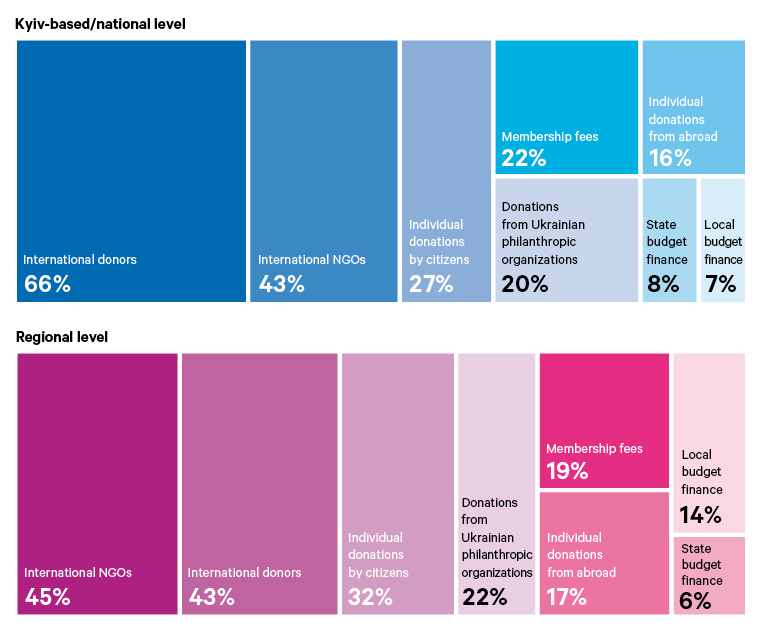
Civil society actors are acutely aware of the lack of finance for recovery. Forty-three per cent of Chatham House survey respondents nationwide pinpoint this as one of the major risks for recovery (see Annex, Q8). Other research indicates that 42 per cent of CSOs assess their financial situation as unsatisfactory. The sector is facing a looming funding crisis due to the effective dismantling of the United States Agency for International Development (USAID), which has been one of the largest sources of funding for development-focused CSOs. The shockwave caused by these cuts will be felt strongly in 2025, as around $2.9 billion of that development assistance is no longer available. This means that many CSOs and UN agencies that work in local communities will struggle to deliver humanitarian, development and reform programmes in Ukraine, as it is unlikely that other funders will be able to step in to replace that amount of funding.