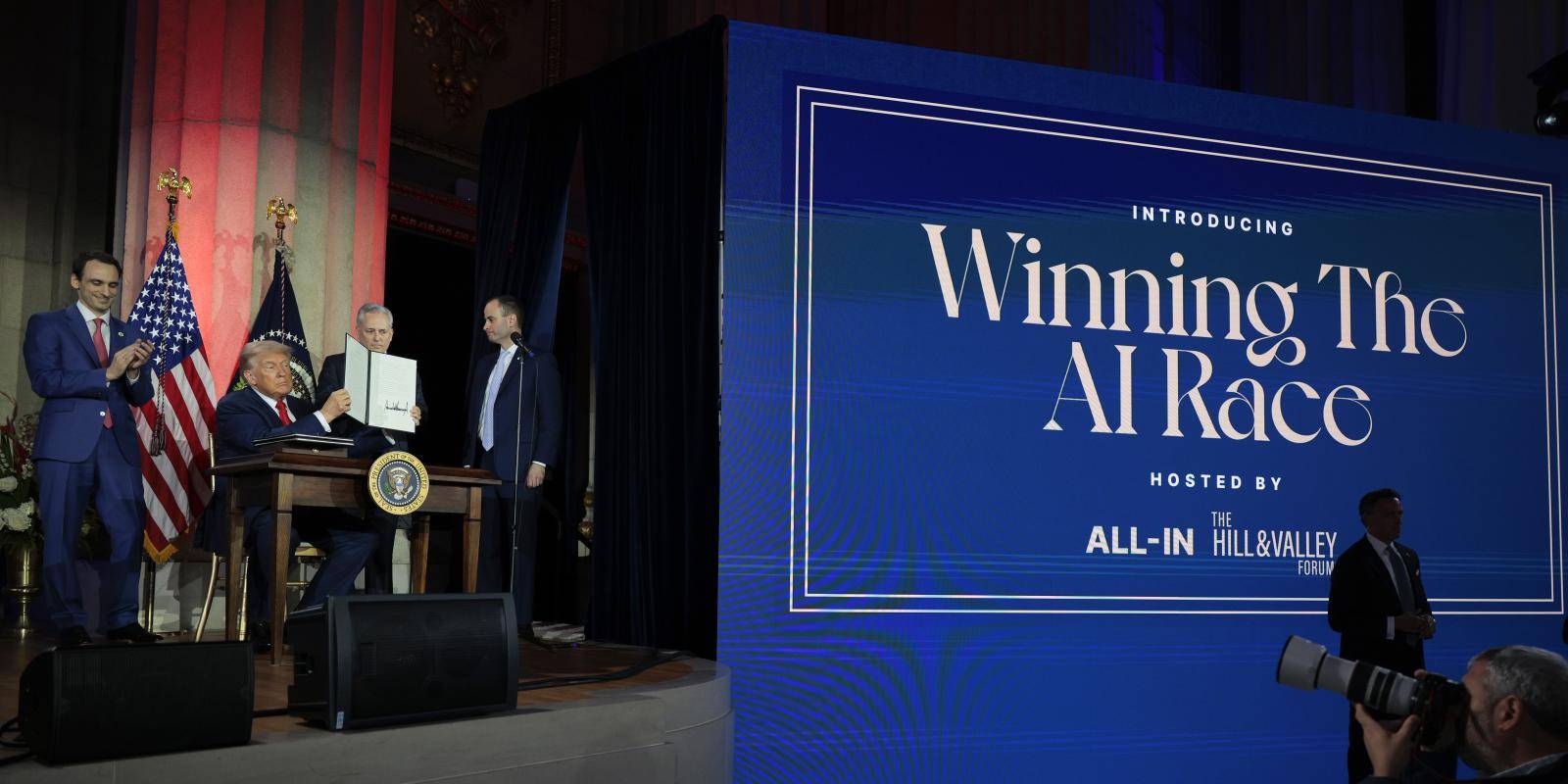

On 23 July, President Donald Trump launched the US ‘AI Action Plan’ at the ‘Winning the AI Race’ summit in Washington. In attendance were industry luminaries and the report’s co-author, White House AI and crypto czar David Sacks. The Action Plan is in parts predictable, in parts surprising, and in total a clear illustration of a changing US approach to the rest of the world.
This isn’t the first AI action plan, but it might be the first one that really matters. The UK, EU, India, the Gulf states and others have laid out their own strategies for securing their role in the development and adoption of this new technology. But the scale of US AI capacity dwarfs them all – and will continue to do so in the future. One metric – the availability of datacentres necessary for training and deploying AI – starkly illustrates the point.
The entire EU’s gigafactories project, ‘combined with France’s more ambitious buildout attempts, look set to make up perhaps 2 per cent of global compute supply’ once online in 2027. The United States, by contrast, contains about three-quarters of global AI supercomputer performance today. AI will remain a two-horse race between the US and China.

The US plan has three ‘pillars’. First, to remove regulation that might hinder US AI development. Second, to build out US AI infrastructure by investing in data centres, developing the power grid and ‘restoring’ domestic semiconductor manufacturing. And third, to export American AI globally and counter the US’s only rival, China, in AI deployment and diplomacy.
That the plan promises reduced regulation of technology companies is not a major surprise. Silicon Valley has embraced the second Trump presidency’s urgent language of ‘a race to achieve global dominance’ in AI and call ‘to innovate faster and more comprehensively than our competitors’. That emphasis on speed can only support the industry’s own lobbying against state and federal tech regulation.
A recent attempt to prevent US states regulating AI as part of the Big Beautiful Bill failed. But the overall direction of regulation under the Trump administration seems to be everything the industry could hope for. The president, for his part, used his summit address to call for ‘a new spirit of patriotism and national loyalty in Silicon Valley’.
A surprise move on open-source – with an unsurprising motive
More surprising is the plan’s insistence on the need for US open-source AI models. The Action Plan makes countering China a clear priority. And challenging China’s current leadership in open-source AI is an important part of the strategy.
Until now, US AI companies have kept their technologies under proprietary lock and key – so-called ‘black boxes’ – that prevent European or Indian AI developers getting hold of models like OpenAI’s GPT-4, so that they can modify them or run them on their own servers.

By contrast, Chinese companies offer open-sourced state-of-the-art AI models like Qwen and Deepseek. These models already provide the bedrock of both academic research on AI and industry adoption of the technology in China and many other countries around the world.
For countries concerned about the limits to their sovereignty, who want more control and oversight of vital technology, such models offer an attractive alternative to signing a contract with a US provider.
The US plan looks to reverse this trend, ‘to ensure America has leading open models founded on American values’. The intention is also presumably that other countries choose US models over Chinese ones.
Opposing Chinese influence is a recurring theme in the Action Plan, particularly in international organizations. The UN, OECD and G7 all catch flak for ‘advocating burdensome regulation’ on AI and promoting cultural agendas ‘that do not align with American values’ or that have been ‘influenced by Chinese companies’. The plan also tasks the Department of Commerce with identifying AI models looking for ‘alignment with Chinese Communist Party talking points and censorship’.
A world of a binary choice
The fact that the plan wields the stick at China is not a surprise. But US allies might be disappointed in the lack of a carrot for them. First and foremost, the plan defines the rest of the world as a market where the US must provide AI services top to toe – or China will. To ensure US supremacy, the plan calls for industry consortia to export ‘full-stack AI export packages’ – hardware, models, software, applications and standards – the whole kit and caboodle, for which the US government can help facilitate deals.
The assumption seems to be that the US’s partners – even when given access to powerful open-source models – will be unable to deploy sufficient capital, infrastructure or talent themselves to roll out society-scale AI. Nor will they have sufficient political willpower to avoid US dependence.
The proposition is to tie partners into dependent tech ecosystems – replicating the dominance of Microsoft Office over the past couple of decades, or Google and Meta on digital advertising – where US AI becomes both the foundation and the garden walls of the global digital economy.
It remains to be seen whether this is something major markets are comfortable with – and to what extent they will look to push their own sovereignty in the face of fast-accumulating concentrations of AI power. Certainly the EU, India, Canada and Brazil have already made big commitments and small moves to reduce their dependence on external technology stacks – both Chinese and American.