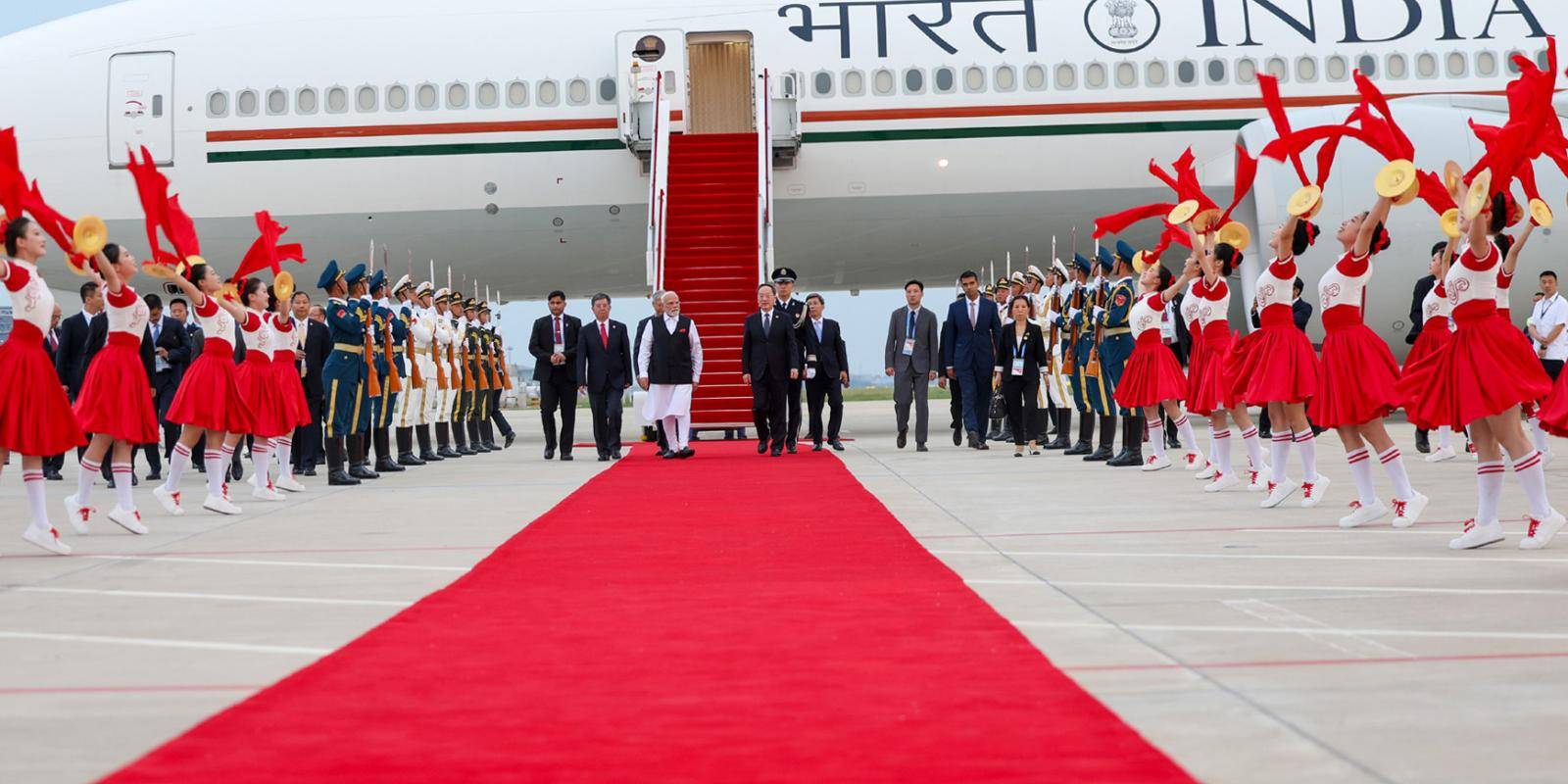

Prime Minister Narendra Modi’s attendance at the SCO Summit in Beijing should be seen as the culmination of efforts by India and China to reset relations after a fraught period in the bilateral relationship. However, despite significant progress and the impetus brought by US tariffs, fundamental grievances have yet to be resolved.
From the late 1980s until 2020, China–India relations tended to follow an unstated formula. The two sides sought to compartmentalize contentious areas of the relationship – most notably their unresolved border disputes – while promoting confidence-building measures and agreements like those of 1993, 1996, 2005 and 2013.
Interactions flourished through forums like BRICS, the Russia–India–China trilateral, and the Shanghai Cooperation Organisation (SCO). This was accompanied by rhetoric of ‘Chindia’ and an emerging ‘Himalayan Consensus’. Despite a string of stand-offs, both countries maintained engagement.
That lasted until the border clashes of 2020, which marked the worst flare up of tensions in over four decades and brought the border issue front and centre. De-escalating these tensions became a prerequisite for engagement in other areas.
A new normal
The announcement of a border agreement in October 2024 finally allowed a nascent rapprochement to emerge: Modi and Chinese President Xi Jinping met on the sidelines of the BRICS Summit at Kazan, and the Special Representatives (SR) framework resumed last December. Other discussions have touched upon ‘people-centric’ engagements, such as reviving a Hindu pilgrimage (Kailash Manasarovar Yatra), expediting visas and resuming direct flights.
Modi has spoken of ‘working to restore conditions to how they were before 2020’ while Xi referred to bilateral relations as a ‘Dragon–Elephant Tango’. In June and July 2025, Indian defence and foreign ministers made their first visits to China since the 2020 clashes.
August’s India visit by Chinese Foreign Minister Wang Yi made further progress. The readout notes the need for a ‘mutually acceptable framework for settlement of the boundary question’, referring to a 2005 agreement notable as the pinnacle of previous efforts to resolve the border issue.
Both sides agreed to establish an ‘Expert Group under the Working Mechanism for Consultation and Coordination on the India-China Border Affairs framework, to explore early harvest of boundary delimitation’. This means a phased approach towards resolving less contentious areas of the border first.
The SCO summit has further reaffirmed the reset in relations. India’s Ministry of External Affairs noted that the ‘two countries are development partners and not rivals’. Equally positive statements were made by China’s Ministry of Foreign Affairs, noting that it is the ‘right choice for China and India to be good-neighbourly friends.’
But serious differences remain. The boundary agreement announced last year has not prompted either country to rescind its territorial claims. Adding to this are several emerging (or re-emerging) fault lines in the relationship.
(Re)-emerging fault lines
Beijing officially claimed neutrality during the most recent India–Pakistan conflict – calling on both sides to exercise ‘restraint’.
In reality, it leaned in Pakistan’s favour through moral and material support. Over 80 per cent of Islamabad’s arms imports came from China over the last five years. And Chinese-made military platforms were used in operations against India, including J10 fighter aircraft, PL-15 air-to-air missiles, HQ-9 air defence missiles and YLC-8E radar systems. In July, the deputy chief of India’s army claimed that Beijing provided real-time intelligence to Pakistan during the conflict.
India’s refusal to endorse the joint statement of June’s SCO defence ministers’ meeting – because of the absence of any mention of the terror attack in Kashmir – illustrates how disagreements over Pakistan are playing out openly in regional and global forums.
Meanwhile, China’s construction of the world’s largest hydroelectric power project across the Brahmaputra River/ Yarlung Tsangpo provides another source of tension. Four river systems traverse China and India and Chinese strategic elites have made veiled threats following New Delhi’s decision to suspend the Indus Water Treaty with Pakistan.
In reality, the threat posed by Beijing to India’s water supply is limited. Most of India’s water does not originate in the Tibetan Plateau but through precipitation and tributaries within Indian territory. And the most recent SR meeting saw Beijing agree to ‘share hydrological information’ with India. Nonetheless, tensions over water add to the bad blood in the bilateral relationship.
Tibet also threatens to become a renewed point of contention. Having recently turned ninety, the Dalai Lama has become more vocal on the issue of succession. He has stated that his successor will come from a ‘free’ state (implying not China) with the process overseen by a trust within the Office of the Dalai Lama based in India. Beijing has challenged this, claiming a veto over the succession process. This could fuel further tensions, particularly if the next Dalai Lama is reincarnated among the Tibetan exile community inside India.
