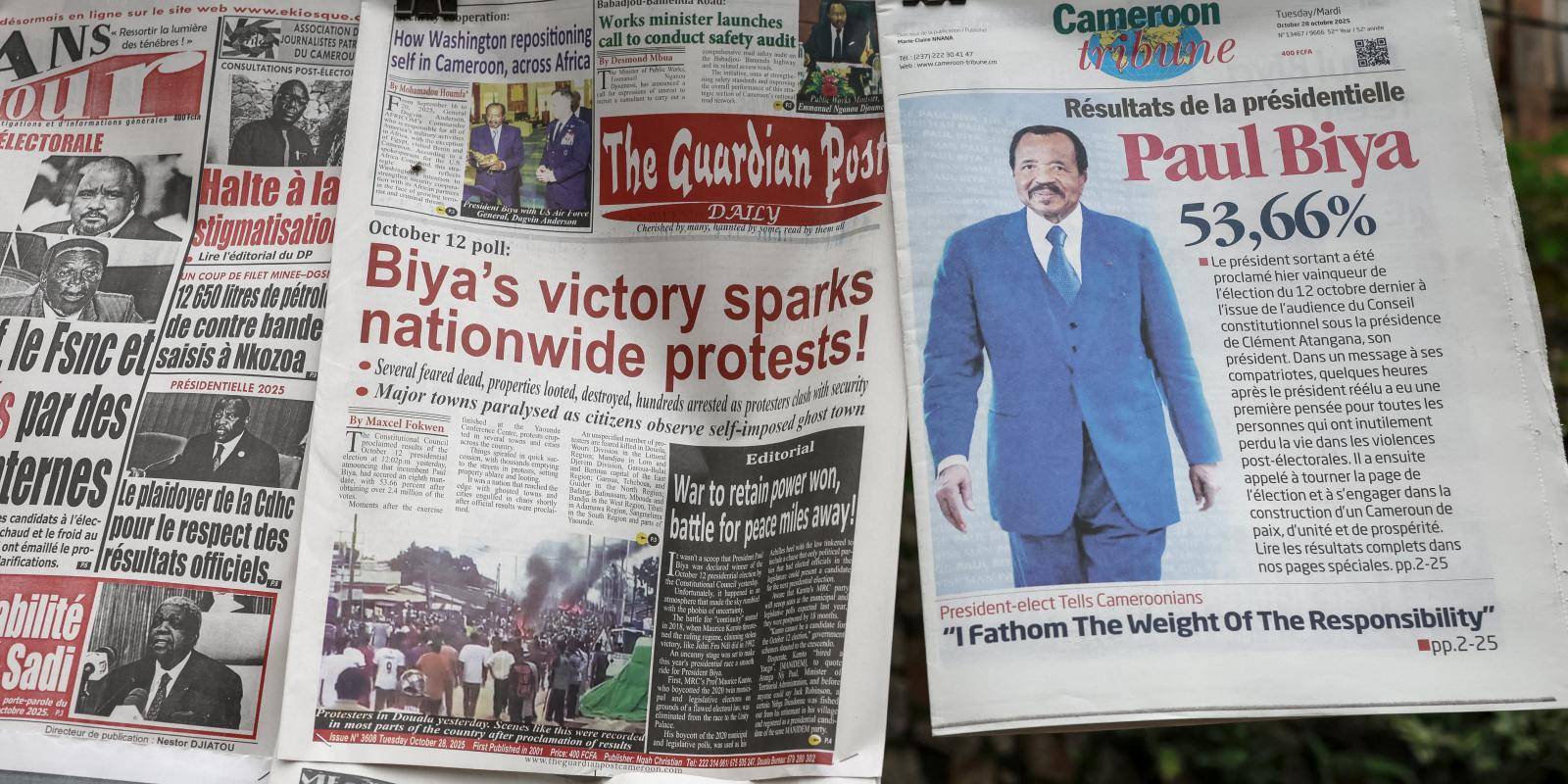


On 27 October, more than two weeks after Cameroon’s presidential election, the country’s Constitutional Council declared victory for incumbent President Paul Biya with 53.66 per cent of the vote. The result secures an eighth term for the 92-year-old, who has been in power since 1982.
By maintaining the continuity of Cameroon’s ruling establishment under Biya, the election has deepened the legitimacy and succession crises facing the country. As security forces crack down on protests in support of the opposition, which has disputed the result of the election, the government is under popular pressure to improve its accountability and inclusivity.
Though Biya winning the election was widely viewed as a foregone conclusion, the election did not unfold seamlessly. Petitions lodged by civil society and some opposition alleged serious irregularities, including reported attempts at ballot box-stuffing. The opposition said ‘state machinery’ was used to manipulate the election and released footage of alleged voter fraud.
The leading opposition candidate, Issa Tchiroma Bakary, had refused to file a petition, but instead declared himself the winner with 54.8 per cent of the vote. The Constitutional Council – composed of individuals appointed by Biya himself and accused by opposition figures of being deeply embedded in the ruling establishment – swiftly dismissed all complaints before announcing the official results.
Even considering the allegations of manipulation, Biya’s declared victory sits only just above the necessary majority threshold and marks a sharp decline from his previous mandates (71 per cent in 2018 and 77 per cent in 2011). This reflects a substantial shift in public sentiment and political alliances, suggesting the ruling establishment underestimated the popular desire for change.
Immediate instability and militarized response
Widespread support for Tchiroma, despite him having served in various ministerial roles under Biya from 1992 until earlier this year, demonstrates the magnitude of demand for leadership change. While Biya has played an important role balancing between different political factions, he has made few public appearances recently and his decision to stand for another seven-year-term was contentious.
Most controversially, Biya was declared overwhelmingly victorious in Cameroon’s restive Anglophone regions, where separatists have been fighting the government for a decade. According to the official results, Biya received 86.31 per cent of the vote in the North West region and 68.79 per cent in the South West. (He also won with 45.93 per cent in the Far North region, which is facing an Islamist insurgency.) Given Biya’s lack of popularity and the regime’s failure to resolve long-running crises in these regions, where separatists have imposed lockdowns to restrict movement during the elections, many doubt the veracity of these results.
The official announcement sparked sizeable protests in major urban areas, as well as among the Cameroonian diaspora. Tchiroma’s ability to sustain this popular mobilization will determine what happens next. It is likely to be obstructed by Cameroon’s heavily militarized response to dissent. Supporters of the main opposition challenger in 2018, Maurice Kamto, were arrested and imprisoned following the post-election crisis that year. Statements by the Minister of Territorial Administration saying that Tchiroma will be ‘dealt with rigorously and firmly’ point to a potential similar escalation of repression.
The military has been preparing to support the police and gendarmerie in containing the protests in cities, including by redeploying soldiers from the Far North. At least four civilians were reportedly killed by security forces during demonstrations on 26 October. Tchiroma alleged that another two peaceful protestors were shot on 27 October outside his residence in the city of Garoua.
With more mass demonstrations planned, escalating militarization risks linking urban political dissent to long-standing armed conflicts in Cameroon’s peripheral regions. This would add further pressure on a security system that has already been challenged for a decade by Islamist militant groups in the Far North, and Anglophone separatism in the South West and North West.
The administration might be tempted to unilaterally postpone the legislative election, already delayed until 2026, in order to regain its footing. But this move would almost certainly trigger renewed public unrest.
The looming succession crisis
Ironically, the ruling establishment’s ability to execute its electoral strategy entrenches its greatest structural weakness. Biya’s victory points directly to the absence of a legitimate political mechanism for leadership transition within the current system and intensifies the risk of a chaotic and violent succession process.