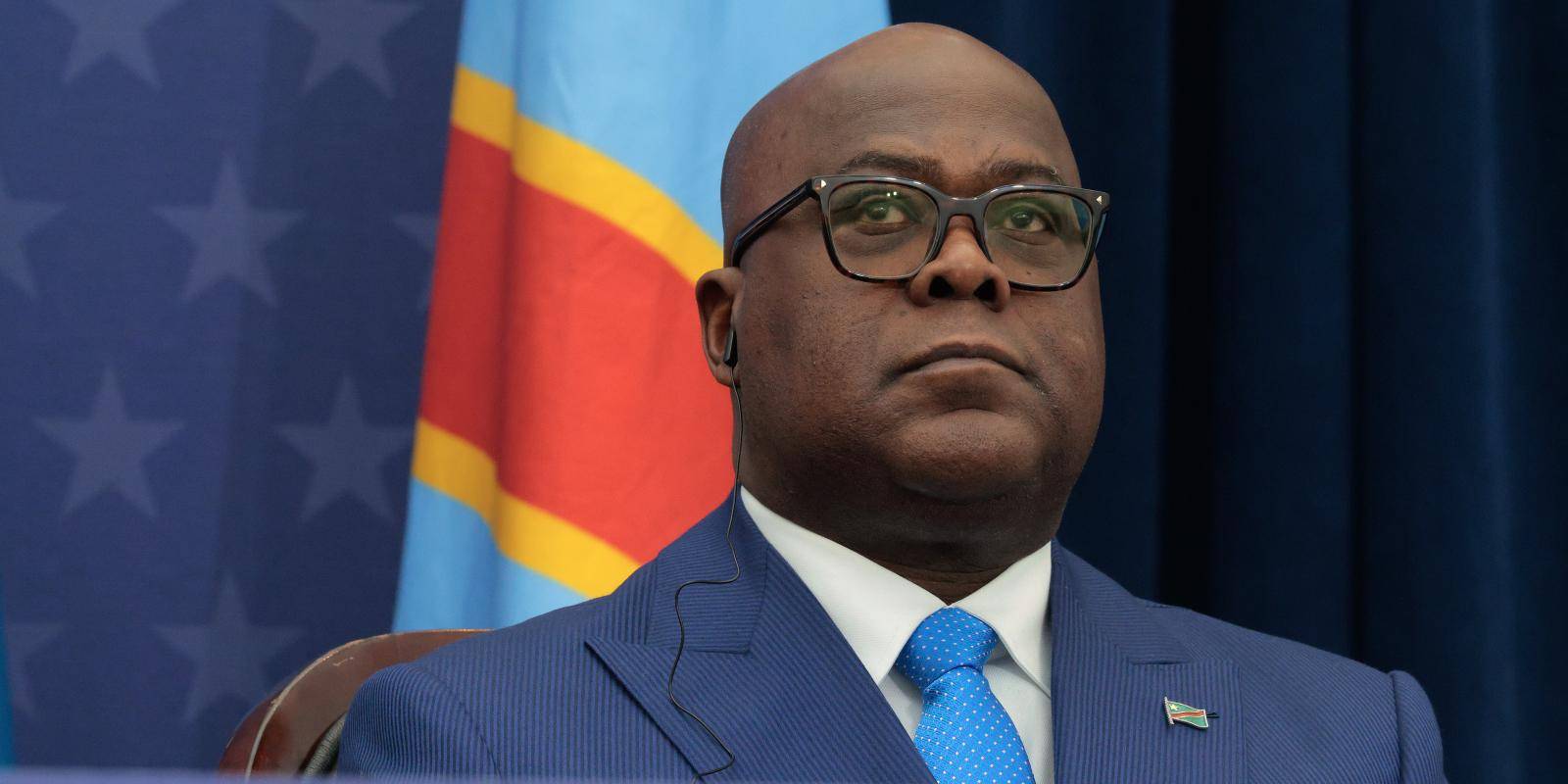

When President of the Democratic Republic of the Congo (DRC) Félix Tshisekedi finally announced a ‘national dialogue’ on 27 August, he evoked the country’s long history of previous negotiations. Too often, he said, they had been about elite power sharing, had not meaningfully included the Congolese people, and had legitimized armed insurrection. This time will be different, he promised.
Tshisekedi appealed directly to the Congolese people by proposing a series of public consultations in all 26 provinces, culminating in a convention in Kinshasa. Unlike previous dialogues, this process has a more ambitious aim. It not only seeks to address the causes of insecurity and inequality in DRC and identify reforms. It also seeks to reconstruct or re-found the state.
The opposition immediately denounced the project. The C64, a coalition made up of opposition heavyweights including Moïse Katumbi, Martin Fayulu, Delly Sesanga and Jean-Marc Kabund, rejected Tshisekedi’s proposal. So too did the ‘Sauvons le Congo’ platform created by exiled former president Joseph Kabila.
Tshisekedi’s plan, they claim, is intended above all to legitimize his attempt to change the constitution, possibly allowing the president to extend his rule beyond his two-term limit, which ends in 2028. They point to a controversial bill that would pave the way for a referendum allowing the modification of article 220 of the constitution, which forbids changing the number or duration of presidential terms.
Points of (dis)agreement
There is much that the DRC’s government and opposition disagree on. But there are two points of convergence. One, publicly acknowledged, is the need for a national dialogue to address the country’s serious challenges. However, apart from the need to bring peace to the eastern provinces, there is no consensus on what these challenges are.
The other point of convergence, acknowledged only behind closed doors, is that elections probably cannot be held by the end of Tshisekedi’s second term in 2028. There are three main reasons: First, little progress has been made in organizing them. Technically there is still time to do so, but the quality of elections held in 2028 would be in question.
Second, important territories in eastern DRC remain captured by the M23 armed group. Any attempt to exclude these provinces from elections could be interpreted as an implicit endorsement of their secession, raising fears of the break-up of the country. Third, some members of the opposition may see a dialogue as a way to gain power without going to the polls.
There is therefore broad, albeit tacit, agreement on the need to delay elections in favour of ‘dialogue’. But consensus falls apart when talk of detail begins. Indeed, it raises the question: what dialogue is needed to resolve which crisis?
For Tshisekedi, the national dialogue is an opportunity to create a ‘united front’ – under his control – aligned against Rwanda. In the president’s telling, the DRC’s problems stem mainly from Rwanda’s support for the M23 in North and South Kivu provinces. Since late 2021, M23 fighters have seized large swathes of territory, including the provincial capitals of Goma and Bukavu. Tshisekedi has dismissed opposition calls to integrate M23 in the national dialogue, saying the Doha Process – Qatar-led talks hosted in Switzerland – is the only appropriate venue for negotiating with them.
But for many in the opposition, as well as the Catholic and Protestant churches, the conflict is more a symptom of the political crisis than its cause. In their view, the M23’s success has been fuelled by dissatisfaction with bad governance and corruption under Tshisekedi’s government.
Many want a neutral convenor for a dialogue, such as the churches, and a venue outside of the DRC that would allow exiled politicians to participate. But Tshisekedi has ruled out an external location. And he has made clear that religious denominations will play a secondary or even symbolic role.
What a post-2028 transition might look like, if elections are not held, is still open for debate. The concept recalls the two-year ‘glissement’ (literally, ‘sliding’) that former president Joseph Kabila negotiated to remain in power beyond the end of this second term, in 2016-17.
For those close to President Tshisekedi, there is hope of getting broad agreement on a transition that could last three to five years. That would be a de facto extension of the president’s tenure beyond constitutional limits, if he remained in office for the duration. Some in the opposition would like to see a shorter transition, even without Tshisekedi. This would see a power-sharing agreement that would pave the way for a new electoral commission and fresh elections.
However, for now the country’s opposition seems fragmented and unable to shape the terms of the dialogue. Crucially, they lack the leverage of significant popular mobilization: a long-postponed opposition rally on 15 September saw relatively little participation on the streets of the capital. And the US, which recently signed a critical minerals deal with the DRC, is seen to be backing Tshisekedi. The president therefore seems likely to move forward with his plan. A recent presidential ordinance laid the groundwork for the dialogue proceeding under Tshisekedi’s control.
The position of the Catholic and Protestant churches may yet prove influential. For the moment, they have not commented publicly, preferring to try to negotiate for a stronger role. However, should their position change and church leaders choose to actively boycott the dialogue, it could diminish the legitimacy of the process. The Catholic church is an important political actor in the DRC: it was instrumental in organizing against a Kabila third term. For now, however, Tshisekedi appears to have the stronger hand.
It may be that Tshisekedi’s stated goal of going beyond past national dialogues to ‘re-found’ the state is just political rhetoric. The risk is that he intends to use talks as a way of co-opting part of the opposition, just as Kabila did in 2016-17.
Meanwhile the opposition wants to wrest power from Tshisekedi but also does not necessarily favour elections to resolve the political crisis. It may therefore view dialogue as the best means of unseating the president and taking power. Either way, the two sides’ framings are fundamentally at odds. It remains to be seen whether all parties can agree on the nature of the nation’s problems, let alone their solutions.
The debate over the dialogue is a reminder that the security situation in the east cannot be neatly separated from national politics. Talk of changing the constitution by Tshisekedi’s camp waned in early 2025, after the M23 seized Goma and Bukavu. It resurged once the threat was contained.
Fundamentally linked
The current assemblage of processes – Washington for DRC–Rwanda negotiations, the Doha process for DRC–M23 talks and now, the national dialogue – draw lines between phenomena and actors that are fundamentally linked.
The relatively limited objectives of the Washington and Doha processes are at least clearer than the national dialogue’s ambiguous aim of ‘re-founding’ the Congolese state or ‘creating peace’. But each process’s success is linked to the other. No agreement with the M23 can exist without an accord with Rwanda. And peace in the east will require progress on transitional justice and community reconciliation – issues which should be part of any national dialogue.
Can a national dialogue deliver the reforms DRC desperately needs? Currently, the greatest risk is that it is limited in exactly the way Tshisekedi said it must not be: to an exercise in which political elites agree how and when power will change hands.