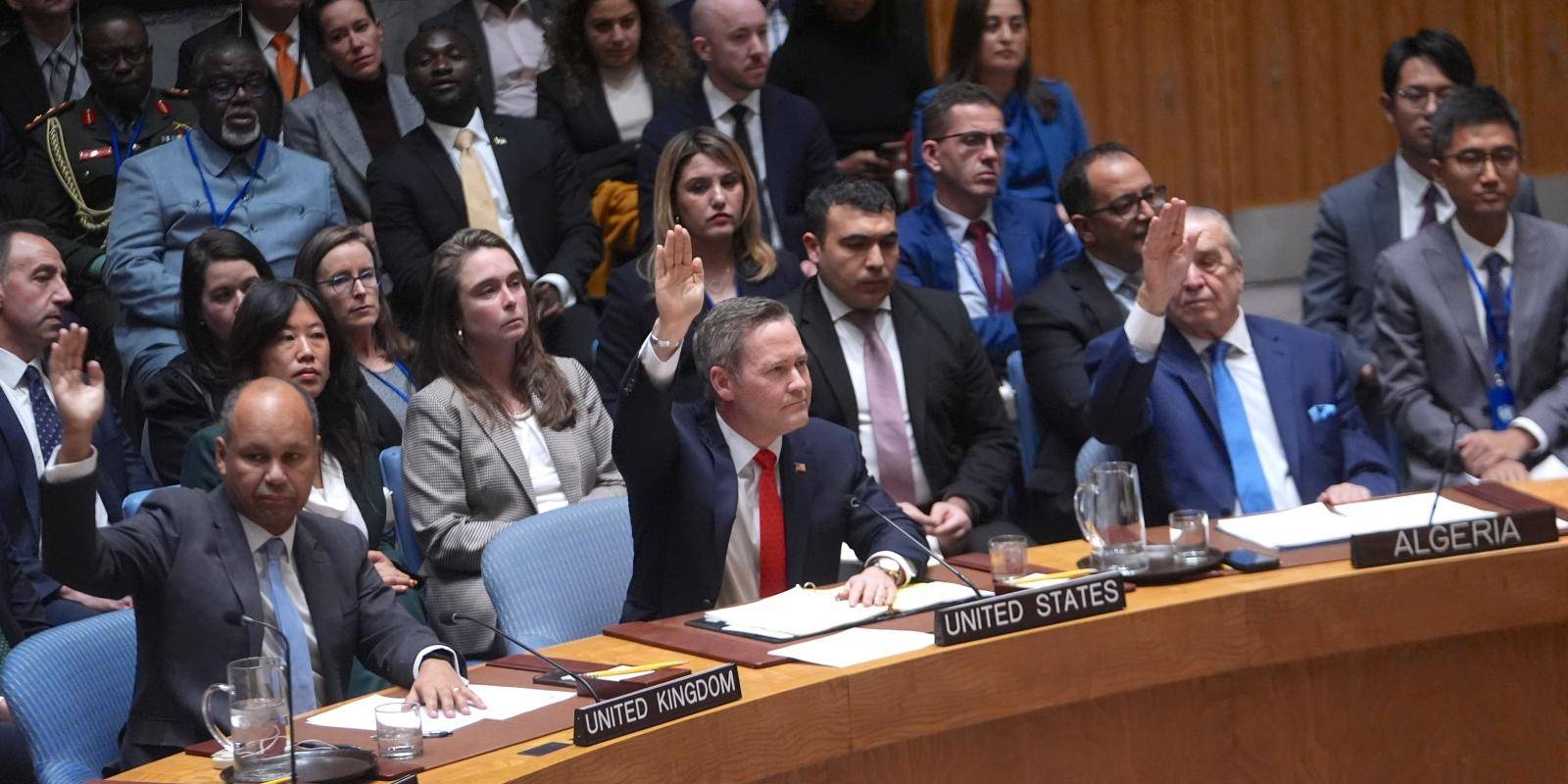

On 17 November the UN Security Council adopted resolution 2803, endorsing the United States-backed ‘Comprehensive Plan to End the Gaza Conflict’ – also known as President Donald Trump’s 20-point plan for Gaza.
The resolution welcomes the establishment of the Trump plan’s proposed Board of Peace and authorizes the Board and UN member states to establish a temporary International Stabilization Force in Gaza. The process of generating the resolution text was compressed. But its wording hides as much meaning as it gives away. In fact, the story of the adoption of the resolution reveals the tension that underlies it.
The US sought to obtain the maximum international legitimacy from the UN, while trying to keep UN influence and control over the operation as small as possible.
Most other members of the Council were hesitant to hand unfettered authority to the US and its implementation partners. But it appears the US has achieved much of what it wanted.
How did the US achieve a resolution on a deadlocked Security Council?
The US applied a pressure cooker technique to limit the influence of others on its draft of the resolution, keeping the consultation period short. Washington calculated that few would want to put at risk a ceasefire that has, at least for now, largely ended the massive suffering in Gaza by delaying or even frustrating adoption of the text.
The Russian delegation did put forward an alternative draft resolution which reflected the concerns of many other Council members. But the US deployed a counter-move, summoning the original supporters of the Trump plan from its conception in New York this September. Qatar, Egypt, the UAE, Saudi Arabia, Indonesia, Pakistan, Jordan and Turkey supported the US draft resolution in a formal joint statement. That communique was in turn welcomed in a separate statement by the Palestinian Authority (PA).
That manoeuvre allowed the more hesitant members of the Council to vote for the US text, despite their misgivings, arguing that they would not want to frustrate a venture that was supported by the regional states most affected by it. Russia abandoned its counter-draft, while voicing grave concerns, along with China. Both abstained on the vote, while all 13 remaining Security Council members voted in favour of the resolution.
Why did the US seek a UN resolution?
The Trump administration has been hostile to multilateral institutions and especially the UN. Hence, it took some persuasion to bring the issue before the Security Council.
However, without the resolution, the Trump plan for Gaza could not have been implemented. Many of the states that have been asked to contribute troops to the International Stabilization Force were insisting on a UN mandate, for several important reasons.
First, there was the perception risk: that without a UN mandate the mission would be painted as a neo-imperialist effort that placed Israel’s greatest ally, President Trump, personally in change of what might be seen as continued occupation of Gaza by proxy – permanently denying the right of self-determination to the Palestinian people.

A UN mandate offers legitimacy. Even if headed by the US, the operation can be presented as an effort by the international community, undertaken in the interest of the people of Gaza and regional peace.
Second, without a formal UN mandate under Chapter VII of the UN Charter, the presence of a foreign force exercising control over the territory could be considered armed occupation.
Under the law of armed conflict, an occupying power would not be entitled to seek the massive transformation that is foreseen by the Trump plan in terms of governance, reconstruction and economic development.
Moreover, the authority of the Trump plan’s proposed ‘Board of Peace’ acting as the supreme governing authority for Gaza for at least two years, must be hinged somewhere – to satisfy legal requirements and to avoid the impression of colonial imposition. A Chapter VII mandate provides the required legal authority, as it did for UN administration of Eastern Timor and Kosovo.
In the alternative, Palestine, in the shape of Palestinian Authority (PA) President, Mahmoud Abbas, could theoretically have formally invited the mission. This was the preference of many in Palestine. If the sovereign consents, this affords sufficient legal authority for the presence and activities of an international governance mission – although this is often still backed up by a Chapter VII mandate.
However, Israel refuses to acknowledge that the PA represents Palestine. The US deemed it politically helpful to have the PA ‘welcome’ the support of the other Arab and Islamic states for the resolution. But the PA did not invite the mission in that statement, nor does the resolution reference it. Its statement was deliberately not cast as a legal act of consent from an authority representing a sovereign state.
Basing the authority of the mission in consent given by the PA would have implied recognition of Palestine as a sovereign state, which is unacceptable to the US and Israel, both of which have very strongly resisted the recent wave of statehood recognitions. (Interestingly, the UK referred to Palestinian ‘sovereignty’ in the Council debate on the resolution, consistent with its recent recognition of Palestine as a state).
Finally, consent to a peacekeeping mission without a Chapter VII mandate can be given – but it can also be withdrawn. Egypt, for example, withdrew its consent for the presence of a UN buffer force on its border with Israel, when it prepared for the war in 1967. The UN troops were duly withdrawn, making way for the six-day war that followed.
Does the resolution have authority under Chapter VII of the UN Charter?
Only Chapter VII of the UN Charter allows the Security Council to authorize the use of force, or to conduct governance operations in a territory without, or even against, the consent of the sovereign.
In this instance, a regional country seems to have resisted a resolution and precedent that granted clear and unambiguous Chapter VII authority over the Gaza issue, and thus also over the Palestine question more generally.
In the end, a compromise emerged that fudges the issue. An opening paragraph of the resolution text finds that the situation constitutes ‘a threat to regional peace and security.’ Such a finding is a passport to action for the Council when it intends to act under Chapter VII. The wording of ‘regional’ rather than the traditional reference to ‘international’ peace and security just about qualifies as an opener to Chapter VII.
The substance of the resolution clearly points towards Chapter VII. The International Stabilization Force is authorized ‘to use all necessary measures’ to carry out its very broad mandate. This is code for the authority to use force. And such authority can only be granted in a Chapter VII resolution.
However, since resolution 688 of 1991, Security Council practice has suggested a further element to communicate that Chapter VII authority is intended.
That resolution was drafted under Chapter VII, allowing coalition states to ensure the delivery of humanitarian supplies to Northern Iraq in the absence of consent by Saddam Hussein’s government. However, it became clear that China would veto such a humanitarian operation if presented under Chapter VII.
The solution was to adopt the resolution text as it was, but to remove the customary paragraph after the preamble clearly stating that the Council is ‘acting under Chapter VII’, or under a specific article from Chapter VII. This was to communicate that the resolution might look like Chapter VII in all other aspects, but was not in fact Chapter VII.
Ever since, the absence of this customary paragraph has been taken in what might be described as ‘informal best practice’ to indicate that a text is not adopted under Chapter VII. The paragraph is absent from the text of Resolution 2803.
This case is clearly an instance of deliberate ambiguity aiming to satisfy a country that does not wish to see clear Chapter VII action in its immediate neighbourhood.
However, on balance, the interpretation of the resolution overall supports the view that a Chapter VII mandate has indeed been granted: recent practice not withstanding, the UN Charter does not actually require inclusion of the specific paragraph formally invoking Chapter VII. And there would have been no point to authorize the use of ‘all necessary measures,’ which is only possible under Chapter VII, if the resolution was not Chapter VII.
How much authority does the resolution grant the Board of Peace (BoP) and International Stabilization Force (ISF)?
Another constant refrain in the Council debate on the resolution was the absence of clarity surrounding the extent of authority granted to the BoP and the ISF.
The resolution requires that the ISF will carry out its mandate consistent with international law, including humanitarian law.
But there are few other limitations, and the resolution does not award the Security Council supervisory powers beyond its authority already established in the UN Charter. The potentially vast powers of the mission are not balanced by mechanisms to safeguard the rights of local inhabitants.
The long listing of tasks for both the BoP and the ISF operating under its authority includes exercising and supervising interim governance, reconstruction, public and humanitarian services, and movements of persons in and out of Gaza. The listing ends with a catch-all clause to include ‘any such additional tasks as may be necessary to support and implement the Comprehensive Plan’.
There was a sense in the Council that the mission may well suffer from overreach. For instance, the resolution states the ISF has a mission to destroy the ‘military, terror and offensive infrastructure, as well as the permanent decommissioning of weapons from non-state armed groups’.
That would include the extensive network of tunnels and other installations that have sheltered Hamas during the conflict. That task eluded the powerful Israeli Defense Forces for two years. And undertaking it might place the ISF into armed confrontation with Hamas.
In fact, Hamas asserts that it has not agreed to its own disarmament, perhaps other than placing heavy weapons beyond use. It insists on a ‘right to resist’ foreign (Israeli) occupation, arguing that its members must retain at least small arms (the ubiquitous Kalashnikov assault rifles).
What does Resolution 2803 say about Israeli and Palestinian involvement?
Beyond maintaining the ceasefire, Resolution 2803 does not provide clear obligations for Israel. The timing for complete Israeli withdrawal is yet to be agreed, and is subject to unclear conditions being met in Gaza.
While the Board of Peace and International Stabilization Force are to support humanitarian deliveries, there is no requirement specifically directed at Israel to facilitate, and cease obstructing, humanitarian access.
Only Trump’s 20-point plan, which is at least attached to the resolution, provides for immediate and full aid deliveries without interference. The US, presumably guided by Israel, was unwilling to include this reference in the actual text of the resolution. The compromise was to annex the plan to the resolution.
However, while the resolution welcomes the plan, it does not state that the annex should be read as an integral part of the resolution, which would normally be expected.
