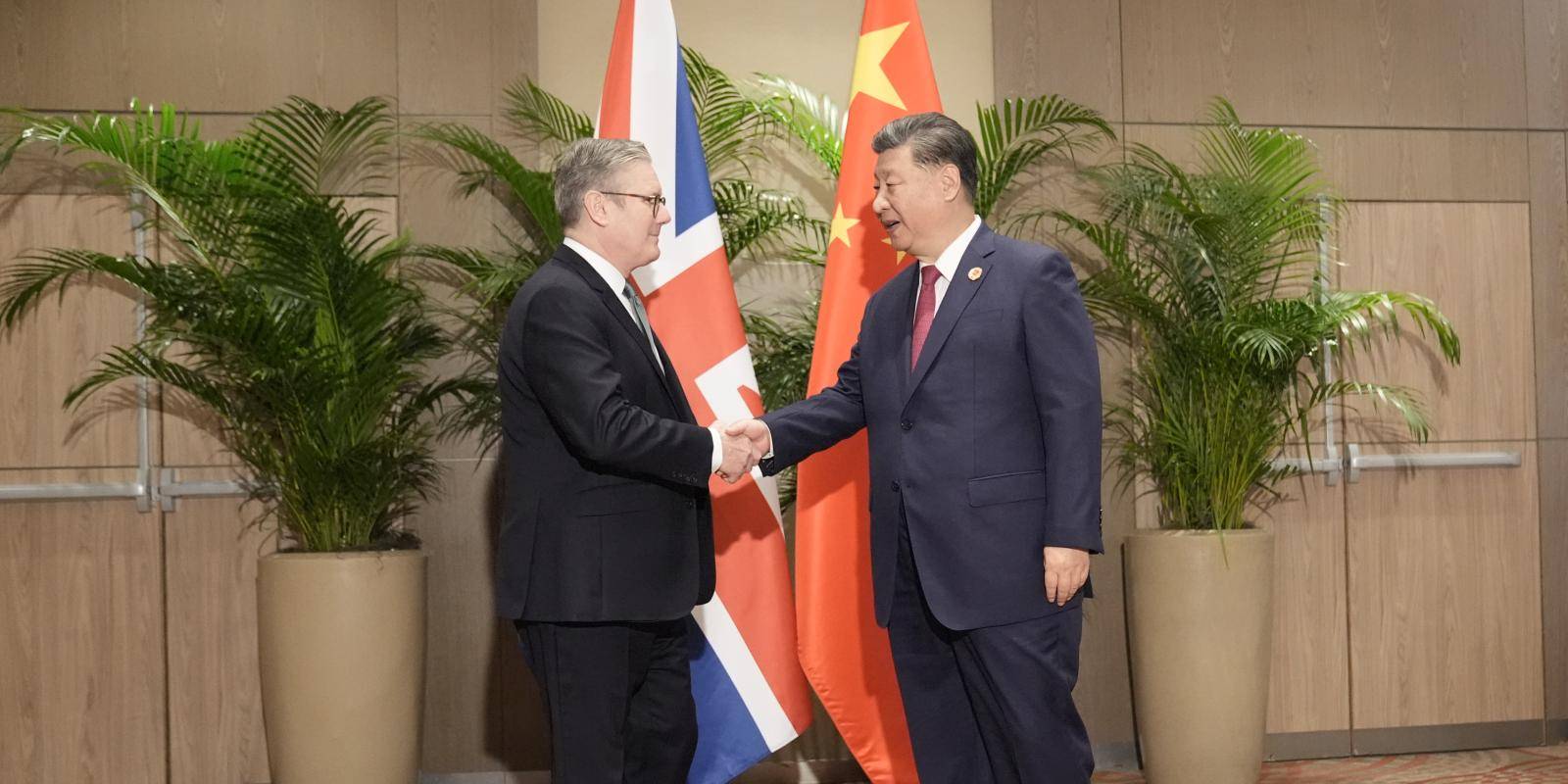

UK Prime Minister Keir Starmer’s trip to Beijing next week marks the first time a UK prime minister has visited China since Theresa May in 2018. Since taking office, Starmer’s government has signalled a desire to reset relations and rebuild trade ties with China after years of strain. High-level talks will reportedly be attended by business leaders from both sides with the aim of improving business dialogue between the two countries. Starmer is also expected to meet with Chinese President Xi Jinping, although neither side has confirmed any details yet.
The highly anticipated visit comes days after the UK government’s controversial decision to approve China’s new ‘mega-embassy’ in London. The approval, which followed numerous delays, has been met with vocal opposition from community groups, commentators and MPs – including figures within Labour’s own ranks. Protests outside the Royal Mint Court site reflect broader concerns that the new embassy could facilitate espionage, foreign interference or other hostile activities targeting the UK and Europe. UK intelligence agencies MI5 and GCHQ did not raise formal objections but are reported to have recommended a ‘range of measures’ to mitigate national security risks. However, the lack of transparency around the approval – and its timing – has fuelled speculation that the decision may have been designed to win favour with Beijing ahead of the visit.
The embassy decision and Starmer’s visit have sparked renewed public and parliamentary debate on the threat posed by China but focusing narrowly on these events risks obscuring a more consequential challenge: China’s invisible leverage . Exercised through economic ties and dependencies, it is harder to detect – and more difficult to unwind once embedded.
Economic interdependence becomes leverage
In recent years, China has repeatedly demonstrated its willingness to use economic coercion to advance geopolitical objectives. Trade restrictions, regulatory harassment and market access bans have been used to punish countries – such as Australia, Lithuania and South Korea – for policies Beijing has opposed. More recently, China’s weaponization of trade has ranged from far-reaching export controls on rare earths to threatening Australia with possible economic consequences for obstructing Beijing’s ‘reunification’ with Taiwan. Beijing’s toolbox of economic statecraft is further enabled by the structure of China’s party-state system. Beijing retains a range of formal and informal mechanisms to control Chinese firms, including private companies, and use them to influence target states and conduct grey-zone activities. This includes China’s national security laws, which compel Chinese firms and citizens to support intelligence services if asked, including outside China.

Economic interdependence can create security risks even in sectors not traditionally viewed as sensitive. This can manifest as access to, and operational control of, critical sectors and infrastructure; extraction and aggregation of sensitive data; and the creation of chokepoints in key supply chains.
This is particularly relevant as the UK pursues its green transition, an area which the UK government wants to partner with China on further. As the UK deepens economic engagement with China in green sectors, China’s dominance across global supply chains for electric vehicles, batteries and renewable energy risks creating new dependencies in the UK’s future energy system. Further security concerns have been raised over China’s manufacturing dominance in Internet of Things (IoT) modules, used in products such as solar panels, wind turbines and other connected systems. Chinese-made IoT equipment can create pathways for remote compromise, data transmission or disruption – an especially alarming prospect given the integration of such modules in critical infrastructure.
China is the primary supplier of solar panels to the UK and is increasingly emerging as a provider of low-cost cutting-edge wind turbine components. While the UK has historically sourced turbines from European and US suppliers, Britain’s largest electricity supplier Octopus Energy finalized a deal with Chinese manufacturer Ming Yang Smart Energy last year, paving the way for the first Chinese-made turbines to be installed in the UK. As the UK seeks to scale up renewable energy to meet climate targets amid rising electricity prices and project costs, Chinese wind power providers will likely become increasingly attractive and embedded in the electricity grid.
How the UK can build resilience
To its credit, the UK has taken meaningful steps in recent years to address aspects of economic security. The National Security and Investment Act 2021 strengthened the government’s ability to scrutinize and block high-risk foreign investments, followed by strategies on supply-chain resilience, critical minerals, and priority science and technology sectors. The Cyber Security and Resilience (Network and Information Systems) Bill currently before parliament promises long-overdue updates to protections for critical infrastructure against cyber and physical threats.

Yet these measures remain fragmented. The UK lacks a clear, forward-looking framework with a holistic approach to economic security – and clearly defined red lines for cooperation with China. Responsibility for economic security is currently dispersed across government departments and agencies, with little evidence of a consistently coordinated approach.
Some level of open trade with China is undoubtedly in the UK’s best interests and complete decoupling from China in areas such as rare earth processing and renewable energy is neither possible nor prudent. But the UK must adopt a more long-term approach to economic security to prepare for the risk that China will continue to weaponize its economic ties.
To achieve this, the UK’s economic security policy requires more formalized coordination to help balance the often-conflicting imperatives of growth and security. This could be done by forming a new permanent interdepartmental economic security cabinet committee, or by expanding the role of the Economic Security Advisory Service from a passive guidance body to an active coordinating entity.