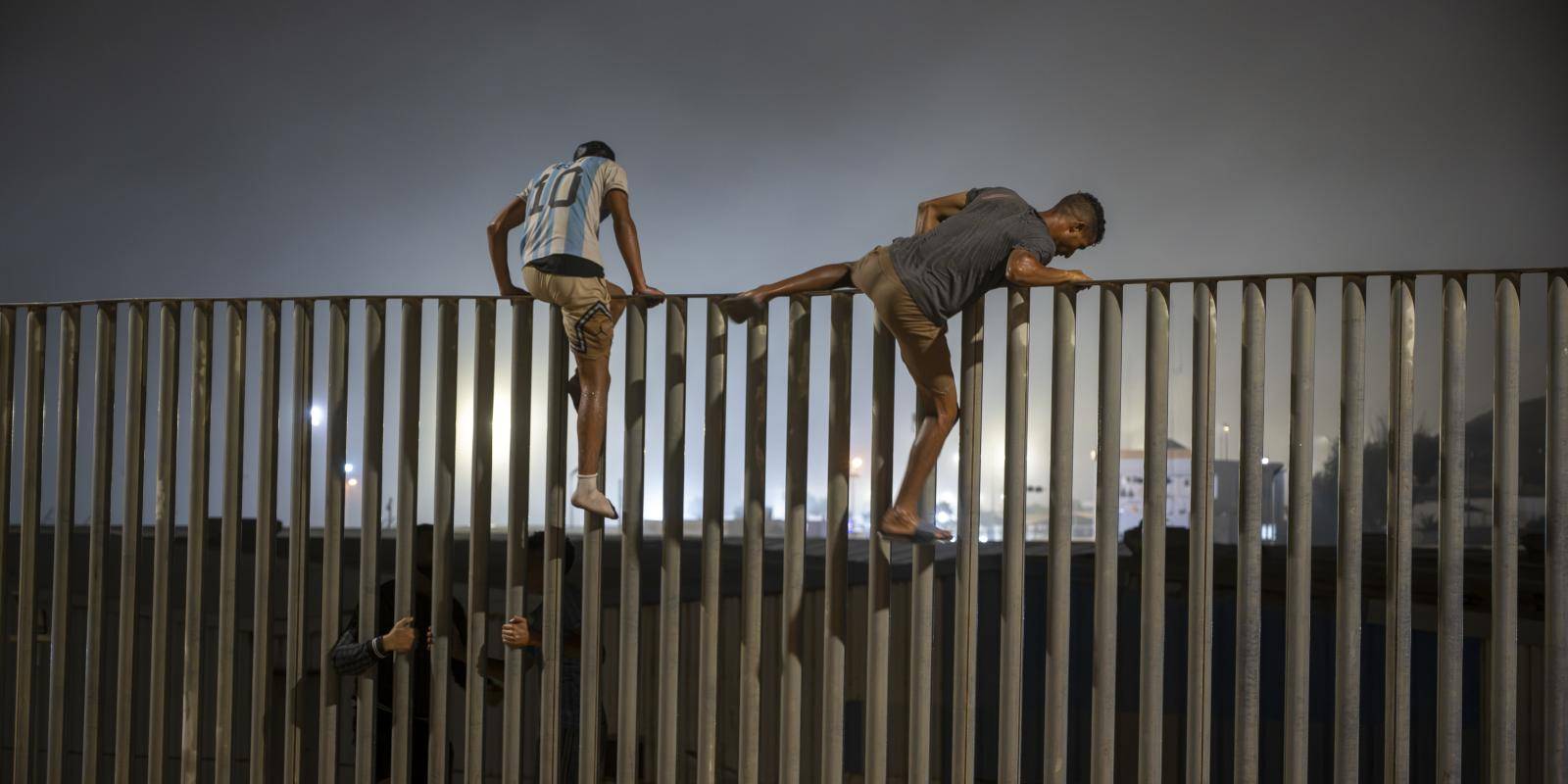

On 30 July, the border between Morocco and the North African Spanish enclave of Ceuta effectively collapsed. Spanish officials put the number crossing within 24 hours in the tens of thousands, perhaps as many as 50,000. Ceuta’s population is around 85,000.
At least 57 people are reported to have died in what has also become a humanitarian crisis. Spain has deployed the armed forces to support the Guardia Civil, and Prime Minister Pedro Sánchez has travelled to the city. Dramatic images have flooded the media. Some European governments have suggested suspending the Schengen agreement or for Spain to be removed from it. On Friday, Italy unilaterally ordered the closure of its sea and air borders with Spain.
Many in Spain blame the Moroccan government for the crisis. Morocco has never publicly acknowledged using migration as an instrument of pressure against Spain. In this case, Moroccan government sources have blamed ‘criminal organizations’. Indeed, publicly Sánchez has used similar language.
But those who accuse Rabat say surges of migrants into Ceuta and Melilla (Spain’s other enclave on the African continent) have a habit of arriving when Rabat wants Madrid to understand the importance of maintaining good relations – and then of subsiding again once that point has landed.
Whatever the truth, the situation has created a diplomatic crisis – and could see immigration become a leading issue in Spain’s general election next year.
A source of contention
Ceuta and Melilla are Spanish enclaves on the North African coast, forming the EU’s only land border with Africa. Morocco does not recognize Spanish sovereignty over the territories and has long demanded their return. They have been a source of contention in Spain–Morocco relations for decades.
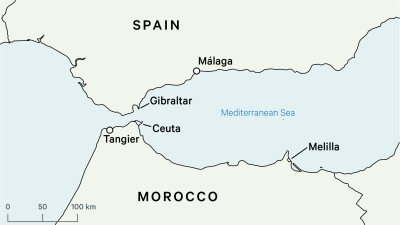
Made with Natural Earth data.
In May 2021, roughly 8,000 people entered Ceuta over two days. At the time, Rabat was furious that Madrid had admitted Brahim Ghali, leader of the Polisario Front, (a Western Sahara nationalist group) for medical treatment – Rabat considers the Front to be a terrorist organization.
Within months, Spain had abandoned its historic position on Western Sahara – supporting an independence referendum – and instead endorsed Morocco’s autonomy plan for the territory. The lesson for Rabat, perhaps, was that pressure on Spain’s enclaves works.
This latest incursion occurred within days of a considerable thaw in Spanish-Algerian relations. Sánchez was in Algiers on 20 July, continuing the patient repair of a relationship that Algeria severed in 2022 because of Spain’s adoption of Rabat’s position on Western Sahara. There were promises of another Spain-Algeria summit in the autumn. Sánchez also discussed increasing gas supply through the Medgaz pipeline, which circumvents Morocco and runs directly from Algeria to Spain.
Election arithmetic
It is noticeable too that this latest incursion arrives as the countdown begins to the Spanish general election, which must be held by August 2027.
Sánchez is under severe political pressure. The parliamentary arithmetic was already looking precarious. There are suggestions that Catalan support for his government may be collapsing. The right-wing Catalan separatist party Junts has been overtaken in Catalan polling by Aliança Catalana, Sílvia Orriols’s hard-right party, which barely registered two years ago and has now surged in the polls. Junts still holds the votes that Sánchez needs to avoid losing a vote of no confidence and triggering an election. Might the anti-immigration Junts seize the opportunity to plant a flag? Might it even go so far as to bring the government down?
That raises the most consequential question: what issues will define the next election? Sánchez has a strong economic story to tell, with growth outpacing most of the eurozone.
But in June the prime minister launched a controversial regularization scheme, which seeks to grant legal status to several hundred thousand undocumented migrants. The dramatic images seen in Ceuta have shocked many in Spain and could see immigration eclipse the economy as the leading issue for voters.
Alberto Núñez Feijóo, leader of the centre-right Partido Popular opposition party, has already called Ceuta a national security crisis. Santiago Abascal, leader of the hard-right Vox party, has laid the crisis at the prime minister’s door, blaming his regularization scheme directly.
The international right has moved quickly too, highlighting the wider risk to European cohesion. Besides closing Italy’s sea and air borders with Spain, Giorgia Meloni has suggested suspending Spain from the Schengen free travel zone.
Finland’s interior minister has endorsed the Italian position on Schengen and called on other member states to follow, arguing that a country failing to protect the external border cannot remain in Schengen. Neither country shares a land border with Spain, let alone with Ceuta.
The situation is a challenge to the free-movement settlement of a kind not seen since the 2015 crisis, whose reverberations included the UK’s Brexit referendum the following year.
Washington has, of course, joined in. The Department of Homeland Security tweeted: ‘If Spain had their own President Trump, this wouldn’t be an issue. Citizens of Spain should take that into consideration.’ Elon Musk has further fanned the flames, tweeting multiple times, sharing clips of the 2013 Hollywood blockbuster World War Z, a film about a zombie apocalypse.
The response
Europe answered the 2021 Ceuta crisis clearly, quickly and with solidarity. The Commission’s position was that Ceuta’s frontier is a European border and the incident was a breach of Spain’s – and Europe’s – sovereign territory. That was the correct answer then, and it is the correct answer now.
Whatever the reason for the crisis, it will remain a collective problem for the EU. Treating it as a Spanish failure, and reaching for the suspension of Schengen, only assists those who would welcome more strain on the European project.
The crisis could seriously undermine Sánchez’s position. He now needs to persuade the Spanish people and European allies that this crisis was not related to his wider immigration policy, and convince them that a unified front is required. Above all, he must try to ensure others do not follow Italy’s lead.