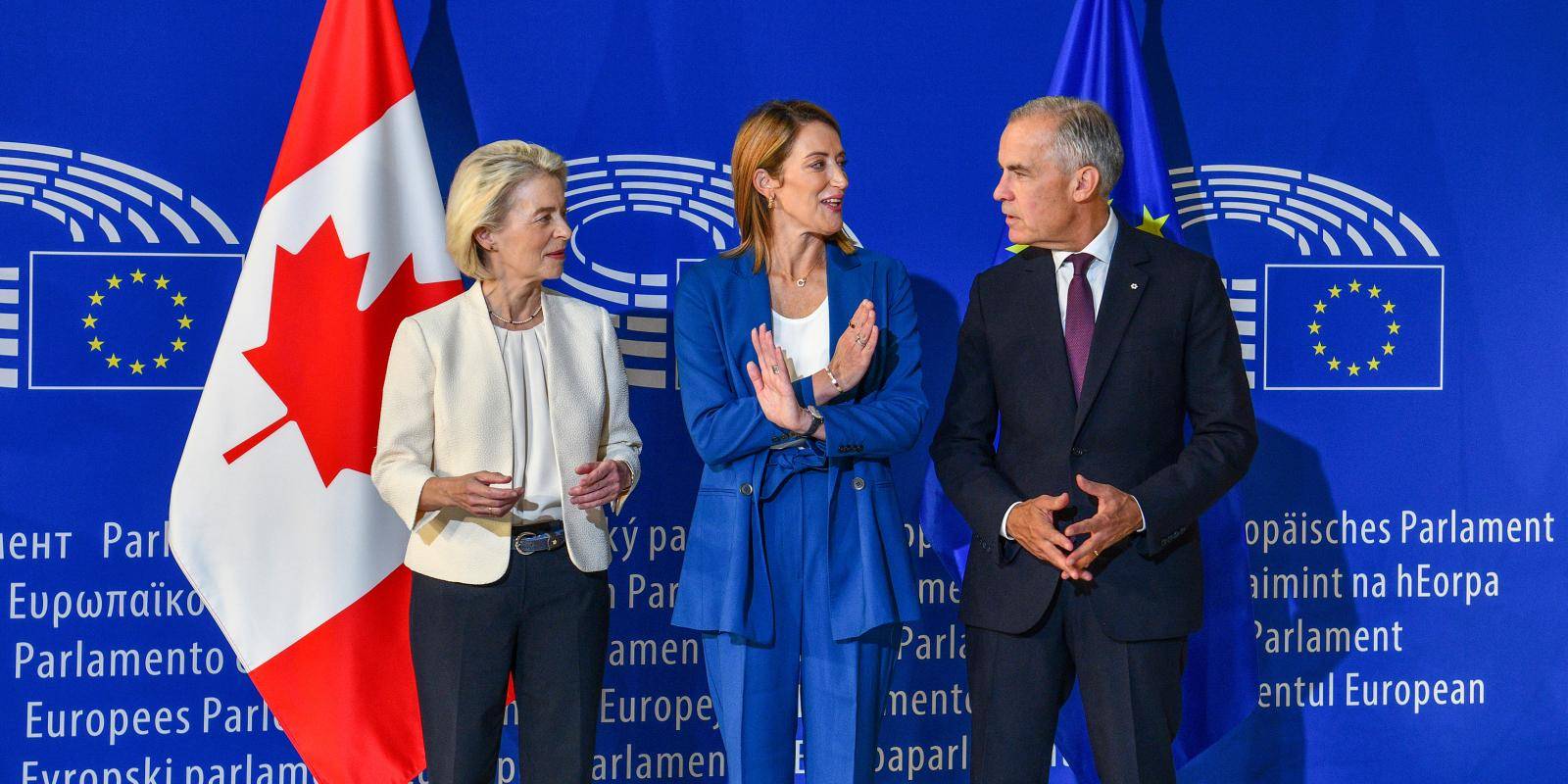

There is something rather extraordinary about the geopolitical times we live in. They are making what seemed impossible yesterday possible today, and what once sounded laughable increasingly credible. This week’s proposals for closer integration between Canada and the EU undoubtedly belongs to that category.
On 16 September, European Commission president Ursula von der Leyen proposed making Canada the EU’s first ‘associate member’. The next day, Canadian prime minister Mark Carney used his address to the European Parliament to set out an unusually ambitious programme of economic and strategic integration.
Canada and Europe, he argued, should cooperate across critical minerals, defence production, artificial intelligence and computing, energy, space and payments. They should move towards ‘seamless’ digital trade in non-agricultural goods and services. And they should expand opportunities for young Canadians and Europeans to live, work and study across the Atlantic. Canada also eyes access to the EU’s Horizon research programme.
If the concept of associate membership is yet to be properly defined – starting with meaningful legal substance – Carney’s address gave it discernible geopolitical purpose. His argument rests on a lesson he has repeated since his Davos speech in January 2026: excessive economic concentration creates vulnerability. And only diversification can restore room for political choice. In Carney’s own words in Strasbourg: ‘The objective is not self-sufficiency. It is collective resilience.’
That logic applies to both sides of the Atlantic. Canada remains extraordinarily exposed to the United States (US), which takes roughly seven in ten Canadian exports. The EU has its own dependencies – including on US technology and security capabilities, Chinese supply chains and, of course, energy imports.
In this context, both sides of the Atlantic see partnership as a timely opportunity. Seen from Brussels, Canada has much to offer: energy, minerals, Arctic reach, investment capital and advanced capabilities in areas including AI, quantum and space. Seen from Ottawa, the EU also brings a lot to the table: a single market of 450 million consumers, a still strong industrial capacity, world-class research networks and considerable regulatory power.

This momentum did not suddenly emerge this week. But the Carney and von der Leyen speeches moved the conversation a step further, giving stronger political expression to a relationship that has been deepening for some time. In June, for instance, Canada became the first non-European country formally brought into procurement under the EU’s €150 billion Security Action for Europe (SAFE) defence instrument.
The relationship is clearly strengthening well beyond trade. It now connects industrial policy, defence production, technology and economic security in ways that the EU has rarely attempted with a non-European power, Japan being probably the closest precedent.
A transatlantic hedge more than a new bloc
Donald Trump’s swift reaction indicates the extent to which the notion of Canadian associate membership really matters. The US president described the prospect as potentially a ‘hostile act’ and threatened heavy tariffs on Europe if Washington concluded that the initiative was directed against the US. Carney responded that Canada would determine its own international partnerships.
Yet Carney was equally explicit that he is not seeking to construct a rival geopolitical bloc. His proposal might be better understood as an attempt to give countries exposed to great-power economic pressure greater freedom of action. In a way, this model resembles what architects would call ‘coupling without fusion’: two structures that reinforce one another against external pressure but retain their own foundations.
Canada cannot realistically detach its economy from that of the US. Nor can Europe dispense with the transatlantic security relationship at this stage: the recent trip of the German defence minister to Washington would even indicate the opposite. The purpose here is to reduce specific dependencies on partners like the US while remaining allies.
If it works, the implications could extend well beyond Canada. Von der Leyen has separately proposed a European Security Council involving partners including Canada, Britain, Norway and Ukraine. Carney himself described the Canada–EU arrangement as potentially open to other democracies. All those ideas point towards a looser outer architecture around the EU, where countries participate selectively in European structures without becoming member states.
In this configuration, the EU would remain the constitutional core of a wider system of concentric circles. Associated countries would be integrated into selected markets, programmes and security structures without acquiring the political rights reserved for members.
The law has yet to catch up with the politics
Nevertheless, at this stage the ‘associate member’ status remains a political expression rather than a legal category. Article 49 of the Treaty on European Union says that any European state may apply for EU membership. Canada does not meet that geographical requirement.
Creating a formal new category of membership with institutional rights – representation in EU bodies, for example – would therefore require treaty revision. Under Article 48, amendments ultimately require ratification by every member state according to its procedures. That makes genuine constitutional ‘associate membership’ a very ambitious undertaking.
There is, however, an easier route. Article 217 of the Treaty on the Functioning of the EU does permit agreements with third countries establishing an association based on reciprocal rights and obligations, common action and special procedures. Such association agreements require unanimity in the Council and the consent of the European Parliament. Brussels and Ottawa could therefore deliver most of what Carney envisages without embarking on the long and painstaking journey of treaty revision.
Politically, such an option could suit Canada better. Carney stressed after his speech that sovereignty would be preserved and that any final arrangement would be put to a vote in Canada. He also played down the importance of what Brussels eventually calls it. The difficult negotiations would concern regulatory alignment, market access and reciprocal obligations rather than the ‘nomenclature’.
In Canada, opposition is already visible. Pierre Poilievre’s Conservatives support trade and defence links with Europe but have warned against EU taxation, legislation or free-movement rules applying to Canada. And they argue that Parliament must scrutinize any transfer of authority.
In Europe, diplomats have questioned what associate membership would mean and noted that von der Leyen’s proposal had not been agreed with the member states beforehand. EU candidate countries could also reasonably ask why Canada should receive privileged access while they undergo years of regulatory and political reform to qualify for membership.
But the immediate warning sign is more tangible. Ten EU member states – including France, Italy, Poland, Belgium and Ireland – have still not ratified the Comprehensive Economic and Trade Agreement (CETA), nine years after its provisional application began. That unfinished business points towards the political challenges ahead. How likely are EU member states to reach agreement on Canada’s associate membership when a simple free trade agreement struggles to secure full ratification?
CETA would be the best framework available to provide the commercial foundation of a new Canada–EU association. Defence cooperation through SAFE already offers a template for selective participation in EU instruments. Negotiations would now need to proceed on digital trade, research, student and youth mobility, critical minerals and energy. Institutional arrangements would then gradually build around them.
To borrow an apocryphal line from Lenin, there are decades when nothing happens and weeks when decades happen. These past few days in Strasbourg may come to be remembered as one of those moments when history accelerates.
The EU and Canada are testing how far integration can be achieved between countries that want greater strategic independence without merging their political institutions. Success could have implications far beyond the Atlantic. One conclusion can already be drawn, however: another kind of transatlantic relationship is possible.