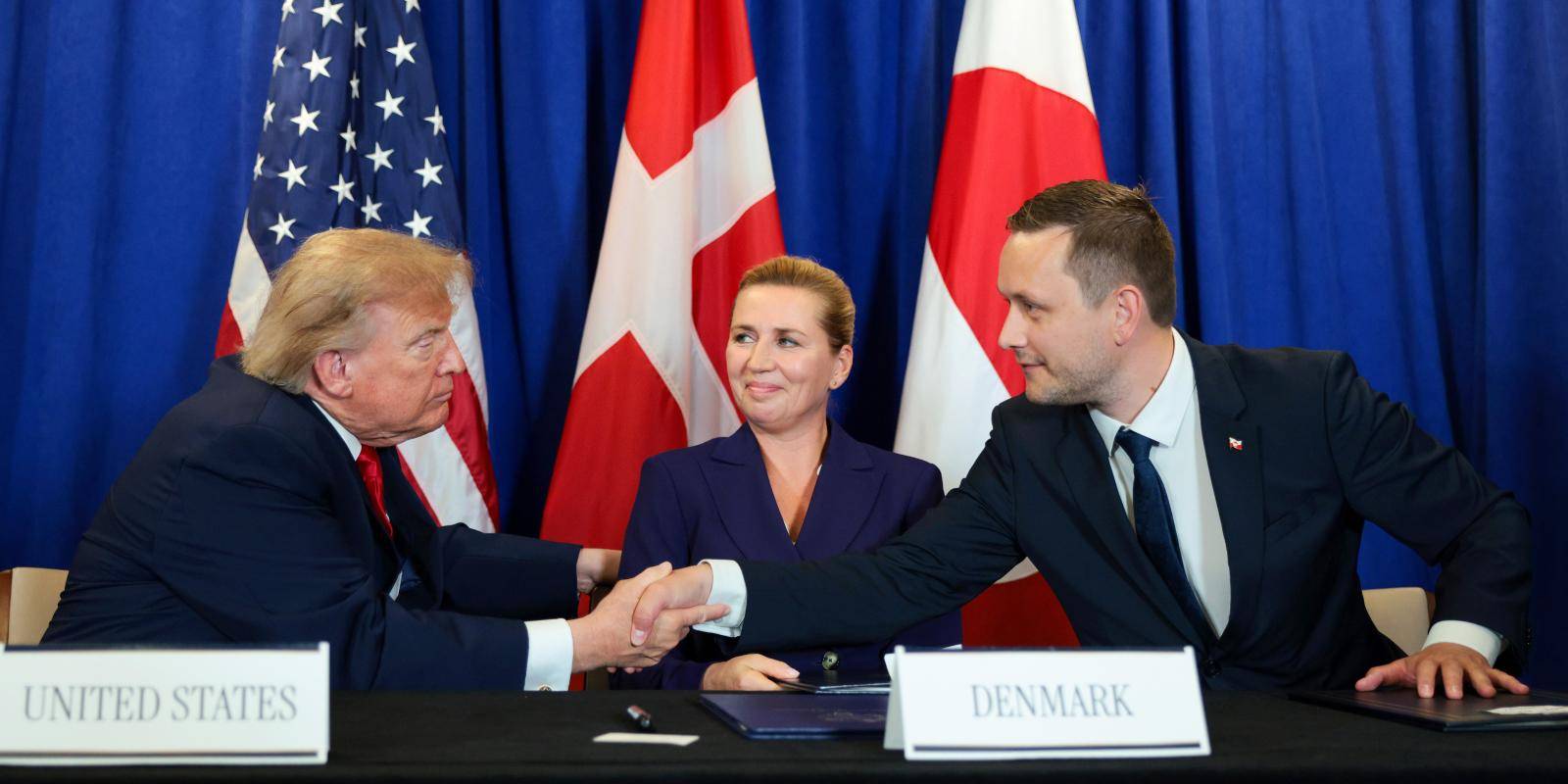

This week, Denmark has extricated itself from a period of coercive US diplomacy over Greenland. The agreement announced on 22 September elegantly resolves the dispute over the territory, without forcing Denmark or the government of Greenland to give up very much.
Even before the dispute, Denmark had indicated it would be content to increase the number of US bases in Greenland and enhance US access to them. These measures were already possible under an existing 1951 agreement.
The new agreement adds an undertaking by Denmark and Greenland to refuse major investments from non-members of the EU or NATO that would grant them a foothold in strategic Arctic areas. Again, on this point, Washington was pushing on an open door.
The only meaningful change concerns the mechanism to ensure that this arrangement will be permanent. The 1951 agreement, amended in 2004, also does not expire. But the new text adds that Greenland will remain part of NATO and continue to comply with the agreement, should it opt for independence.
An independent Greenland might have been willing to retain the US bases and related agreements anyway. After all, it would need to rely on US defence support and a NATO security guarantee. But expressly making these points in an agreement co-signed by Greenland overcame the deal-breaker of President Donald Trump’s demand for sovereignty over all of Greenland or at least the US base areas.
The agreement represents a masterclass by Denmark in using the classical art of diplomacy to overcome bullying, in an age of changing geopolitics and unstable global governance.
Indeed, the steps Denmark took to resolve the dispute provide valuable insight into how countries can defend their interests in the face of apparently overwhelming pressure.
Step 1: Isolate the bully and call the game
In January this year, President Trump declared that the US would need to ‘own’ Greenland to prevent Russia or China from taking it, and to ensure US national security. He even raised the option of a military takeover of the territory.
The president may have believed opposition would be minimal. Just days before, EU and NATO countries had been unwilling to confront him publicly over the armed US intervention against Venezuela, despite it being a clear breach of international law. In the emergency meeting of the UN Security Council that followed, they had stayed meekly silent.
Greenland was different. Denmark could clearly assert that Trump was placing the future of NATO in peril. Hence, Denmark could show that the US action posed a threat to both the territorial integrity of Denmark and to the security of all states in Western Europe. Accordingly, NATO countries and EU members overcame their hesitancy to upset the White House, and strongly and unanimously rejected his demand. Indeed, they went further, dispatching a European defence mission to Greenland, supposedly as a matter of routine.
Calling out the US’s game for what it was – a demand to surrender national territory under the threat of force at a time when the West was resisting Putin’s assault on Ukraine – was crucial in rallying support.
Step 2: Enter the fray with clean hands
In this dispute, Denmark continually had the advantage in the battle for international sympathy. It entered the fray with clean hands, taking advantage of its soft power, which has been nurtured over decades of sensitive advocacy for justice in relation to the Global South and the international rule of law. The US under Trump, on the other hand, has caused continued upset throughout, as a result of its military actions and other activity such as the president’s sweeping ‘Liberation Day’ tariffs.

The US could also not accuse Denmark of hypocrisy over any supposed colonial legacy relating to Greenland. By 1954, the UN General Assembly had determined that Greenland had freely decided to integrate with Denmark on the basis of equal constitutional and administrative standing with other parts of Denmark.
By 1979 Copenhagen offered home rule. Two decades later, in 2009, it granted wide-ranging self-government to Greenland. Crucially, this 2009 arrangement included an express right of self-determination for the people of Greenland, with a provision to opt for independence. Any sale of Greenland (as Trump had previously proposed) or its transfer to the US against the wishes of the population, would have violated this existing right to self-determination.
This meant that throughout the dispute, Denmark could claim a role as both the upholder of the international right to self-determination, and the defender of its own territorial integrity.
Step 3: Clarify the legal status
President Trump sought to enhance his claim by suggesting that Denmark did not have a clear title to Greenland. In view of the 2009 agreement’s self-determination provisions, this assertion became less relevant. In any event, it was easy to prove that Denmark held good title. And the US clearly had none at all.
In 1916 US Secretary of State Robert Lansing issued a declaration accepting Denmark’s claim to the island. When the US took over the defence of Greenland during Germany’s occupation of Denmark during the Second World War, it did so in ‘recognition and respect for the sovereignty of the Kingdom of Denmark over Greenland.’
This expressly included Danish sovereignty over base areas constructed by the US. The post-war agreements on defence cooperation and US bases of 1951 and 2004 also consistently confirmed Danish sovereignty. Indeed, in an amazing reversal of the US position, so does the new 2026 agreement. The text reaffirms the sovereignty and territorial integrity of Denmark and acknowledges Greenland’s right to self-determination.
Step 4: Dial the temperature down and let experts do the work
When encountering the US, Denmark was careful to avoid a public confrontation with Trump in front of cameras, learning from President Volodymyr Zelenskyy’s experience at the Oval Office in 2025.
Instead, when the row intensified, Copenhagen dispatched Foreign Minister Lars Lokke Rasmussen to Washington. As foreign minister, protocol demanded that he should meet with the slightly more moderate US Secretary of State Marco Rubio, instead of the president.
Vice President JD Vance almost derailed this cunning plan when he insisted on leading the meeting and moving it to the White House. But Rasmussen, a former Danish prime minister, calmly focused on shared security interests in the Arctic. And he remained steadfast where sovereignty and the rights of Greenlanders were concerned.
After a supposed breakthrough on the issue at the Davos conference later in January 2026, Denmark managed to divert dialogue to technical meetings, held confidentially, outside of the public eye. This was the critical change that allowed Copenhagen to defang the entire episode.
Step 5: Focus on interests, not positions
Negotiations experts know that success depends on persuading the sides to step away from their incompatible, publicly stated position and instead address their underlying interests. In this instance, President Trump had claimed that only full sovereignty over Greenland would answer US security needs.
At Davos, NATO Secretary-General Mark Rutte offered the US sovereignty at least over its base areas in Greenland. Trump seized that initiative and accepted, withdrawing his threat of invasion.
However, neither Denmark nor Greenland representatives had been party to that proposal. Handing over even a part of sovereign territory would hardly be acceptable to their parliaments.
But in the technical discussions, it became possible to move from a flat-out demand for sovereignty, to achieving the underlying US desire: a permanent arrangement safeguarding its interests in Greenland.
Step 6: Be generous in victory
On signing the agreement, Danish Prime Minister Mette Frederiksen was careful to avoid any sense of climb-down by President Trump. It is a deal that can ‘last forever,’ she said, reflecting Trump’s claim that he had achieved an outcome just as permanent as a transfer of sovereignty.
As President Trump’s original stated position was that ‘the ownership and control of Greenland is an absolute necessity’, this new agreement seems a clear victory for calm and quiet Danish diplomacy. And it plainly illustrates the power of unity among NATO states and EU members. The lessons for future dealings with great powers are clear.