

Americans go to the polls on 3 November to elect a third of the US Senate and all the House of Representatives.
The Republicans currently have majorities in both chambers of Congress. But their prospects of retaining this control look increasingly dire.
The Republicans’ chances have been dragged down by President Donald Trump’s near-record low public approval rating and voter dissatisfaction with his handling of the Iran war and the economy, among other things. Democrats appear poised to take advantage, with most pundits suggesting they will retake control of at least the House of Representatives.
But the race is not over yet. In the end, the key factor will likely be turnout, which is historically lower in midterms than presidential elections. Whichever party better mobilizes their voters to turn up on election day will ultimately determine the outcome.
Democrats are strong favourites
At this point, this election is the Democratic Party’s to lose.
Republicans currently hold a narrow majority in the 435-seat House of Representatives. To control the House, which gives a party the ability to name chairmen of committees and set the legislative agenda, the Democrats will need to win at least 218 seats. They currently have 212 seats.
Due to polarization and redistricting, most seats are highly unlikely to change party. Election analysts estimate that only around 21 House seats are close contests or ‘toss-ups’. Still, most pundits forecast Democrats winning between 220 and 230 seats overall – a relatively comfortable majority.
Senate more challenging
The Democrats face a more difficult challenge recapturing the Senate. Republicans now hold 53 of the 100 seats. Given that the vice-president can cast a tie-breaking vote in the Senate, the Democrats will need to win four seats (and not lose any they currently hold) to gain control of the Senate.
They are likely to pick up a Senate seat in North Carolina, where the state’s former two-term Democratic governor, Roy Cooper, has a significant lead in the polls. Then things get harder for the Democrats.
They need to win contests in three other states currently represented by Republicans. Current polling suggests their best chances are in Alaska, Maine, Ohio, Texas and Iowa.
Public opinion surveys show all five races to be toss-ups. But the Democrats also need to defend a Michigan seat that is considered a toss-up, where the incumbent Democratic senator is retiring in a state Trump won in 2024.
If the national tide swings heavily in the Democrats’ favour, they could gain control of the Senate. But that is less likely than their chances of winning the House.
Public dissatisfaction
Public opinion has been generally downcast ahead of the election. Two-thirds of those surveyed in May think the country is headed in the wrong direction. A July survey found only about a quarter of the public think the economy is doing well, with concerns over the cost of healthcare, food, housing and gasoline. Most recently, a majority said going to war with Iran was the wrong decision.
More registered voters think the Democrats would do better than the Republicans in dealing with gas prices, the economy, and foreign policy.
Democrats also have a 6 to 14 point advantage in nationwide polls of voter intentions known as the ‘generic ballot.’ This question measures party popularity by asking a selection of registered voters nationwide which party’s candidate they intend to vote for, without naming specific candidates. Historically, the generic ballot is a key indicator; the Democrat lead suggests a majority on election day.

Moreover, in the last five midterm elections, there has been a change in control of at least one chamber of Congress. And only four times in the last 164 years has the president’s party gained seats in a House of Representatives midterm election.
Voter turnout in midterm elections is usually relatively low compared with presidential elections: averaging less than 50 per cent compared to roughly 60 per cent. Voter enthusiasm will therefore be a big factor in maximizing turnout. Polls suggest Democrats are more motivated to vote: 79 per cent of Democrats said they are extremely motivated to vote, compared with 69 per cent of Republicans.
The Trump factor
Looming over all of this is voter opinion about President Trump, the ever-present force in current American politics.
The most recent Reuters/Ipsos poll has Trump’s approval rating at 32 per cent, a new low for him, with a disapproval rate of 66 per cent.
Other recent polls have shown Trump’s approval rating ranging from the mid-30s to low-40s; a recent YouGov poll put it at 37 per cent. But a recent poll by the American Research Group, conducted 16–20 September, showed the president with just a 29 per cent approval rating – the first time it has dropped below 30 per cent.
Historically, presidential approval matters in congressional elections. For context, Trump’s ratings are significantly lower than either President Bill Clinton’s in 1994, when the Democrats lost 54 House seats and 8 Senate seats, or President Barack Obama’s in 2010, when Democrats lost 63 House seats and 7 Senate seats.
Majorities disapprove of how Trump is handling all major issues. And a plurality of registered voters, including a majority of independents who make up about a third of the electorate, say their vote in the congressional election is ‘mostly against Trump’.
The potential impact of Trump’s low approval on the November outcome has led Charlie Cook, a leading political analyst, to observe not a ‘blue wave’ but the effects of a ‘red undertow.’ Either way, Democrats appear well-positioned to take advantage of disapproval with Trump to make congressional gains.
Caveats
But as with any forecast, there are caveats. While Democrats may be more motivated to vote overall, polling shows that 83 per cent of Republicans who strongly support President Trump claim they are absolutely certain to vote in November. Moreover, Republicans have the advantage of much larger finances as they try to mobilize their voters.
The electorate is also more polarized between Republicans and Democrats than at any time in recent history. And congressional gerrymandering means that there is a relatively small margin of error for Democrats.
So, despite the various factors that point to a Democratic victory in November, the election could still tighten.
Not over yet
Ultimately, voters decide elections, not pollsters. And recent election polling has repeatedly underestimated Republican support, as Hillary Clinton and Kamala Harris learned to their dismay.
Historically, American voter intentions are unlikely to change this close to election day. But US elections are also notorious for October surprises: the deepening financial crisis in 2008 and developments in the Hillary Clinton email probe in 2016 are just two examples.
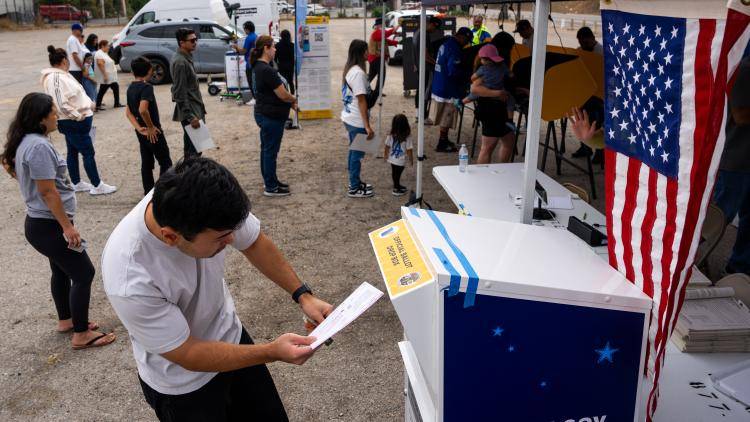
It is also possible that 4 November will dawn without a clear victor. The president’s previous challenging of election results and processes, for example with regards to postal votes, could mean potential disputed outcomes and court challenges. This could delay final results for days or weeks, further undermining the reputation of American democracy.
Polls suggest the Democrats are poised to win the US House and possibly the Senate. But, as the American baseball player Yogi Berra once said: ‘It ain’t over till it’s over.’