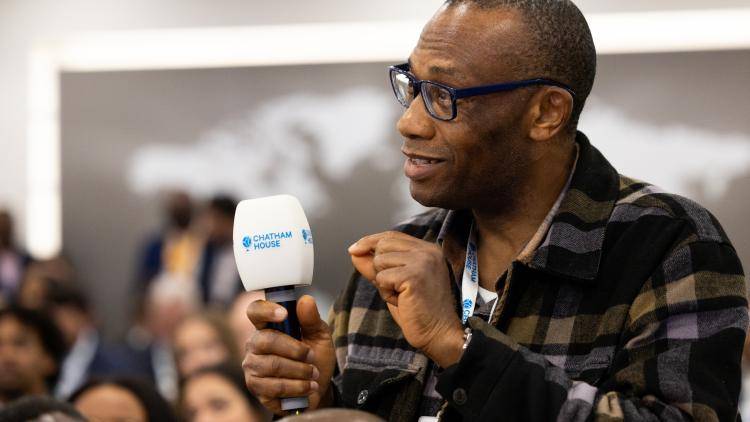
Bronwen Maddox, Director and Chief Executive of Chatham House,described a world of two superpowers whose competition for power ‘is a threat to the peace and prosperity of others’ before being interviewed by journalist Matt Frei and taking questions from the audience.
You can watch the full event in the video above. Here is the text of the lecture:
Chatham House Director’s Lecture 2026
So. Iran. Venezuela. Greenland. The Federal Reserve. It has felt like the week where decades have happened, to appropriate what Lenin is said to have said.
Never mind how much has changed in the past year. When I gave this talk a year ago, it was two weeks before Donald Trump became president for the second time. It was also one week before China released DeepSeek, showing that it was the equal of the US in artificial intelligence.
Most attention has gone on the first, inevitably. We have had from President Trump what amounts to a revolution. He has given the US a radically new role in the world and – at the 250th anniversary of the Declaration of Independence – a role that rejects the principles on which the US was founded: that government should be accountable to the people. He has dismissed international law and the interests of old allies. It is not grandiose to call this the end of the Western alliance.
On China’s side, though, we have also had hugely significant change. We have had rising military aggression around Taiwan, Japan and the Philippines, support of Russia in its war against Ukraine and Europe, and a strategy of dominating world trade in key sectors with little interest in buying others’ products. When President Xi Jinping met President Trump in October it showed that China could force the US to back down over tariffs by threatening to withhold critical minerals, where China commands more of the global supply than the White House had cared to notice.
So this year has clarified what we face. We are in a world of two superpowers, in rising competition with each other. Each says it does not want a war with the other, but the possibility is not zero and it would be catastrophic for the world. Even without that, though, their competition for power is a threat to the peace and prosperity of others. In the case of the US’s allies, they must now contemplate what was unthinkable: to have to defend themselves against the US itself, in trade and perhaps security.
This messy world does offer opportunities, I should say. For countries that are not superpowers there is a chance to play both sides, a reason to make new alliances and pacts, a way to get access to new technology. But there is also a chance to stand up for principles that the superpowers are shredding and to reaffirm those in their own name. That effort is worth making and it drives much of Chatham House’s work.
I am going to talk about three things.
First, China: how it has moved ahead in key parts of the technology race and the challenge that presents.
I’m then going to talk about the US and the implications of Trump’s actions. But I’m going to spend most time on how others should respond – how to protect their own interests, how to work together to salvage international order. Even – we should not be embarrassed about the value of this – an order based on liberal values, the respect for law and individual rights. Europe is failing that challenge and the UK making a muddle of it. Others are doing better.
China
So let me start with China. The US has never had a rival like China: its equal or more in technology, trade and military power.
As James Kynge, our Senior Research Fellow puts it: ‘The era of China as the world’s leading tech power has arrived.’ At Chatham House, we have built up a superb China team precisely because the decisions made by China affect all our work. James adds that ‘in industry after industry…Chinese manufacturers are making cutting-edge technology at prices that western competitors cannot match’.
In just a few years, China has become the leading exporter of electric vehicles. It’s not just those, solar panels and turbines; you can see the same happening in pharmaceuticals, batteries, 5G telecoms, factory automation and shipbuilding.
China has spent decades pursuing this supremacy through mineral deals, loans, sending students around the world, keeping its currency low. And without question through theft of intellectual property.
In 2023, the heads of the intelligence agencies of the ‘Five Eyes’ countries – that’s the US, UK, Canada, Australia and New Zealand – together accused China of intellectual property theft. But it would be quite wrong to take comfort from the delusional mantra you still hear that China can only adopt others’ technology – it has emphatically proven it can invent the best itself.
China’s progress may not be sustainable; the economy has plenty of problems. Competition is ferocious, often driving manufacturers into losses even if the state-owned banks maintain support. And President Xi warned about this in July. Pressure from the middle class for a rise in living standards – most easily achieved by letting the currency appreciate further – may slow down exports. A demographic crisis is looming as the population falls. But for the moment, China is a powerhouse of cheap exports to the world with not much interest in reciprocal trade.
What does China want? As our Dr Yu Jie has written, he wants domination of China’s region, self-sufficiency in technology and the dependency of other countries. It is fair to say China seeks the destabilising of the West including allies such as Japan, hence its support to Russia over Ukraine in supplying drone engines and buying oil. And while President Xi has said he supports global governance, he wants emphasis on sovereignty more than human rights and a greater role for China in world institutions where it is very successful in steadily placing more officials. Yet it is striking where China chooses not to get involved. It wants to invest in the Middle East, not broker an elusive peace; exactly the same in Ukraine. It presents a rival to US power without mimicking it, one reason the US has been so confused in how to respond.
The US’s choice of role in the world
So let me turn to the US, that magnet of all conversations at the moment. Trump has brought his unique character to his second presidency. His son Donald Trump Jr, at the Doha Forum in December, praised ‘my father’s unpredictability’ which he called the ‘best thing about him’, a view not shared by the entire world. It is not just the improvisation, though, that has been disruptive: it is the pursuit of what Trump determines to be in the US’s interest, without principle.
This does mark the end of the Western alliance: that is, a group of countries confident they share not just interests but principles of individual liberty, intellectual and religious freedom, constitutional democracy and free trade – principles which have been the engine of their prosperity as well as the rationale for their global influence.
In the past year the US has levied higher tariffs against allies than rivals. The administration has eloquently disparaged Europe, from the Vice-President in Munich to Trump’s own attack on “weak” and “declining” countries and the National Security Strategy’s prediction of “civilisational erasure”. The administration has often taken Russia’s view of its invasion of Ukraine. Most recently, it has attacked Europe and the UK over supposed infringement of ‘freedom of speech’, equating the US’s interests with those of its tech giants. Not enough is made either of the monetisation of the presidency, a threat to the long-term reputation of US institutions.
Most profound, we have had the rejection of principles of international law that the US helped forge – even if it often declined to apply those to itself. Venezuela brandished that rejection to the world, followed by the President’s intention to acquire Greenland. That is a flagrant offence against the UN Charter and if he did so, acquire Greenland by using force, it would be the end of NATO. Members of the world’s most successful military alliance are already forced to contemplate how they might have to defend themselves against its most powerful member.
Trump is right on some things. He has won the case on Europe’s defence spending. He is right, too, about the unaffordable welfare states of many European countries including the UK. Although countries of southern Europe and Ireland which went through financial shocks have done better in facing hard political and economic choices, the predicament of France, Germany and the UK now provokes alarm or contempt, depending on your philosophy.
Trump is right, too, about voters’ concerns about immigration. And he is right to try to use the US’s power to resolve wars. His attack with Israel on Iran’s nuclear facilities brought relief to quite a few of Iran’s neighbours, even if they didn’t say so.
He is deeply wrong about many things, though, and he is weakening the US because of it, accelerating its loss of power to China.
The first mistake is to think that the US will prosper from scrapping the world it helped to build. He is probably wrong on the economic impact of tariffs: inflation has so far been lower than predicted, but the unemployment rate is close to the highest for four years and affordability – cost of living - is the big issue in this year’s mid-term elections. The risk of a financial crisis if the world loses confidence in US institutions is rising – enormously more since the Department of Justice’s decision this week to bring a criminal case against the chairman of the Federal Reserve. In the end, shielding US companies – particularly technology ones – from competition may undermine the very factors that made the US economy great.
Even though the US identifies China as its great rival it makes profound mistakes in trying to counter it. The National Security Strategy wrongly assumes the US can prise Russia away from China; Russia is too dependent on China, nor does Beijing want to cede that control. The strategy says the US doesn’t want conflict over Taiwan but the US immediately sends more arms, provoking China’s military harassment of the past two weeks. By scrapping President Joe Biden’s $400bn federal investment in green technology, Trump handed China the advantage in a booming global market. By launching tariffs against India and Vietnam, he drove them closer to China.
Above all, Trump is wrong to think the US can jettison rules and alliances with no consequence to itself. The only time that Nato’s Article V on mutual protection was triggered was to help the US after 9/11. Peace-making without principles does not work, as Ukraine and Gaza are showing; without a commitment to values, the aggressor will know there is a limit to the stamina of those trying to end the conflict. Venezuela and remarks about Greenland are not just precedents which China and Russia will cite, though they will. They have a global, insidious effect, encouraging many malign players to see how far they can get without retribution.
The world should assume that much of what Trump has done will stick. Because it will not snap back, because it is what many Americans want, or because trust is gone. Despite what Mike Pence and John Kerry both said this autumn – not on the stage together – this autumn at Chatham House in defence of the ability of US institutions to constrain the president, the world’s most famous Constitution has been shown to be just words if the president does not respect them. The courts cannot move quickly enough to counter presidency by Sharpie pen – in the past year Trump has signed more executive orders than the 220 he signed in the whole of his first term.
There are other constraints on executiive authority of course - Republicans in Congress are speaking up a little bit more, provoked by falling poll numbers. The markets may decide they don’t want to lend the US money so cheaply if its institutions are weak – and that is a threat that the administration is taking too lightly, in my view. Most important, there are voters: the mid-terms will show what they want – and whether the president will accept their verdict. These are all questions that Laurel Rapp, who has joined Chatham House from the State Department to lead our US work, is now analysing.
But the consequence for the moment is that we have been thrust into a world with torn up rules, at huge economic and human cost.
There are some opportunities in this world, I should say. Bigger countries are playing both sides: Indonesia, Brazil, South Africa, India are making an art of non-alignment and selective cooperation, as the jargon has it.
But even if some are thriving, many say to us they want some rules. Those who have accused the west of double standards for years don’t want no standards. Advancing some kind of order, in private talks, in mediation, in policy proposals, with many countries involved including the Global South, that is at the heart of what Chatham House is now doing.
So here are three points, then, about how the world should respond.
Defend institutions and create new ones
The first one is to defend existing institutions and to create new ones. Don’t give up on the United Nations, I would say. The Security Council may be paralysed – the agreement on Trump’s plan for the Gaza ceasefire was a rare consensus as was Haiti (and Chatham House’s Chris Sabatini has led our exceptional work driving for that agreement). But countries can still use it to express censure and they can use the General Assembly to forge common cause over refugees, climate change, humanitarian response.
Or they can seek that on their own. Ghana’s president John Mahama has led international cooperation to say what are we going to do after the gutting of US aid which had given nearly $13bn in 2024 to sub-Saharan Africa, 0.6% of the region’s GDP.
The International Court of Justice which hears cases against states and the International Criminal Court, which prosecutes individuals, are still functioning despite the US’s hostility (and what I might call China’s complex ambivalence). One important test will be the ICJ hearing this month on the Gambia’s allegation that Myanmar has committed genocide in its treatment of the Rohingya. And that will bear on the important South African pending case alleging that Israel has committed genocide in Gaza.
Institutions can also be strengthened without the US or China. The IMF is essential to the world’s economic stability, and the World Bank more important given the cuts in US aid; shareholders should push back now on US attempts to cut essential work. The World Trade Organisation still settles a steady stream of cases despite the US blocking the appeals process. And the CPTPP, the trans-Pacific trade partnership which Japan helped revive when the US withdrew, is a triumph; it shows how new pacts can be made that transform the fortunes of their members.
In Brazil, it was a downbeat COP after fossil fuel producers scuppered the agreement on phasing those fuels out. But the meeting still reaffirmed the 1.5C degree goals and agreed some financial support for workers and forests. And while wrestling over a global plastics treaty frustratingly continues – our environment team has played a big role there – the issue has firmly caught public attention.
Resolve conflicts:
The second point I am going to make is to urge countries to resolve conflicts, in line with principles they would like to preserve.
Regional blocs have a new responsibility as global order unravels.
For Europe and Ukraine, this is a crucial year. The US has essentially told them they are on their own. Too little support for Ukraine still looks like the verdict. Nor was Europe immediately united in condemning Trump on Greenland. It’s obvious what the EU’s concern is - it doesn’t want to jeopardise trade with the US or the US’s help on Ukraine. But it would better be able to say where its principles diverged from the US’s, or indeed China’s, if it invested seriously in its own defence – and improved its economy. The EU is a trading bloc larger than the US or China but Mario Draghi’s account of its economic failings unfortunately remains timeless. If stronger, the EU would be able to speak out more on principles - as well as strike better deals in its own interest with the US and China.
The European Union is just one bloc that has not yet risen to the challenge of our times – though it could. Asean, which is one of the more effective groupings, has done little to head off the Thailand-Cambodia clash. Nor did Brazil and other Latin American countries respond enough to contested Venezuelan elections that might have led us to a different point here.
In the Middle East, the clash between Saudi Arabia and the United Arab Emirates over Sudan is not just worsening that awful conflict (and we have awarded the 2025 Chatham House prize to Sudan’s Emergency Response Rooms who help citizens through the turmoil). But that tension between those important two countries really matters also for the Israeli-Palestinian dispute - both Saudi Arabia and the Emirates are likely to be involved in a solution. Qatar, which is putting its international mediation ambitions centre stage, has an important part to play as well in security talks and in helping form a Palestinian leadership.
The African Union has been one of the more consistent groups trying to uphold order, working for years to try and help counter the Islamist threat in the Sahel although I think we have to admit not with complete success. But it did work with ECOWAS, the West African group, on the recent deployment of mainly Nigerian troops to help Benin suppress a coup.
Uphold rule of law:
The third point I’m making, is urging countries to uphold international law. That might seem Utopian in the wake of all we are dealing with: the US’s action in Venezuela, Russia’s in Ukraine, China’s actions around Taiwan. Professor Marc Weller, the new director of our International Law Programme, says wryly he would not want his subject to be regarded as a branch of history. But there is much that countries can do by affirming the importance of international law and combatting lawlessness in their region.
The African Union and the EU in November made an important joint pledge to uphold the UN Charter. They called for a just peace in Ukraine and elsewhere, an important acknowledgement by leading Global South countries of the destabilising effects of ‘might is right’.
I want to mention here Chatham House’s anti-corruption work in Libya, where we are working closely with the UK and UN on countering the huge illicit flows of money in a way that should help countries from the Mediterranean to the Sahel.
I’m going to say a few words on some particular implications for the UK.
The UK has performed a balancing act of some agility to the point where it can be hard to discern the policy. It needs to put itself in a position to be tougher with both the US and China. It is good to have a US trade deal except its terms haven’t stuck and the president is taking aim at the BBC, a national institution which the prime minister will have to defend if the lawsuit goes on. It is good to visit China but a tougher response on spying is important. And there are difficult decisions ahead on whether to buy wind turbines and how much to depend on Chinese students.
It is important to champion the rule of law but that is undermined at home even by something that seems small but isn’t: postponing local elections on spurious grounds.
To strengthen its hand with both the US and China, the UK needs a closer relationship with Europe but appears unsure how to achieve this. It will need to cut welfare to pay for defence but if this government cannot make that case, it will take another government – or a security crisis – to do so.
Conclusion
In conclusion, this is not a comfortable picture. It is impossible to rule out the global catastrophe of a US-China war even if the superpowers appear at this point to be building parallel zones of influence. But there is a lot that other countries can do to protect themselves and to stabilise the world. It is encouraging that some are doing that.
There is also much they can do – particularly the US’s one-time allies, and particularly the UK – to explain to the American public in this crucial election year the consequences of the Administration’s choices. There is an obvious temptation to stay silent, try to avoid causing offence and hope that the forces of politics, economics or the American Constitution will constrain what happens. But the risk of staying silent and not standing up for the principles that have underpinned the liberal international order is that those principles do indeed become an article of history, not the foundation of the world we want to live in.
ends