Dr Andrew Payne
Okay, welcome everyone. Welcome to Chatham House. Very good to see so many of you here in person and online, I can see everyone loading up there. My name is Andrew Payne. I’m a Research Director here covering our work on Europe, Russia and the Americas, and delighted tonight to be chairing an entirely home team panel. I will introduce my esteemed colleagues in a moment, but just a couple of words on the topic tonight. Now, a fortnight ago, many of us met in this very room for a discussion of “Trump” as “the imperialist,” and, today, we are discussing Trump, the peacemaker.
And I will confess that when I first saw that in the schedule, I thought the juxtaposition of those two terms, ‘imperialism’ and ‘peacemaking’, struck me as rather odd. But actually, on reflection, Trump’s threats to acquire Greenland, his plans to run Venezuela, these are relatively new innovations when compared with a much longer standing stated desire by President Trump to go down in the history books as this President who has pursued peace and not got the US dragged into long drawn-out conflicts. During the 2024 campaign, Trump made a great deal of the fact that he was the first President since Jimmy Carter not to start a new war. In his inauguration speech, President Trump said that his “proudest legacy will be that of a peacemaker and a unifier.” Anyone who has watched the new film about the First Lady will appreciate that part of that framing was actually Melania’s idea, but be that as it may, there is certainly a grain of truth, I think, in the idea that President Trump genuinely has this goal of projecting himself as a peacemaker.
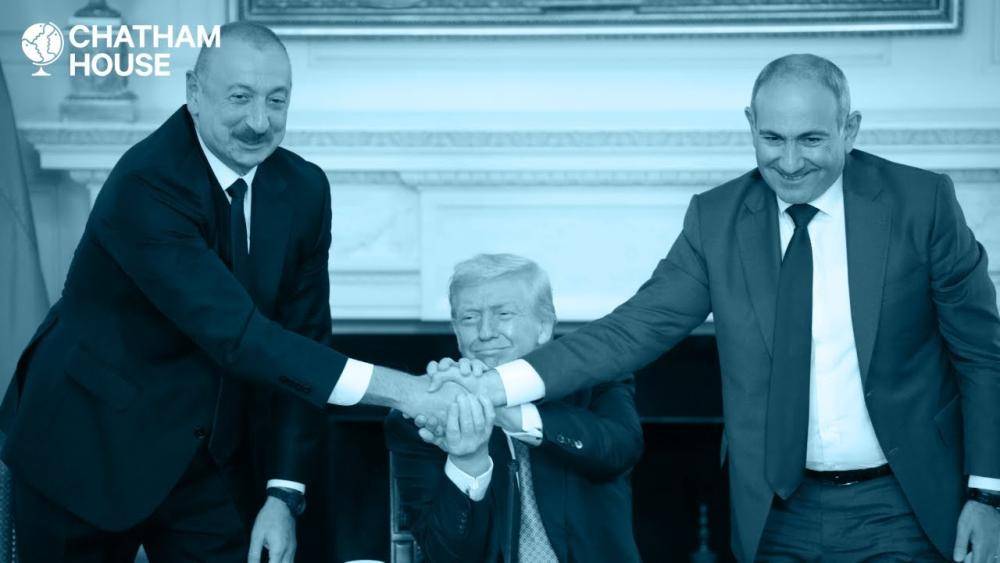
So, to set the scene for today’s discussion, I wanted to actually begin by reading an extract from President Trump’s speech in Davos at the signing ceremony of his newly established Board of Peace, and he said as follows. “Today, the world is richer, safer and much more peaceful than it was just one year ago. As President, I ended eight wars in nine months, including Cambodia and Thailand, Kosovo and Serbia, the Democratic Republic of the Congo and Rwanda, Pakistan and India, Israel and Iran, Egypt and Ethiopia, Armenia and Azerbaijan, and of course, the War in Gaza.” President Trump then referred to “Hamas and Hezbollah” as, “little fires and remnants of conflicts” that could be extinguished, “very easily,” before continuing as follows. “In another great victory for the ultimate goal of peace, in June, we obliterated Iran’s nuclear enrichment capacity with Operation Midnight Hammer. We’ve also hit ISIS in Syria, and in Nigeria, we’re annihilating terrorists who are killing Christians. We’ve hit them very hard.”
So, eight wars solved and an extensive use of military force across the globe. This is quite some list, and not included in it, of course, is the War in Ukraine, which rages on, despite Trump’s pledge to solve that conflict within 24 hours. So, this evening, we’ll take stop – take stock of what Trump has and has not achieved, we’ll assess whether his successes are as complete and as durable as he implies, as well as what remains to be done. We’ll also look at how he has approached this effort in peacemaking, what to make of Trump’s transactional style, his use of leverage.
And to help us unpack all of that, I’m delighted to be joined by four Chatham House experts, who I will introduce in the order in which they’ll speak. Laurel Rapp, to my left, is Director of our US and North America Programme, with almost 20 years of experience in Washington, including stints at the State Department, the NSC and the Senate. Professor Marc Weller is Director of our International Law Programme and brings with him academic expertise as a Chair of International Law at Cambridge, as well as deep policy experience as a former Senior Mediation Expert with the UN. Simon Smith chairs our Steering Committee of our Ukraine Forum and brings with him 35 years of experience in the British Diplomatic Service, including stints as Ambassador to South Korea, to Ukraine and to Austria. And last but not least, Zizette Darkazally is an Associate Fellow of our Middle East and North Africa Programme, as well as a Consultant for a range of Middle East-related initiatives, having previously worked for the UN and other international organisations in the region.
Before we get started, a couple of brief points of housekeeping. The event is not under the Chatham House Rule, it’s on the record, it’s being recorded and indeed, it is being livestreamed, so please do bear that in mind when we get to the Q&A segment of the session. And we do want to include you in the discussion, so please, as we go, be thinking of your questions. When we get to it, you can raise your hand in the room, and if you’re online, please just drop your question in the Q&A box, and if you would like to tweet about the event, please use the hashtag, #CH_Events and tag @ChathamHouse. So, Laurel, let me turn to you first. How should we make sense of Trump’s approach to peacemaking?
Laurel Rapp
So, I think Trump very much sees his role in mediation and conflict resolution very much in line with Trump as a dealmaker, right? Making a huge deal with countries that are at war with each other, that are fighting with each other is, in his view, the ultimate deal. He’s, of course, not the first President that has sought to use his good offices or his role in the Oval Office to advance these objectives, but I think he’s probably one of the only ones that sees it so personally tied to his own, kind of, personal legacy and personal brand. And we’ve seen that in a couple of different ways, including the rebranding in Washington of the US Institute of Peace that was shuttered and is now the Donald J Trump US Institute of Peace, or the Board of Peace, right? That is – the Chairman is President Trump and will be the Chairman for life, not the United States, but President Trump himself. So, there’s this personal mixing with the national in making these deals.
And look, as we walk through this list, and I think the President said we’re at ‘8.5’ now, right, because there was a flare-up between Cambodia and Thailand that he resolved again, some of these deals are quite superficial in terms of the role the United States and President Trump has played, some are quite half-baked or have even just started, but a couple are more meaningful. So, in the superficial category, I would put probably India-Pakistan, where some of the parties have, kind of, disavowed a significant US role in resolving this very longstanding conflict. Maybe it amounted to a couple of phone calls here and there.
If you look at the Ethiopia-Egypt dispute over water rights and resources and the dam, those talks have just started, or a US approach and offer was just made a couple weeks back, so that is not a resolved conflict in any shape or way. If you look at a conflict like Gaza, that is more meaningful in many ways. It did bring about a ceasefire. It brought Israeli hostages home. It ended high – very high levels of violence in Gaza, and so – and it was enshrined in a Security Council Resolution. So, if you’re looking at results on the ground, probably that’s the one that points – you can point most clearly towards.
Look, the strategy here is maximum flexibility and maximum pressure. So, on maximum flexibility, it’s, kind of, letting go of a lot of the US negotiating positions and values the United States has brought to the table on, sort of, instr – within the context of the UN Charter, within the context of being unwilling to talk to actors that are just too far beyond the pale that US – former US officials would have thought that that would have validated their role. And, you know, we looked at some actors, like, Hamas and the Houthis, or Maduro, for example. Maximum pressure, so we’ve seen instances, and I hope we get into this debate a bit, of US use of military force in Iran, right? It was that Trump use of a bunker buster against Iran’s nuclear programme that then resulted in his, sort of, presentation of that conflict, of that was the thing that brought about an end to the conflict between Israel and Iran.
And so, yes, this brings new leverage and new tools to a negotiation, but it also has costs when President Trump or the US is not willing to deliver on threats it’s making, when it directs pressure at close US partners, right? That is a value that the US has brought to past negotiations, that you would back your ally or your partner, sort of, over that adversary you are negotiating with, and we see that very much in the context of Russia-Ukraine. And if you care about a US values framework, it is largely absent here, so that is problematic in many ways.
Just a – one note on the, sort of, domestic politics of it, Andy, you said Trump wants to be remembered as a “peacemaker and a unifier.” 25% of Americans agree that he has made it better, and 47% of Americans, as a CNN poll last month, say that Trump’s effort to be a peacemaker and a unifier has actually made things worse in the United States and around the world. And so, even within his own base, you know, mediating water rights between Ethiopia and Egypt is not really in the core MAGA, sort of, set of motivating factors here in sending Trump to the Oval Office. And so I think we’re going to see growing pressure on Trump’s role globally and, sort of, desire to be seen as this peacemaker, and then what it very tangibly translates into for Americans and American voters, especially heading into the midterms this November.
So, I’ll stop there. I think we’ll – questions about the durability of all of these arrangements and, sort of, what we see moving forward, but it is a – it is quite a complex picture right now.
Dr Andrew Payne
Great. Just before I come onto you, Marc, just one quick follow-up on the politics of this…
Laurel Rapp
Hmmm.
Dr Andrew Payne
…and it, sort of, gets at the durability question.
Laurel Rapp
Hmmm hmm.
Dr Andrew Payne
If Trump’s efforts at peacemaking are as unpopular as you have suggested, what lessons do you think there are for a future successor? And that could be a Republican successor, it could even be a Democratic successor. Is this style of peacemaking, the transactional style, just now so politically toxic that it will be gone in three years, or how do you see it playing out over the longer term?
Laurel Rapp
So, the US is not involved in many peace deals and negotiations around the world simply to resolve the conflicts, right? The US brings a national interest and a set of values to these discussions. Sometimes these are very welcome and sometimes those are very unwelcome by the parties, but that is what has animated a lot of the US approach across these range of conflicts. And so, if these arrangements are not advancing, sort of, long-term US goals and are only advancing the, kind of, prestige of the current office holder, that is not going to be a durable arrangement, right? So, you’re not getting the prestige from your voters on the one hand, and you’re not really advancing some of the core US values.
Some – in some instances it absolutely is, but in others that has not been the animating factor. It’s been more of the, get the headline, get the deal, and move on. I think that’s a big concern on the Russia-Ukraine conversation right now. You know, and the – for countries to want and actors to want the US to be involved, absent, sort of, like, an endless coercion loop where the US is putting pressure, economic pressure, sanctions, military pressure, to be involved in these conflicts and resolving them, you need some minimal trust from the parties and, sort of, good faith that the US will bring a, sort of, a better outcome with its role in these conflicts than absent it.
Dr Andrew Payne
Great. Marc, let me turn to you. If you take this list of eight, eight and a half, whatever we are at now, conflicts, and you take them in the round, what patterns do you see? Is this – is there an identifiable Trumpian approach to peacemaking, or should we just be considering these as discrete cases on their own merits?
Professor Marc Weller
Well, the temptation to say that there is an easily discernible pattern must surely be very high. You could say that Trump peace initiatives are brief, they’re incomplete, they focus on a spectacular outcome, a ceasefire, and they disregard the need to stabilise the situation in the longer term. And in fact, in that way, none of our eight and a half examples qualifies, as our title suggests, as ‘conflict resolution’.
Laurel Rapp
Hmmm hmm.
Professor Marc Weller
These are Band-Aids to stop the fighting, but they will not stop the next fighting, as we saw.
Laurel Rapp
Hmmm.
Professor Marc Weller
And that’s why we have eight and a half examples. India-Pakistan started again, and some other conflicts that are claimed to have been resolved haven’t really, Egypt-Ethiopia perhaps. Moreover, the US deploys the President, President Trump, to bully states into a settlement, using even the threat of the use of force, which is internationally prohibited in principle, Tehran, at the moment, to achieve an outcome that inevitably advances the economic interests of the US…
Laurel Rapp
Hmmm hmm.
Professor Marc Weller
…minerals agreements and so forth. And yeah, all of this, kind of, sounds true. The agreements mainly seem to be ceasefire, they are focused on President Trump himself or on a small group of people, like, Secretary of State Rubio or Steve Witkoff. They are extremely short. I just brought one along, sort of, two pages is already a substantive peace agreement.
Laurel Rapp
That 14-page font – 14-point font there, yeah.
Professor Marc Weller
And the – that contrasts with the first agreement, this is the “Deal of a Century,” which is book length, when they sat down and drafted how to make peace in the Middle East. The peace plan for the Middle East in the end was 20 principles…
Laurel Rapp
Hmmm hmm.
Professor Marc Weller
…rather than 181 pages as far, as we’ve come. Often these agreements contain issues that are extraneous to the actual conflict, like the minerals agreements for Ukraine, but also several other ones, like, Armenia-Azerbaijan, they…
Laurel Rapp
Hmmm hmm.
Professor Marc Weller
…sort of, concluded parallel agreements on future relations with the US. The Kosovo-Serbia one, they had to recognise Israel, or at least Kosovo had, and Serbia had to move its Embassy to Jerusalem, I think. So, things that aren’t really connected with the actual supposed conflict, and, like, Kosovo-Serbia, the supposed agreement doesn’t actually address the conflict that the two sides don’t recognise one another as states. Each of them had to sign a separate piece of paper, and they couldn’t sign together on the same one because one of them thinks the other one doesn’t exist. And there may be coercive measures as we have seen in relation to perhaps Thailand and Cambodia, where tariffs were threatened, or now Iran…
Laurel Rapp
Hmmm hmm.
Professor Marc Weller
…where there’s a massive threat of the use of force. But in reality – and I had hoped to show you behind me a giant picture of this tiny graph, which actually takes all the eight and a half agreements, splits them up under analytical categories, and shows that actually they’re highly devar – diverse. There are different approaches. There is a difference between the first administration where they try, first of all, to have a big, sort of, global solution to everything, and then they move to this more, sort of, let’s try brief principles first approach. And actually, the picture is more complex and reveals, yes, an overwhelming wish to be the one who at least ends the fighting…
Laurel Rapp
Hmmm hmm.
Professor Marc Weller
…and I think that is probably genuine in terms that Trump feels strongly that he can exercise that role, and he – if he can do it, he should do it. And that, after all, has some price amongst the MAGA, sort of, voters.
But if we look at it, there are actually quite a number of agreements that do not end the fighting because there wasn’t any fighting. One of them is preventative in nature, Egypt and Ethiopia, where there’s a risk that they might come to fight over water, and that’s why we try to help them come to an agreement. Kosovo-Serbia and Armenia-Azerbaijan, three out of the seven, or eight, they’re about normalising relations after conflict, but there wasn’t an immediate risk of further conflict.
Secondly, yes, it’s true that there is a tiny team, and I’ve spoken to one of the co-mediators, not the US, but another state that is very active, and they say, “Yeah, the problem with the US is during one week they can only deal with one issue in relation to one conflict. They can’t do any more than that,” and that’s why you see, sort of, things moving in stops and starts.
Laurel Rapp
Hmmm.
Professor Marc Weller
You know, it takes a while until the next step is done on Gaza or something. So, it is a small team, but if you actually look at the breadth of activity they’ve done, it is actually breathtaking. And I don’t quite understand how they managed to keep track of all of these files, although they don’t do it as yet in a consistent way and looking at the longer-term approaches, but we’ll have to see.
Full-fledged agreements are rare, but where they actually take the trouble to have a Special Envoy who focus just on that agreement, the impossible case of DRC Congo, which the UN have tried for 20 years to address, they actually come up with an agreement and it is, kind of, a real one. It’s like 20 pages, containing the issues which people who work in this area would normally expect in an actual peace agreement, rather than eight or whatever little principles. They have managed to achieve that, although sadly, this one that looks like a real agreement is the one that has been least implemented…
Laurel Rapp
Hmmm.
Professor Marc Weller
…thus far, but it’s a very difficult case. So, they are, sort of, navigating and having different approaches. Laurel has already said it. They come to the Rose Garden to sign the agreement, but it is actually a very cunning use of international coalitions of getting there. There are either the African Union, the League of Arab States, states like Qatar, Turkey, Egypt, and others involved in getting to the point of coming to an agreement. And that is perhaps unexpected, that they have a fairly significant role, although as I said, they are complaining that the US administration doesn’t ha – really have the full capacity…
Laurel Rapp
Hmmm.
Professor Marc Weller
…to deal with all of these inputs. Now, a real concern, and, again, we agree, is that very few of these agreements address the underlying conflict. They are conflict management rather than conflict resolution, and the verdict is open whether things like Gaza will transform themselves into something that has any chance or hope to offer a longer-term solution. And the initial hesitancy to offer a pathway towards a future for the Palestinians does not necessarily bode fully well. Is there a lot of use of force? Actually, not really. There is Iran as an…
Laurel Rapp
Hmmm.
Professor Marc Weller
…extraordinary example just at the moment. Yes, India-Pakistan, they were, sort of, told to make peace now, given the global ramification of escalation and nuclear risk, so you can perhaps see it. But otherwise, it is, sort of, a balancing of incentives and disincentives, which are not untypical, although of course, the US does have more power and sometimes will use it to change the negotiation environment.
So, there is more to be learnt and looked at from this than at first sight might appear if you just base yourself on the daily newsfeeds, as it were. But at the end of the day, we have to admit that unless you address the underlying causes of the conflict, yes, you may have stopped the fighting today, but have you stopped it tomorrow too?
Laurel Rapp
Hmmm.
Professor Marc Weller
That’s the problem. Thank you.
Dr Andrew Payne
Thank you very much, Marc, and I appreciate I gave you the tough task of, was it 83 – 87 conflicts when your – your full grid was much larger than the eight and a half, and summarising that quite so succinctly was a tough task, so I particularly appreciate that. Let’s go to one specific, yet nevertheless difficult case, Simon, let’s turn to Ukraine. This isn’t on Trump’s list of successes, despite all of the rhetoric that we’ve heard so far. Why do you think Trump has failed to make progress here?
Simon Smith
Well, we’re starting now on the specifics, where Marc finished, really, with the – as he put it, with a conflict that hasn’t even stopped today…
Laurel Rapp
Hmmm hmm.
Simon Smith
…and it won’t stop tomorrow either. So, why has Trump failed on that? One –just to list five or six factors very quickly. One, he oversimplifies. There’s nothing wrong with simplification in looking at conflicts, but there’s a whole lot wrong in not actually understanding some of the complexities, if not all of the complexities. Trump was even on record last year as expressing his opinion that this was “a conflict that Ukraine started.” He is keen also to express things in terms of very gross simplifications, like, “The killing’s got to stop, everyone wants the killing to stop.” And that leads onto, sort of, unhelpful assumptions, or unhelpful statements, that will construe any attitude that says, “Yeah, saying the killing has got to stop won’t quite cut it as the beginnings of a serious approach to peace.” That you will then, if you advance that argument, be characterised as “not wanting peace.” So, Zelenskyy, for example, has been characterised as “not wanting peace” when he has said, “Excuse me, President Trump, this is all a little bit more complicated than you appear to think.”
Related to this oversimplicity, I think, is a excessively shallow analysis of the conflict. I mentioned that Trump was under the impression Ukraine might have started this conflict. But it also means in terms of analysis of how to deal with resolving the conflict, that Trump fails to spot some pressure points and he homes in on one or two pressure points in an unbalanced way. So, for example, he will characterise Ukraine as “not holding any cards.” What he quite means by that is quite difficult to understand, but it sends a signal to Russia that Trump has already decided that Ukraine is, if you like, in the, sort of, weak position in negotiations, Russia is the strong one. And that will set a number of unbalanced assumptions as a basis for even starting to talk about how a ceasefire, let alone a peace settlement, might shape up.
This also leads to a, sort of, unbalanced use of leverage. Trump has publicly discounted the – or given away in advance, issues which could and should have been the subject of negotiation. He’s made repeated public assumptions that the territorial issue is one where Ukraine will, as he sees it, need to make significant concessions to Russia. And he has signalled, although this has – this position has become slightly more nuanced in recent weeks, he has signalled that the United States is not interested in a substantial contribution to any security guarantee, any guarantee of Ukraine’s security in the future. So, two elements there which have almost been, sort of, wilfully pulled away…
Laurel Rapp
Hmmm.
Simon Smith
…from a possible negotiation – negotiating dynamic and put pressure on one side, Ukraine, and constantly take pressure off the other side, Russia.
Another example, Trump has, to my knowledge, said nothing in terms of pointing out the absurdity of Russia engaging in each round of discussions on ways of resolving the conflict. Russia’s repeated insistence on these absurd conditions, like de-Nazification, demilitarisation of Ukraine, of repeating this, kind of, maximalist position. Now, this is not a surprise for anyone who has negotiated with Russian representatives, and yet, if you’re going to set a dynamic for a – if you’re going to set a confidence-inspiring dynamic for a negotiation, I think it helps, actually, to intervene on issues where one potential party of that negotiation is simply repeating absurdities.
So, altogether, those factors, I think, lead to, on the one hand, a lack of confidence, certainly from the Ukrainian perspective, from, I think, the perspective of large parts of Europe, they lead to a lack of confidence in Trump as a leader of a negotiation. And in an opposite sense, they will give Russia the opportunity, in a sense, to pull the wool over. Trump’s expr – own expression is a nice one, “to tap him along.” He’s spoken in public about Putin, “tapping him along,” and I think this tendency not to make the effort to analyse the conflict in at least reasonable depth continues to present an opportunity for Putin to tap him along.
Final point, I would say, is about the absence of a moral purpose. Now, that sounds a little bit, kind of, over-philosophical, but I mean that in two senses. One, it’s the absence of a moral purpose, but the existence of a very personal aim of personal self-aggrandisement ,which again, is a factor which has failed to raise the necessary level of confidence in Trump as a negotiator and has meant that we have spent a year or so, at least – if you think back, we are almost a year since the ghastly meeting that Zelenskyy had with Trump in The White House in February 2025. There have been several, sort of, convenings in various formats of the parties to talk about the way ahead, and the position has developed very, very little. Again, I think one of the central drawbacks there has been Trump’s lack of credibility and lack of ability to inspire confidence as a leader of negotiations.
Final, final point is the – I think we’ll come on to this a bit later, is the absence of a European dimension. That at the same time as Trump has repeatedly signalled that the United States is in various ways, not willing to invest in the long-term basis of conflict resolution in this context, he has also, in many respects, kept at arm’s length and kept out of the picture in – not entirely, obviously, but he has kept out of the picture a lot of more helpful and more constructive approaches that might have come from European leadership, had Trump not taken the series of positions that he’s taken with regard to, in an sense, his, kind of, standoff with Europe. But that maybe is for slightly later in the discussion.
Dr Andrew Payne
Yeah, I – in the interest of time, I’m going to keep us moving, but I will pose as a rhetorical observation, as it were, it’s interesting to think about, in the case of Ukraine, whether the main diplomatic success, in a strange, kind of, way, has actually been the periodic trips that European leaders have gone to Washington to try and talk Trump into backing down from some of his more dramatic positions. So, I gently encourage anyone in the audience to pose a question around Europe’s role to Simon, or indeed, the panel as a whole. But as I say, in the interest of time, let’s move on to Zizette, last but not least. I want to ask you about the Board of Peace.
Zizette Darkazally
Hmmm.
Dr Andrew Payne
This is something, of course, that was initially envisaged as a mechanism for addressing the situation in Gaza, but it’s grown into something much grander than that. Is this just a gimmick, or do you think that this could play an effective role in global peacemaking?
Zizette Darkazally
Thank you. Well, look, the Board of Peace is not operate – operational yet, so we don’t know what it’s capable of doing, what it’s not capable of doing. But with that in mind, I would like to take a step back and actually talk about how the Board of Peace came about, and a bit about its membership, because that will shed light about whether it’s a gimmick or effective. So, if we will remember, the Board of Peace came about, it was point nine of the Trump plan, the 20-points plan that was presented end of September last year. And the Board of Peace there was supposed to be a transitional entity and would focus only on Gaza, that it is – will present a framework that will help redevelop Gaza after the war until the Palestinian Authority would come in and con – and take control of Gaza.
Now, what was announced in Davos was not that. What was announced in Davos is a standalone entity, Board of Peace. Gaza even wasn’t mentioned in the Charter and in the discussion, but it was – the Charter of the Board of Peace talks about a ‘standalone entity’ that envisages to solve more conflicts. And it’s very much aligned with the America First approach, America on top approach, President Trump on top approach. That he’s – has all these responsibilities and authority that was granted to him in the Charter. So – and we also saw in the Charter itself that it had a clause that said it will “have the courage to depart from institutions that have failed,” which is a subtle or unsubtle reference to the United Nations.
Now, with that in mind, if you look at, also, who joined the Board of Peace and who did not join the peace and why, that also shed light about where it stands, as well. So, countries that joined the Board of Peace, some of them did so because they are ideologically close to President Trump’s thinking, like Hungary. Others saw that that might give them some relevance on the international arena. Other countries just did not want to be spoilers for the effort. Some were also pushed by the bi – to preserve bilateral relations with President Trump.
But it’s also very interesting, the Arab countries that joined the Board of Peace, and they joined to have a ta – a seat at the table when it comes to Gaza. So, you could – I would note the statement that they issued when in – when joining the Board of Peace, limiting it only to Gaza, mentioning the United Nation, the Security Council 2803, the Resolution, and that showed some, kind of, being a bit uncomfortable in joining the bigger Board of Peace on different issues, but being specific, they’re there specifically on Gaza.
Now, who didn’t join and why is also important for this discussion. There were some countries that said they’re not joining upfront, like France, and these coun – many European countries, as well. And these countries did not join because they saw that the Board of Peace could pose some danger and risk to the UN and to the multilateral institutions. Others found it uncomfortable to be there with Russia, to sit at the same board with Russia. Mind you, President Trump did say that Russia accepted, but Russia hasn’t confirmed that it accepted the membership, but the suggestion that Russia would be on the Board of Peace made other countries uncomfortable. Others, like Italy, said that it is – it oppo – it contradicts its constitution, because Italy is allowed to – isn’t able to join multilateral entities, only if it has on the same footings in terms of decisions. But the Charter gives President Trump a much more exclusive and – say, so Italy is out because of this.
There were also – as you know, Canada was disinvited. So, there’s a very – they’re different – but also, some countries are not comfortable with having members on the Board of Peace that are persecuted under international law, as well. I mean, there is a Prime Minister in – of Belarus, I think, and there’s the ICC, International Criminal Court, decision, arrest warrants against Prime Minister Netanyahu, and Israel is on the board. Prime Minister Netanyahu signed it yesterday, if I’m not mistaken, to officially join the board. So, these – the membership, the – what it hopes to do, and the transition beyond Gaza tells you a lot about how it aims to operate.
Now, whether it’s going to be effective or not, that depends on many different factors. There needs to be more clarity on the mandate and the roles and responsibilities and the dynamics, as well, between the members on the Board of Peace, in order for it to be effective. There’s also – it needs to be anchored in, like, in common values and what peace means, and they all have to be on the same page of what peace actually means, achieving peace, what it means. It also has to address, as Marc alluded to it earlier, the underlying causes of the conflicts and not to have quick fix. Quick fixes just don’t work, in many of the conflicts that were mentioned, the eight and a half, and other conflicts.
And there’s also – there needs to be, also, very much clarity on who’s in, who’s out, and how is that going to function? Now, can it replace the UN or not? I think it’s too early to say, but, you know, the UN operates on – across a lot of different spectrums, so, like, the humanitarian, developmental, and it’s been functioning for 80 years. There’s, of course, criticism on the UN, that it’s been absent, that it needs some reform, which is true. But nevertheless, one can’t dismiss an entity that has a much – many more members represent the world, but also that emerged out of the bloodiest war that the world knew.
And finally, just one word, because I was talking to, actually, Simon about it earlier. Look, much of it – much of the structure depends on the will, as well, of the member states themselves. I mean, there are a lot of United Nation, Security Council Resolutions and General Assembly Resolutions that are stacked on the shelves that have the consent and agreement of all member states but haven’t been implemented. It depends a lot on the third parties themselves, on the states themselves, of when they look themselves in the mirror and just decide what kind of states they want to be, and what kind of values they want to have in conflict resolutions.
Dr Andrew Payne
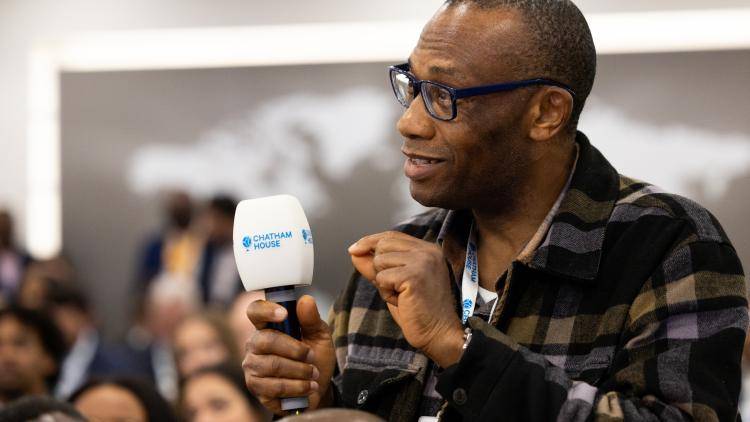
Thank you. We need to get into Gaza, as well, but in the interest of time, let me open up the floor and invite questions specifically about Gaza for Zizette that we didn’t have time for on the stage. But please, if you’re in the room, just raise your hand and wait for someone to bring you a mic. If you could, when asking your questions, please state your name and affiliation. Please ensure that your question is exactly that, something that has a question mark at the end of it, and is as concise as you can possibly be, so we can get as many in. If you are joining us online, I’ve got a long list of questions here that I’ll try to get to as many as I can, as well. Please do keep those coming. Good Lord. Okay, we’ll go in the middle, yeah, blonde hair. Yeah.
Marina
Marina [inaudible – 41:16], PhD Researcher, University of Portsmouth. I have a question to Simon. Simon, I understand that it’s very difficult to make some predictions about Trump, but looking at the situation in Ukraine and Trump’s position on it, how do you see events unfolding over the next six months, or even year? Thank you.
Simon Smith
So…
Dr Andrew Payne
Hold that thought. I’m going to take a couple just so we can get a few in. Right at the back in the corner, over there.
Tim Chattell
Thank you very much. Tim Chattell, the British Army’s visiting Research Fellow here at Chatham House. There’s been a lot of debate since Trump 2.0 around what changes are likely to outlast his presidency and what are likely to stay around.
Laurel Rapp
Yeah.
Tim Chattell
And you can look around the world, I think, and see a lot of proto-Trumps embodying this quite masculine, this quite populist, figure of leadership. To what extent do the panel think that his personalised diplomacy involving his own personal gain and dealmaking is something that’s likely to outlast him? And do we see any evidence of this being replicated by other leaders in other parts of the world? Thank you.
Dr Andrew Payne
And I’m going to take – thank you, and I’m going to take one more from this side of the room. Front row, on the left, there. So, we’ve got, Simon, prediction on Ukraine, personal diplomacy and durability, and…
Alexander
Hi. Alexander, I’m a undergrad at King’s College London studying law. My question is, this panel has talked a lot about the shift from multilateral, procedural-driven consensus peace, to a more leverage-based peace that Trump has proposed. I’m just – this is a question for the Professor Weller and also, for Miss Rapp. First of all, is it – does the legal form of these treaties – has their legal form changed, or is it more of a instrumentation change in terms of the final form of peace that it has, or is trying to achieve? And, also, has the United States grown tired of the procedural-driven consensus and it has decided to go it alone, essentially?
Dr Andrew Payne
Thank you. Alright, Simon, let’s start with you on Ukraine, if you don’t mind.
Simon Smith
Very briefly, I think that President Trump will continue very seriously to aim to achieve some kind of ceasefire in Ukraine over the next six months or so. I can’t say whether he will achieve that. What I do envisage is that at some point on the road to trying to achieve a ceasefire, he’s going to have to confront a very fundamental question about how he deals with Russia. Because I don’t see any change in the dynamics over the next six months in just having a repeated session of people coming together and talking past each other, which is basically, with the exception of a few prisoner exchanges and so on, which have been welcome, that’s, basically, how it’s been.
But things are not going to change unless Trump confronts a Russia question, and that fundamental question is, is he actually – has he actually always been of the view that the big country is going to win this and he wants to be alongside and he wants to be deriving the benefits from the United States of a future relationship with Russia? And so, does he go into enforcing a ceasefire with that degree of cynicism, or does he decide that actually, part of his tactic and part of the leverage which is available to him includes the ability to put more pressure on Russia?
Dr Andrew Payne
Marc, do you want to pick up the legal aspects?
Professor Marc Weller
Yes. First of all, is this going to last? I think, yes, I think there has been a longer-term shift in the US attitudes to international relations, to international co-operation, and also to peacemaking. But as I was trying to say in my presentation, not everything that is occurring is the work of the devil. There are actually some examples in there that are useful to look at, and there are different teams and people working on these things in different types of cases.
On your legal question, I think we need to distinguish between substance and form, legal form. In terms of substance, yes, we have much less of it.
Laurel Rapp
Hmmm.
Professor Marc Weller
We have seven – 20 – 28 principles, and I contrasted it with the 181, sort of, Deal of the Century outline, which they produced in the previous iteration. On the other hand, in the middle ground, we have some instruments that look more like an agreement, but mainly, all of these outputs are policy declarations. Sometimes you have just Mr Trump announcing in a tweet at night, or in an X at night, that “Pakistan and India have now made peace,” but we don’t actually see the ceasefire. And they probably have, but there isn’t, you know, the actual agreement that we would normally have. So, then we have this form of parallel separate agreements when the party can’t sign together, which is not helpful when the essence of what you try to achieve is to make the parties recognise one another. So, it’s, kind of, a faux agreement, something that looks like an agreement, but it isn’t really.
And then we do have slightly more formal instruments. Look at Gaza, which we were meant to address, where you have the 28 principles, which is just a policy declaration. Then you have the actual agreement signed by Hamas, which is the agreement on the ceasefire and release of hostages, but they didn’t sign onto disarming, which I think people now, sort of, regret that that wasn’t part of what they actually signed onto. And then we have a political agreement, the Sharm El Sheikh one…
Laurel Rapp
Hmmm hmm.
Professor Marc Weller
…which is a, sort of, policy declaration by those who were involved in the negotiations, and it doesn’t really say anything either, but it’s not legally binding. And this will become a real problem later, if, say, there is a real Gaza peace agreement or Ukraine agreement, that the US cannot ever sign any agreements anymore…
Laurel Rapp
Hmmm hmm.
Professor Marc Weller
…due to the need for advice and consent of the Senate. The issue of if there’s – is there a security guarantee, will there be a security guarantee for Ukraine? Where Zelenskyy says it “has to be ratified by the Congress,” and the US is saying, “Well, maybe there could be a declaration by the Congress noting that there is such a guarantee,” because ratification is too difficult. But normally the practice nowadays is like the JCPOA on Iran…
Laurel Rapp
Hmmm hmm.
Professor Marc Weller
…that it’s a non-binding political agreement, which nevertheless, is binding on the other state that is meant to comply with it. So, all of these things have become more difficult, more complex. During my career as an Advisor in peace agreements, we would just negotiate an agreement, 200 pages, people sign it, and then we have a mechanism to implement it. Everything we’ve seen here is only the very first step. A declaration of principles, yes, you can have, but then the next step is a framework agreement, where you say, “These are the elements that have to be agreed in detail.” And the third is the comprehensive peace agreement, which has all of these elements and whatever, it is 18 detailed annexes, dealing with all the issues that need resolving if you really want to make peace, and we are several hundred miles away from that outcome.
Dr Andrew Payne
Laurel, is there anything quickly you want to add?
Laurel Rapp
Sure. Let me pick up this, just very quickly, pulling those two questions together. So, on durability, I think best practices to look for are whether it’s a unilateral agreement versus multilateral. We saw the Abraham Accords in the first Trump administration did endure across administrations. It was bought in by many countries in normalising relations with Israel. International standing, whether you can get Security Council consent, like, that makes it more durable. And then the personal versus national interest we talked about.
On your, I think, very good question on the procedural – the endless procedure. I think Americans have seen, you know, many rounds of Middle East peace talks, have seen endless discussion in the Security Council that have not resulted in –not just on Gaza, but on many conflicts, Ukraine, that have not resulted in durable resolutions to those conflicts. And so, I think President Trump is asking the right question, in some ways of, what are those international bodies and structures that can actually deliver to solve conflicts, to solve problems, irrespective of your motivation? So, he has, kind of, given the wrong answer, in my view, to that question with the Board of Peace.
But I remember, you know, when I was at the State Department, I was working there during – working on the Security Council during the first Trump administration, and I remember my colleagues and I would often go and say, “Well, here’s why what you’re saying might be a bad idea. Here are the risks involved. Here’s the reason to not act,” right, in, sort of, the traditional, more conservative, or, like, restrained diplomatic way. And I think this administration, we’ve seen a bias to action, right? And so, I think it’s, sort of, incumbent on all of us to bring ideas forward, right? If the Board of Peace is not the right answer, what is – what are those other models? What are those other ways? How can the Security Council be strengthened and work in co-operation with other entities? I think this is one of the big challenges of our time, and this President has acted in one direction, but good ideas are needed right now.
Dr Andrew Payne
Okay, let’s go for another round. I’m going to take at least one in the room, and then maybe bring some in online. Third row here.
Ruzan Pluzyan
[Pause] Thank you very much. Ruzan Pluzyan, University of Bath PhD Researcher, about underlying reasons, how they can be tackled. Talking about post-Soviet space, Armenia-Azerbaijan conflict, I guess that the main underlying cause is a very low level of sovereignty and the peace agreement that is associated, also, with other agreements, nuclear energy and economic independence, etc. How this – I mean, this is – this can be considered as a long – in the long run…
Laurel Rapp
Hmmm.
Ruzan Pluzyan
…as the main driver for long lasting security.
Dr Andrew Payne
Hmmm.
Ruzan Pluzyan
How can we – what lessons can we learn from this for other post-Soviet space conflicts, whether they can be useful? And how the UK, as a leading European nation, can be helpful in resolving – overall understanding this approach, how it can be helpful for Ukraine also conflict and other conflicts, as well? Thank you very much.
Dr Andrew Payne
Thank you. Alright. Let me couple that good question with a similar one online, which is Morakinyo Olotu, who says, “How effective are President Trump’s conflict resolution methods when it’s apparent, they do not attempt to mitigate the root causes of conflicts? Rather, they seem transactional and mainly directed towards making deals that would benefit the US, rather than people – than the people in the conflict zones.” So, you know, the costs of not addressing root causes.
And also, maybe there’s one for Zizette here on the Board of Peace from Michael Jinete, who says, “It’ll be interesting to see this board of peace and how it differs from R2P, given that many of the members on this board do seem very pro-veto when it comes to the UN Security Council. Can we expect the same, and will this be another way the US is backtracking from and causing fragmentation to liberal institutions?” That’s probably enough for now. So, Zizette, do you want to kick off on that? And then anyone else, feel free to jump in on the broader root causes versus transactional and dealmaking.
Zizette Darkazally
I mean, look, the short answer is there is a risk, of course, there’s a risk. The veto powers, I mean, if you look at the – if you read the Charter, the authority that is given to President Trump, to one man, on how to decide and how this all goes, from voting, from who joins the Board of Peace, who dismisses, it’s very vast and it is, of course, risky. So, I – the veto power in itself is dangerous to a great extent, given that politics have their own way of – have their own interests, as well. We see that as well in the United Nations with the five member states with the veto power, so – because decisions aren’t always made based on the greater good, or human rights, or peace values that are in the Charter of the UN.
So, if the veto is a problem there, then the veto is definitely a problem in a Charter that was written not inclusively, not as a consultative effort by different – by the members of this new multilateral, if you can call it that, multilateral body. So, there is a great danger, yes, and I think that will manifest itself when the Board of Peace – if the Board of Peace becomes operational and it starts operating and addressing conflicts.
Dr Andrew Payne
Anyone else want to pick up the root causes, post-Soviet states versus dealmaking?
Simon Smith
Just to add one comment on the post-Soviet space issue. I really am not optimistic about a bright new era of being able to work alongside other countries in that post-Soviet space until the extraordinarily malign influence of Russia on the entire region has been dealt with effectively. I think that the prospects are very, very limited, and that, of course, is one very fundamental issue that is alive in addressing what to do about the war of aggression that Russia has launched on Ukraine and continues to wage there.
Dr Andrew Payne
Great. Okay, let’s take another couple.
Zizette Darkazally
Can I just add something?
Dr Andrew Payne
Yeah, please, go ahead.
Zizette Darkazally
Underlying causes, just because I know that it relates to Gaza, but not on Ukraine. The question was about Ukraine, but general underlying causes. Look, because the question hasn’t come up about Gaza, I just want to point out that it’s not a Gaza conflict. It’s an Israel-Palestine conflict and reducing it to just a security question or humanitarian question in Gaza defeats the whole purpose of a comprehensive peace plan or a plan for Gaza, so just, kind – for the Palestine-Israel conflict. So, just the underlying cause isn’t the humanitarian problem in Gaza or the security problem in Gaza, between Gaza, the borders, and Israel. It is – it remains occupation of the Palestinian territories. We can’t forget the West Bank, we can’t forget what happens there, so, and the aspirations of the Palestinian people.
So, just about the underlying – just want to make that point about how underlying causes is a big issue in terms of approaching a conflict.
Dr Andrew Payne
Thank you. We’re very rapidly running out of time. So, I’m going to take a slight bumper batch here, and then I’ll run back through the panellists in reverse order to answer any of the questions that come up in this batch and any closing comments you want to make. So, there was one over here…
Mahnoor Omer
Hello.
Dr Andrew Payne
…and then…
Mahnoor Omer
Thank you for this insightful discussion. Mahnoor Omer, I’m associated with the Islamabad Bar Council. I’m curious about how Trump’s recent initiatives, such as the Board of Peace and other forms of interventionism, reconcile with his national America First narrative. What’s the national sentiment? Is this going from Make America Great Again to him trying to make the world great, in a way? So, how does that reconcile with each other? Thank you.
Dr Andrew Payne
Great, and over here. Yeah.
Houman
Hello. My name is Houman. I’m a PhD Researcher on financial crime with focus on Russia, China, and Iran. How can President Trump’s peace efforts between Russia and Ukraine, Azerbaijan and Armenia, remain impartial, given his ties to Russian Azerbaijani oligarchs, like Agalarov’s family? And what safeguards exist to prevent conflicts of interest? Thank you.
Dr Andrew Payne
One more in person, and then I’ll take a couple online, and we’ll go for it.
Thomas Brayford
Hi, Thomas Brayford, British Council. To what extent have US cuts to USAID and changes in support for civic society partnerships affected the value and the effectiveness of US soft power and soft power more generally?
Dr Andrew Payne
Thank you, and then online I’m going to take two. One is about Europe. Trisha de Borchgrave has taken my cue. “Shouldn’t a shaken and vulnerable NATO imagine what Europe would look like without Ukraine’s scale, sense of purpose, commitment, resilience and defence expertise, physically embedded within the alliance in the years ahead, especially with wavering American security guarantees?” Similar question from Robert Kilpatrick, “Trump clearly has no qualms about alienating USA’s key allies. Are European states still counting on a return to a more typical transatlantic alliance in a post-Trump future or expecting a more permanent shift?”
And the final question I just want to leave hanging is the longest one here, so didn’t take my cue about being concise, but nevertheless, I do think it’s a good question. Hatim El Otmani says – injects a bit of optimism here. There’s a note of scepticism in our assessment of President Trump, and Hatim asks, “Don’t you think that looking back, for all of the flaws in Trump’s methods, that actually what Trump is doing might be what the world needs at the moment? During President Obama’s administration, Russia took Crimea. During Biden’s Administration, Russia invaded Ukraine and there was a war in Gaza. At least with Donald Trump, no matter what we can say about his method, can’t you say that at least things are moving forward?” So, in reverse orders, Zizette, bring us home.
Zizette Darkazally
On moving forward. Thank you, Hatim, for this question, that’s very important. Look, despite all the – I’m going to zoom in on Gaza here. Despite all the challenges, lack of clarity in the Board of Peace, and all of what’s happening, there is – remains some hope because of the structures of – with the implementation of the structures in Gaza. Especially the National Committee, that is tasked with changing – with services on the ground in Gaza. And that does give some hope if, of course, it’s allowed to operate, if, of course, Israeli restriction doesn’t stop it from operating. But that’s also a test for President Trump and the Board of Peace itself to see how they – how that will move on.
There’s also the fact that with all that, again, the Palestinians under no illusions, and the Arab world, I would imagine, that President Trump is going to pivot from the well-established support that the US has for Israel, but they have seen some surprising moves, as well. The direct negotiations with Hamas that was – that Israel objected to, bringing Qatar and Turkey on the Gaza Executive Board, to the – also to the – Israel’s objection. And lifting the sanctions more broadly, even beyond Gaza, lifting the sanctions in Syria, as well, was a surprising move, because they were – Israel was objecting to it, as well. So, there are these moves that people are watching and seeing maybe the unpredictability of President Trump can actually, you know, change the allies, shift a little bit a new order in the Middle East, shift a little bit balance of power that the Palestinians, that the Gaza might benefit from.
Dr Andrew Payne
Thank you, and then, as concise as we can be, Simon.
Simon Smith
I think in answer to the question over here, there is a great danger that we’ll see quite a number of things that President Trump has in common with President Putin, in terms of both these men having been people who have wilfully destroyed democratic institutions and processes in their countries with disregard for the rule of law, etc., etc., and in a sense, have also commoditised politics. On the other hand, the European recipe is a brave one, but we’ll have to fight extremely hard to continue to have leverage in incentivising the sort of changes that make for competitive spheres in the economic and political sense in those countries, that make for countries that work effectively and provide security and prosperity for their people.
But a last word to another question was, I think this idea of Ukraine as an asset to European security, not just, if you like, a, sort of, problem, has been something that has been developing for some time. And I think that may, I’m not hugely optimistic, but that may provide a further useful dynamic in developing, in a sense, a European concept which countervails what is going on in terms of the erosion of democracy elsewhere.
Dr Andrew Payne
Marc.
Professor Marc Weller
Can the series of agreements succeed if none of them addresses the underlying root causes? Well, for a while, maybe the US, if an agreement collapses, can press the sides back into service, as we saw with India-Pakistan and one or two others. But in the long-term, the question is, are they using the space they have generated through a temporary ceasefire or a suspension of hostilities to move towards addressing the underlying issues?
Laurel Rapp
Hmmm.
Professor Marc Weller
At the moment, it doesn’t quite look like that in many of these cases, they have the ability and the breadth to do so, but I think that will be the real challenge, to build up an infrastructure from the odd Special Envoy to an office that can deal with these issues in the longer term professionally. And that will be the ultimate test whether this is a pan in the – a flash in the pan or indeed, a significant change in practices on peacemaking.
Board of Peace, well, it will last until Mr Trump goes, or a clone, Mr Vance or Mr Rubio, another Trump coming into office and doing similar things. But it is very much conceived as a machinery to implement the peace agreements the US has achieved or thinks it will achieve. It is very, very specific, I think, for that purpose.
Laurel Rapp
Hmmm hmm.
Professor Marc Weller
It’s not a new UN, or it’s not – it also doesn’t have authority to grant R2P. It doesn’t have the legal authority to authorise the use of force, which only the UN Security Council has. So, having this body doesn’t resolve those kind of problems, and having the same, kind of, difficult states in it, Russia, China, will also not give you more support than you would have in the UN Security Council, which at least has legitimacy and authority in support of such actions.
Dr Andrew Payne
Laurel.
Laurel Rapp
On the question about USAID, not only has the United States lost a tool of great soft power, it’s also lost a tool of conflict resolution, right? USAID was designed to address economic challenges, hunger, climate-related disasters, institutional weaknesses. These are all root causes of dri – and drivers of conflict that the US is not in the business of anymore.
And on the question over here, a very good question, on the, sort of, domestic versus international tensions, the Trump administration has a problem here, and they know it because they put it in the National Security Strategy. They said even in these – they, sort of, laid out very core US national interests in a very narrow way, and they said, “But look, in peripheral regions where the President is solving problems, it’s still in the US interest because, you know, it can open new markets, or it can make new friends.” And so, they were very intentional to say, “This is part of the strategy,” but was very clear that it was a bit tenuously connected back.
We’ll see if President Trump’s efforts are chastened by the midterm elections and how voters, kind of, give marks on his and his party’s role across the world, but that draw of the Nobel Peace Prize is just so strong. So, let’s see what happens.
Dr Andrew Payne
That is a very good note on which to end. We are not just at time, over time, so thank you for your patience. There are so many questions online we couldn’t get to, I apologise. Please join me in thanking [applause]…