Georgia Cole
Good evening, everyone, welcome to Chatham House. We’re grateful to be co-organising this timely discussion today on the future of European and British defence co-operation with the European Parliament Liaison Office in the UK. I’m Georgia Cole, a Research Associate here in the International Security Programme at Chatham House. I’m delighted to welcome you all here tonight and to be chairing this session.
So, just before we get into it, I’ve got a few housekeeping notes. This event is not under the Rule, it’s on the record and is being livestreamed. We’re joined by an online audience. If you would like to share the session on social media, please use the #CH_Events and tag @ChathamHouse. As we go along, please be thinking of your questions for the Q&A, and if you’re online, you can put your questions in the Q&A box.
So, in recent months, the transatlantic security environment has shifted in ways that would’ve seemed extraordinary just a year ago. US threats to Greenland, the effective sidelining of European allies in negotiations over Ukraine and the ongoing war in Iran have highlighted the need for European strategic autonomy. Against that backdrop, UK-EU defence co-operation sits at a pivotal juncture.
The EU-UK reset launched last year’s summit, with a new strategic partnership and a security and defence partnership, signalled serious political intent. And we’ve seen real progress in some areas, yet the collapse of talks over the UK participation in the SAFE programme in November last year revealed that much progress is yet to be made. Brexit era mistrust, contested questions about the UK’s place in European defence industrial base and competing national interests within the EU, have itself slowed progress at precisely the moment Europe can least afford it.
So, we have a fantastic panel tonight to delve into how the UK and Europe can work together to improve their co-operation on security and defence in this increasingly complex geopolitical environment. Joining me we have Mr Sandro Gozi, Co-Chair of the EU-UK Parliamentary Assembly. We have the Right Honourable Liam Byrne, Chair of the House of Commons Business and Trade Committee. We have Lord Peter Ricketts, former Chair of the European Affairs Committee in the House of Lords, and we have Professor Jamie Gaskarth, an Associate Fellow here in the U – in Chatham House’s UK and the World Programme. Cool.
So, I will turn to you first, Jamie. Yesterday, the House of Lords International Relations and Defence Committee published a report concluding that the UK should balance its approach towards the US and dismiss previous sentimentality about the special relationship. In particular, the committee urges the government to “urgently pursue implementation of the recommendations set out in the Strategic Defence Review” and to “prioritise the publication and implementation of the Defence Investment Plan.” Under the current state of affairs, what does the UK offer to European security? How does the UK compare to peers in Europe and what else does it need to strengthen or bring to the table?
Professor Jamie Gaskarth
Thank you. Tough questions and this is a difficult time for the UK defence, ‘cause I think our weaknesses have been exposed quite cruelly in recent weeks. We’re getting a very strong message from senior policymakers and officials. We have, you know, Blaise Metreweli in December last year, “Our world is more dangerous and contested now than for decades.” George Robertson in his recent speech said, “We are underprepared, underinsured, we’re under attack, we are not safe.” Bronwen Maddox, the CEO of Chatham House, has talked about the Trump presidency marking “the end of the Western alliance.” So, it’s a really serious time that we’re facing and major challenges. I mean, there’s always been periods when people make a security and defence speech, where they say, “Oh, it’s more dangerous and volatile and contested than” – and they have to do that to get some cash.
But I mean, I think this is real now, that actually, we are living in that world, and we need to try and confront the challenges that that presents. But unfortunately, I don’t think we are. If we look at defence policy, we see many announcements, but we don’t see sufficient action at pace coming from that. If we think about the, you know, the most obvious challenge that we faced when we ca – when the government came into office in 2024, the UK faced a challenge of diminishing munitions stockpiles and “We need to ramp them up to get on a war footing as soon as possible.” Two years later, we’re still issuing expressions of interest for munitions factories. They’re not built, they’re not there and they’re not usable. We haven’t ramped up our production.
And that’s – we knew that that was going to be something that in any future war, we would have to have that capability. Russia’s expending ten to 15,000 rounds a day, producing seven million shells a year. You know, we’re just not in that game at the moment. We’re not taking action in the same way. We’re still seeing the level of self-deception that we used to see in previous – under previous administrations, continuing. So, the announcement that there was going to be – you know, the suggestion there was going to be £6 billion worth of savings in the reviews last year, in a period where you need to ramp up your expenditure because, you know, you are confronting these very serious threats.
Just a little plug, I’ve got an article coming out in the British Journal of Politics and International Relations soon, and we interviewed a whole bunch of people who’d done previous Strategic Defence Reviews. And I was very struck by a previous Defence Secretary, who said, “The reality is everyone is lying, but everyone has decided we can lie together.” And so, it’s a ba – you know, the Treasury knows it’s lying ‘cause it’s not giving enough money. The MoD knows it’s lying ‘cause it’s saying, “We can buy this ship” for so much and we know it’s going to cost us more than that, and everybody’s part and complicit of that kind of system.
So, we are having unreal defence debates, and we can see this in the way people talk about defence. We see the Prime Minister talking about the UK making a contribution to a peacekeeping force in Ukraine, you know. We just do not have the land capability to produ – to contribute that, unless we put ourselves at serious risk in other potential, kind of, crisis situations. And the Defence Secretary talked about in the UK making a contribution to NATO, two armoured divisions. No-one thinks that we could contribute two armoured divisions to NATO. Rolly Walker, General Walker, sorry, talked about doubling fighting power by 2027. How’s that going? I mean, the Challenger 3 upgrade isn’t due ‘til 2030, so how are you going to double your fighting force by next year?
So, we need to think seriously about how we confront this, and I think many of these, kind of, solutions are being presented and they’re in the discourse. One of them is we must start focusing on real capabilities. What do we need to have a capability now that we could engage very soon in serious warfighting behaviour? And when we think about in Europe, across the, kind of, European space that is necessarily going to involve a division of labour, we can’t have, you know, major countries trying to have full spectrum capabilities when they have slightly different threats and slightly different capability biases. You know, it makes more sense of Germany and Poland to focus on the land component. It makes more sense for the UK to focus on maritime, air and that kind of thing, and space.
We need to co-operate, though, on areas of shared interest. So, things like air defence, every European company has an interest in developing air defence together, in developing UAVs, underwater aireva – underwater autonomous vehicles and also a counter-drone technology, that kind of thing. So, there are definite areas that we could – we should co-operate together. We should also think much more seriously about developing actual real capabilities that we can deploy that face the threats that individual countries face.
We need to quicken the pace, which means new channels, ways of working. If you think about the UK managed to supply Ukraine, it did it through a different route, a different track, not the usual, kind of, civil service route, and actually engaging in it and then getting – ramping up supply much more effectively. And we need that, kind of, public diplomacy effort, as well, government-to-government, Parliament-to-Parliament, people-to-people, actually persuading people that we are in a serious threat environment, and we all need to co-operate and confront that together.
And so, one of the things I think we need to do, Mr Gozi and others, so, you know, I do think unfortunately, we’re in a situation where we need Europe to be pressurising us in the UK to do more and to act faster and have more real capabilities, which is a rather unusual situation. Usually, it’s the UK urging European partners to do more. But the EU also need to make sure that Europe is not, kind of, investing more in what, effectively, are Ghost Armies in lots of capabilities, that aren’t real, that are latent capabilities or are capabilities that are, kind of, spread across the board, rather than actually ones that you can deploy in a real situation.
Georgia Cole
Thank you. I’d like to pick up on this – what you mentioned about finding new ways of working. And we’ve seen, obviously, the UK and other countries have been pursuing security, not just through UK-EU formats, but also through bilateral and minilateral formats, like Coalitions of the Willing and like the Joint Expeditionary Force. Do you think that there is too much fragmentation on defence co-operation in this way, or how – if not, how should the UK balance working with the EU versus these smaller other groupings?
Professor Jamie Gaskarth
Well, I think that’s an example of the division of labour we should be thinking about. You know, there’s obvious capabilities there, synergies, skillsets that we can share and develop and you have a real capability and you have a geographical area where you say, “This is an area that we are going to provide security and we’re going to share our capabilities in order to provide that,” and that makes sense, you know. But that doesn’t, you know, that doesn’t – I think the problem is, I think a lot of our capabilities have been symbolic and some of that is legacies of Cold War discussions, but it’s this idea that UK has to have a land component that will be able to contribute to NATO. Otherwise, our credibility as a NATO partner and our contribution to deterrence will not be real and therefore, people – you know, it would undermine that.
But I think it – you know, nobody thinks that that’s real anymore, do they? I mean, it’s – you have an – effectively, you have a tripwire force and the problem I think a lot of European countries are facing, you know, you see this gap between you have a very degraded conventional force and then, you’ve got your nuclear option. And we – you know, we have – we’ve been talking for a long time about the fact that you need to close that gap. You need to have real conventional forces that can actually respond to threats, rather than either not being able to respond or would only be able to respond with a, kind of – with a massive nuclear response, which nobody wants.
Georgia Cole
Thank you. I think, Sandro, this is a good time to come to you for…
Sandro Gozi
Yeah.
Georgia Cole
…the European perspective. Do you think that there’s been a genuine shift in, sort of, the political atmosphere regarding the UK’s intention to move closer to the EU? How is your viewing this and what do you think you need more from Westminster to be able to move into this closer relationship?
Sandro Gozi
The answer is – sorry, the answer is yes, there has been a shift in the tone, there is shi – there is a shift in the policy announced, and there is – there has been a shift in the action, certainly. It wasn’t difficult to improve, compare to the situation which we – in which we are when the Labour Government started, huh? But I mean, even if it wasn’t, so that difficult, the improvement has been substantial, and from our perspective, as Parliament, from our European Parliament perspective, this is of the utmost importance. Because, I mean, we have identified some key issues around which we have to re – stren – reorganise and strengthen the EU-UK partnership.
And now, we are very demanding about the implementation of this framework. After all, I mean, we are talking about bringing closer Westminster and Brussels. I think the issue is not an issue of per proximity. I think there is proximity and there is – from the sensitivity of the – of – for the approach towards the sensitive issues, the issue of political alignment and the real implementation. So, I mean – and we have put the bar pretty high with the security and defensive framework that we have been designed.
As a Member of the European Parliament, but also, I will say also, of the Parliamentary Partnership Assembly I talk about, under the control of a longstanding member of this Parliamentary Assembly, which is Lord Regan [means Rogan]. I think that we have also speed up the process and we are – we have also enter into a new phase of our parliamentary relationship. And I think that is very important because I strongly believe in parliamentary diplomacy and I think that when we talk about persuading the public opinion that it’s time to increase expenditure for defence in time of economic difficulties, I think that the Executive really needs, also, the contribution of the Member of the Parliament.
So, I mean – and as we are in this situation, both – across the Channel, I think that to not limit this new partnership only to Executive at high – a diplomatic level, but to fully involve the parliamentary dimension, is in the interest of the two side. And I think that this is very important. This is why we insist on the need to – for a speedy implementation of the commitment and the speed use of this security and strategy framework that is been set up one year ago between EU and UK, in a vol – in a increasingly volatile security context. We want quickly to address the gaps of the Trade and Co-operation Agreement, which was conceived – which is very useful, but was conceived, I will say, in another century.
The Rt Hon Liam Byrne MP
Hmmm, exactly.
Sandro Gozi
And now we are in a new century, it doesn’t mean that we have to forget about the previous century, but we have to enrich, and this is certainly addressing the gaps, means mainly, not only but mainly, addressing the security and defence gaps in the relationship. So, we would like this new pact to – and here, I mean, you stole my words, because from our perspective, we think that we have to identified the missing capabilities and we have to organise a division of labour. Because – oh, and these already challenging within the union, but it is fundamental in the moment where we want to think of a new security concept, of a new security architecture in the continent, together with UK.
In time of I mean, few resources, in time of social and economic difficulties, it is absolutely essential if you really are serious about our commitment, to increase our right for defence, to organise an effective division of labour is already difficult between Italian, French, German, Swedes, Spainiards [means Spaniards] and Poles. But certainly, in this equation, we must fully integrate also, our party with UK, our party with Norway. I will go that far, even if it’s a little bit bigger the Atlantic than the Channel, with Canada.
The Rt Hon Liam Byrne MP
Yeah.
Sandro Gozi
Because I mean, they are more and more a new European actor when it comes to security, and also, the dimension of economic security.
The reason why, and we have to do that, are very well-known, because China is more and more aggressive and because we cannot depend on the choice of US voters every four years for our security. Even worse if you think that every four year, they don’t choose according security and foreign policy, which motivated 2% of the American voters, but they choose only on strictly domestic issues.
The Rt Hon Liam Byrne MP
Hmmm hmm.
Sandro Gozi
So, I mean, this is situation where I think it’s clear to everybody that – I mean, that the Channel is smaller than the Atlantic, that’s the point. I mean, to discover this, it is a big discovery. It’s not the discovery of America but is something very important for us.
And it’s so important that I mean – and I will – my – I just – you know, I mean, it’s a – but remember what – I’m not a – I’m a Democrat and I’m not quoting Barack Obama or Bill Clinton, I’m quoting Ronald Reagan, which to say, “This is not the absence of conflict, but the ability to cope with conflict by fe – peaceful means,” is exactly the opposite of what Donald Trump is doing today.
The Rt Hon Liam Byrne MP
Hmmm.
Sandro Gozi
Exactly the opposite. So, I mean, it is clear that, I mean, we have to start with what is absolutely necessary. The good news today is that we have agreed, because Orbán is gone, to the 90 billion loan to Ukraine.
The Rt Hon Liam Byrne MP
Hmmm hmm.
Sandro Gozi
That’s very important. It’s very important now to work on how UK can participate…
The Rt Hon Liam Byrne MP
Hmmm hmm.
Sandro Gozi
And also, to continue with the talks about SAFE. I wasn’t happy about the err – the failure of the SAFE negotiation, but first of all, informal discussion will have to start because there is a second phase and I think in the second phase we must make it. And second, even if you want a – I mean, in every cloud there is a silver line. The fact that we didn’t manage to reach an agreement didn’t – has not affected the other sectors and the other issues on which we are co-operating. In other time, it would have blocked everything, and it would have polluted everything.
So, I think that even if it is not something about which I’m – we are particularly satisfied as Member of the European Parliament, but the good point is that we have continued to work on other issues and that I think that now, I mean, in this very moment, there are already for – informal consultation to see if we can do better in the second round. But now, I – and it will be my last word, the issue of the UK participation to the loan facility to Ukraine, in my view, also in the light of what you are saying, concrete things that can be a very good concrete step of implementation of our security framework.
Georgia Cole
Thank you. So, on that topic of Ukraine, as I, sort of, mentioned in my opening remarks, we’ve seen Europe be sidelined recently in a lot of really important negotiations, both on Ukraine and on Iran. I’m interested in your thoughts on how Europe can, sort of, restore its heft on that geopolitical stage and how it can gain back that power that it might’ve lost recently.
Sandro Gozi
Well, I think that – I mean, on Iran and Hormuz Strait, I think that what Emmanuel Macron, Keir Starmer, Friedrich Merz and Giorgia Meloni did a few days ago in Élysée is something very significant, focused operational – potentially operational. And I think at the – in the – it is sign that the Europeans, when they get together, they can have a say, also, in the Midd – in the Gulf Crisis.
On Ukraine, we have to be – and we have to be very demanding, because it is clear that – I mean, first of all. there cannot be a – an – a deal at peace on Ukraine without the Europeans being involved. Even worse if in a document on peace on Ukraine, you say that one of the point is a very fast Ukraine accession to the European Union. So, I mean, it is clear that that cannot be done without the Europeans, but also it’s true that the Europeans – as Europeans we must, and this is another official position of the European Parliament, I was the trust – I was the Rapporteur of this – of the report on governance, enlargement and the new geopolitical context. I think that the issue of Ukraine must push us to organise a Europe of free political will.
The Rt Hon Liam Byrne MP
Hmmm.
Sandro Gozi
And the Europe of free political will is a Europe where we – those are willing to move ahead using all the instrument of – using all the flexibility that they disposed of in the treaty, they can do so without obliging the most reluctant to follow, but without – or accepting anymore to be veto or to be blocked by the Orbán or the situation. Why do I say this? Because this is very important to have a – I mean, a more efficient and fast direction on Ukraine, and this is a part of your answer, but is also true because this would mean to use the current instrument, the European Union, to be build up a Security Council, to even buy – build up a Security Council open to UK, open to Norway, open to Canada…
The Rt Hon Liam Byrne MP
Hmmm hmm.
Sandro Gozi
…because what we call in our jargon of strategic co-operation, which mean the flexibility that we have to let some member state, three, four, five, six, seven, even four would be enough, to deepen their integration on security. It is clearly something that it is foreseen in the treaty, that it’s never been used. It has been used only for specific industrial project. It should be used in a strategic way.
The Rt Hon Liam Byrne MP
Yeah, exactly.
Sandro Gozi
The flexibility must become a strategic method to organise a security and defence and already it’s there, we can open this security and defence section to UK, to Canada and to Nor – as we have done on specific Industrial Council. That would be the change and that would be a change where, of course, Ukraine would be in. I mean, in this new Security Council, this is new security structure, that we could organise it very quick, with synergy with EU budget, with synergy with SAFE, with synergy of – with Ukraine law. As UK could be in, Ukraine could be in.
The Rt Hon Liam Byrne MP
Yeah.
Sandro Gozi
And this is – I think that that could be a really, I don’t same a game changer, but a strong – a stronger decision that we could take to come back, also, in the Ukrainian discussion, in the Ukrainian future.
The Rt Hon Liam Byrne MP
Yeah, very good.
Georgia Cole
A lot of really good ideas there, thank you. Liam, I’ll come to you now. What do you think the government’s vision for the UK-EU defence co-operation should be? Do you think they’ve been ambitious enough or do you think that they should be more ambitious, given how complex the geopolitical environment has become over the last year and a half?
The Rt Hon Liam Byrne MP
So, I think the will is there. The means aren’t quite there, but I think the government is now as clear as any other European that the transatlantic relationship is not going back to what it used to be. And I think between the threats to Greenland and the asks over Iran, you know, when we look back in history, we will see that window as the real – a real, kind of, turning point. Because, you know, what Greenland taught us is that the President wanted us to be weak and then, when it came to Iran, what was sought was that they wanted us to be strong. And actually, we just can’t have that kind of unpredictability in the relationship.
And I think, you know, what is really clear now is that the transatlantic relationship is not going back to what it used to be because of that kind of predictability. That unpredictability is going to force Europe to step up and become a very different kind of space by the time the next President is elected. But also, look, the political space within which each of us operate as Politicians has now been fundamentally reshaped, not just amongst our people and our voters, but amongst our institutions. When you’ve got EU Officials going to Washington with burner phones in the way that they once did – you know, they way they do to, sort of, China elsewhere, that, kind of, tells you that we’re in, you know, very new territory now.
So, where does that take you? That, basically, takes you to, kind of, five basic elements around defence strategy. So, one is, you know, there is a real acknowledgement across the political class, I would say, across party in the UK, and I think across Europe, that we’ve now got to build the capabilities that allow us to genuinely lead on conventional defence. We, kind of, know what they are, strategic command, heavy lift, air-to-air, deep precision strike, position navigating and timing. You know, building that stuff is going to be expensive and that’s why I think Sandro is right to say there is going to have to be a division of labour because that is a big cost, but there is also going to have to be real interoperability. You know, because what we learnt in Ukraine is that even when we’re deploying the same tanks, it turns out in the field, they’re not the same tanks, because actually, they use – they – it turns out they use different kind of components and different kind of components and different sort of spares. And so, all of that needs ironing out in a big way.
So, that is going to require not just a, kind of, a shared capability plan, a shared division of labour or a commitment to interoperability. It’s going to require one of the biggest defence industrial policies that the continent has seen for generations and that has got to be shared. And there’s some work that the EU’s got to do, so sorting out the relationship between the EU Commission and NATO to create a, kind of, a European defence mechanism that genuinely allows us to co-ordinate defence industrial policy. You’ll forgive me for saying that the Industrial Accelerator Act is a real threat to getting that right, but I know you know that. So, you know, let’s not damage ourselves over the next year as we…
Sandro Gozi
It will not, it will…
The Rt Hon Liam Byrne MP
…get this organised. And, you know, we’re not just going to be, you know, building stuff that we need to, sort of, deploy and put in stockpiles and that kind of thing. We’re actually going to need to build capability that allow us to innovate at the speed in which the battlefield changes. And actually, that is one of the big lessons that the countries like the UK can bring because of our involvement in Ukraine.
The fourth bit of the puzzle is then, obviously, money, and so, this is all going to go a lot faster once we have figured out exactly how we’re going to scale up to the 3.5 and the 1.5 to make the 5%, and that is genuinely really, really difficult. We came in as a government with some, you know, tough commitments on not raising tax. We’ve got debt at ove – getting on for over 100% of GDP. We’ve got new external shocks, like the energy shock. So, rustling up the kind of money that is needed is genuinely difficult, but we will get there because we have to get there, absolutely no question about it.
Where I think the debate in the UK needs a bit more nuance is that – and this is where, you know, respectfully, I disagree with Lord Robertson, if we present this as a guns versus butter choice, then we are going to damage the social cohesion that you need to mount a whole of society approach towards defence. And so, you know, one of the things I admired about the German approach is the way Vice Chancellor Klingbeil actually announced the €500 billion infrastructure fund, alongside the rearmament programme, to make it clear that, you know, Germany was strengthening Germany as a whole, not just the Bundeswehr. And so, you know, that’s why the, kind of, the financing challenge is extra hard. That is going to require defence funding co-operation, that’s why SAFE is important, but we’re going to have to go well beyond that, I suspect, in the medium-term, to issuing European defence bonds. I think the Germans will be up for that, once they realise that their contribution falls from about 35% to something a bit lower. London, City of London, can play a really significant role in that.
And then, the final piece of the puzzle is then, obviously, economic security. So, today, we cannot rearm without deepening our dependence on Chinese rare earths, it’s just a fact. And so, unless we, kind of, get ourselves organised on midstream processing for critical raw materials, diversifying our supplies, in particular of rare earths, we can only – we can’t – the UK can’t do that alone. You know, that is a, kind of, a $60 billion adventure and so, we’re going to have to be doing that with [inaudible – 30:45] partnership, through the G7 and crucially, through RESourceEU.
So, there’s a really big European agenda around capabilities, division of labour, defence industrial policy, defence financing and economic security that can only really be affected by the UK and the EU drawing much, much more close together. And the debate about that here in the UK is going to be completely transformed over the next two years as we head into the next election, because the British electorate has now, kind of, settled down into a, kind of, a left bloc and a right bloc. And frankly, it – Labour can now see more clearly, I think, that key to consolidating the progressive bloc in British politics is leaning into a closer relationship with the European Union. And the debate, frankly, that we’re going to have over the next couple of years is whether Labour has a manifesto commitment about a new referendum in the near Parliament about asking to go back in, and that’s got all kinds of consequentials, actually, for our diplomacy and soft power strategy.
Final point very briefly is let’s not forget soft power. So, you know, the middle powers around the world now are all, kind of – you know, whenever we, kind of, get together, we’re all, sort of, asking ourselves, right, what is the new scaffolding that we have to, kind of, put together to ensure that Europe and Japan, Australia, Canada, Korea, you know, our other partners, how do we now turn friendships into clubs, clubs into institutions that are actually load-bearing for new times? Because the era of American hegemony is now over and that isn’t a disaster as long as the Coalition of the Willing steps up and actually builds a multilateral space that defends democracy, pluralism, tolerance and free trade, and is prepared, where necessary, to defend it with force.
Georgia Cole
I’m just going to throw New Zealand into that group of countries.
The Rt Hon Liam Byrne MP
Thank you, I would absolutely add our friends in New Zealand into that group.
Georgia Cole
So, just to bring it back to, sort of, the reason we’re here today, a lot of the EU-UK relationship has been reforged through national leaders, but I’m interested in what role you think that Parliamentarians specifically can pa – can play in this reset and how they can drive progress.
The Rt Hon Liam Byrne MP
So, they can create the political space and, you know, these are – there’s – you know, at leader level, there’s going to be a lot of argy-bargy, quite a lot of argument, disputes about money. You know, money is tight in the European Union. We’re going to see that with the multiyear financial framework. Money’s tight in the UK. So, arguments about money are difficult, but, you know, DG TRADE is going to ask us for money for the cohesion funds as part of a price of a closer proximity in the future. We’re going to have some more arguments about, you know, home tuition fee levels for European students as part of Parliament.
You know, there’s going to be all of these, kind of, arguments that in the scheme of things, are actually quite small but they can really jeopardise a – getting a summit to where it needs to be. And so, what Parliaments are doing right now, and I’ll – here I have to play credit to my friend here who’s just doing a – such an incredible job with the Assembly, helping create that political space, if there is a, kind of, a warmth and a fraternity, you enlarge the canvas of possibilities. And that, I have to say, is one of the things you’ve done with admirable tenacity over the last couple of years.
Sandro Gozi
We’ll continue. Thank you very much. Thank you.
Georgia Cole
And Peter, if I just come to you to, sort of, wrap it all up together. How do you – what do you think the UK and the EU need to do to come together a bit better on defence and security? Where do you think the barriers have been so far and where should we go next?
Lord Peter Ricketts GCMG GCVO
Well, thanks, Georgia. I mean, a lot has been said. I don’t want to take up much more time ‘cause I want to hear the questions from the audience. I mean, you’re hearing everything that’s been said, I think, the painful process of adjusting to these huge tectonic shifts that are going on, certainly uprooting the certainties that I had throughout my career and the painful reality that for the US, European security is no longer a priority. We have a President who puts no store by allies or by international law, and that’s very difficult, particularly for the UK, because we have designed our foreign policy and our defence policy around the assumption, ever since Suez, that we need to be in close to the Americans and they will be a reliable ally.
And unwinding from that position, I mean, we’ve heard a lot of ambitious words here, but we do have continuing dependencies on the US, perhaps more than any other European country, in our nuclear weapon programme, our intelligence relationship and others, which mean we can’t simply break away from the US or, you know, disconnect from that relationship. So, we’re having to do both at the same time. We’re having to maintain a working relationship with the Americans despite the insults and the disruption of Trump, and at the same time, find new ways to build a much closer and more effective working relationship with the EU.
So, I think it is particularly difficult here and when you come to look at what’s actually happening in the EU-UK relationship, it doesn’t match up to the level of ambition and aspiration that we’ve heard here in terms of building these, kind of, new structures. You know, the Security and Defence Partnership that was signed last year, yes it’s useful, yes it helps the soft power of interaction, more co-operation, more Working Groups, more attendance by British Ministers at EU meetings, but the real operational co-operation is going on outside the EU, inevitably, I think. The Coalitions of the Willing I think are very interesting. The Ukraine one, Macron and Keir Starmer have led effectively and there’s now the Strait of Hormuz Coalition of the Willing, where 50 countries are involved in the discussion.
And in both Ukraine and on the Strait of Hormuz, they are involving Australians, Canadians, Japanese, New Zealanders, I think in some cases South Koreans. So, there is a transatlan – European allies and Asian allies coming together in that very ad hoc way, and in my experience, that’s how institutions and groups develop. They develop not by people like us sitting around a table and drawing organigrams, but in the heat of operational need, and I think that’s what’s going on. And I think the Ukraine one is going to be needed durably, because clearly, the Americans have passed the ball to us. However this war ends and winds down, there is going to be the need for a continued European leadership, and it needs to be as widely spread as possible.
So, in fact, the really vital and innovative co-operation is not going on through UK-EU channels, as I say, not surprising. The EU’s comparative advantage in all this is the defence industrial one. I mean, the EU is an industrial policymaking machine, it’s a regulating and legislating machine and it’s there where the big money is coming. But there, you know, it’s a very mixed picture in terms of UK-EU co-operation so far. I mean, we have our bilateral co-operations that go on, in MBDA, UK-France. On missiles we have our Global Combat Air Programme, which involves Britain and Italy and others, but not France or Germany. But when it comes to EU programmes, a critical point to me, seems to me that we are still treated as a third country, under third country rules in the rulebook, despite the fact that we’ve got war in Europe and US disengagement from transatlantic relations.
And so, I think there’s a strategic disconnect between what I’ve heard today, the rhetoric, the ambition, and the reality that we are bogged down still in third country relations. All the proposals that were made at that EU-UK Summit last May are moving forward, but slowly, slowly, slowly, far disconnected from the pace at which events are moving in the world. And I think that that’s a real problem, because time is short, things are urgent, but what Liam is suggesting, and I think he’s right, that any big new push for UK-EU much closer relationship, joining the single market or whatever, is only likely to come after the next British election. I mean, that is lightyears away in terms of what is happening on the ground in the transatlantic relationship and more widely.
So, I think there’s a problem of time. I think we have to be honest about that. We are not going to be able to do all the things that have been talked about at the pace we want, and the SAFE negotiation was just an example of that. For the UK not to be able to join this programme right now, given all that you’ve said about the importance of defence industrial flexibility and agility in this new world, I mean, seems to me to be completely, well I used the word ‘bonkers’ in the British media. Maybe there will be a SAFE II, maybe we can negotiate access there, but that is a wakeup call, I think, that the instruments are there, but using them if you are outside the EU is very difficult.
Canada did get into SAFE, a much smaller, of course, defence industry, much less integrated and therefore, the Commission machine showed that they could be involved with a smaller introductory fee. The EU loan to Ukraine is brilliant news, of course, it’s vital for Ukraine. I’d hope the UK can participate in it, but that’s not of the level of difficulty we’re talking about. That’s all of us putting money into the pot, and the more the better. But I think the industrial programmes are going to be tricky. Liam made a joking reference to the Industrial Accelerator Act. I mean, I really do hope that…
The Rt Hon Liam Byrne MP
It wasn’t really…
Lord Peter Ricketts GCMG GCVO
…it will be…
The Rt Hon Liam Byrne MP
…a joke.
Lord Peter Ricketts GCMG GCVO
…bi-European, not bi-EU. That seems to be the critical thing. I mean, in my – it seems to me essential that it has a capacity for EU companies to be part of the supply chains and all that.
So, I think the – I mean, the lesson is that we need a much more defence industrial agility than we have. Ukraine is showing that the pace of innovation, the cycle of innovation, is, you know, within about six weeks…
The Rt Hon Liam Byrne MP
Hmmm.
Lord Peter Ricketts GCMG GCVO
…whatever you’ve produced is out of date. And so, European defence industries need to get smarter, need to integrate tech and drones. They need to work with the Ukrainians, and we won’t get that from what I will dare to call protectionist industrial policies in the EU. There’s no doubt a great deal needs to be done on the British side, as well, so excuse my slightly warning point there that the instruments and the way they’re used have got to adapt to the strategic reality we face and the time pressure that we are under. And if the EU is going to adapt in order to bring in, in some associate way, a Ukraine with all the dynamism but all the problems of the Ukrainian economy and society, well, that more adapted EU could well be a place where the UK would find a place, as well, I would hope, you know, in that, sort of, three to five year time.
Just two words on the PPA, because I think I went to every one except the first of the PPA meetings. Clearly, it’s a good forum for co-operation between British and European Parliamentarians. We have done a lot of talking there about the way that Ukraine has shaped the strategic reality we both shape. It’s great for the contact and the margins and the warmth and the conviviality between Parliamentarians, but I mean, to be honest, there are two weaknesses. One is that governments don’t really listen to what the PPA says and recommends. We’ve never really had, I think, a very constructive reply from governments. So, we need to find a way of cutting through more so that the parliamentary voices is heard. You know, and the second is that it is only meets every so often, every few months, and is episodic.
And I think Sandro, if a way could be found to do some intra-meeting work, keep some of the momentum going. We did have a gap of about a year, I think, when there were elections on all sides. It seems to me that we need something a bit more fluid and a bit more continuous than a six-monthly gathering for a day and a half. And if we are going to do what we talked about here, and in particular encourage government to adapt the EU rules for this strategic imperative, that we need a stronger Europe that will take responsibility for its own defence.
The Rt Hon Liam Byrne MP
Yeah.
Georgia Cole
Wow. As many questions as I have to follow up on that, I think in the interests of time, we’ll just go straight to the Q&A.
Lord Peter Ricketts GCMG GCVO
Yeah, fine.
Georgia Cole
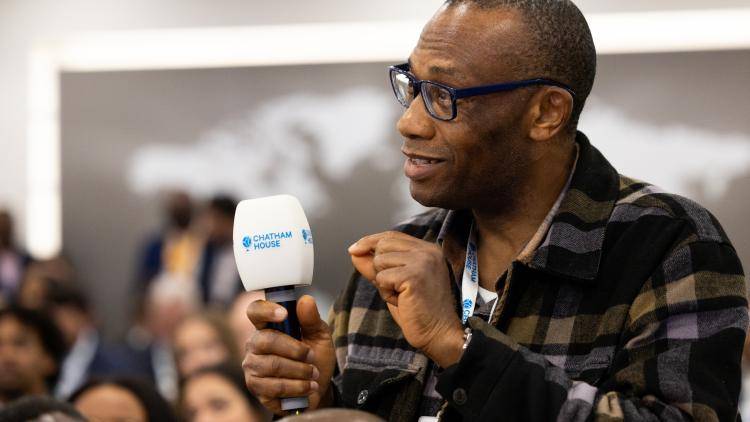
So, please raise your hand if you have a question. We will have a roving mic come to you. Please be concise, in the interests of time, and introduce yourself before asking questions. So, come to the gentleman in front here.
Lorin
Ah, thank you.
Georgia Cole
Oh, we just got a mic coming there, yeah.
Lorin
Thank you very much. I appreciate greatly the thought that maybe the UK needs to step up its game in relation to preparing additional arsenal. I think, Jamie, you talked to that pretty effectively. But I’d say that there’s also a glass half full side of that, as well, because we look at UK has committed 120,000 drones a year. These are small, like, £3,000 each, you know, cost, low cost, ground launched, to be able to interfere with the current Shahed drones and so forth that Iran has, that Russia has used prolifically. And as well, some of the more high-speed, the hypersonic, sort of, drones and stuff that Russia’s now trying to get up in the air. I think that we’re well prepared with the current technology to be able to address that and to counter these kinds of current – so, the current risks.
I’d say that probably UK – I’d just like to appeal and then, well, what can we do to encourage that? You mentioned that we have about a six-week – Peter had said there’s a six-week cycle that Ukraine goes through and then, they’ve just completely revamped. Consider all of the drones that UK is currently involved within in Mildenhall to be able to build and ship over to Ukraine now do not use Chinese parts. Now we have our own technology and it’s AI-centric, as well. So, that even if there’s interference as that vehicle is going towards its destination, there is a possibility, through various means, if there’s complete loss of GPS and everything else, there’s a possibility to still have that thing self-guide and to find targets very effectively and to be effective.
I’m here to say there’s a glass half full here. What can we do to bolster that very economically advantageous set of weaponry and then not worry about it? Now, I know we are – well, that HMS Wells needed a big refit and so, yeah, we – well, that was a little embarrassing on our part, okay, in the UK. So, it’s – but golly, we have so much technology and capability that we bring to the table for Ukraine and around the world, I’m excited. I know, like, as an American, actually, I’m embarrassed as anything about the current situation, and this is why I moved to the UK 11 years ago, in fact, to be here in this environment. And I never expected to get to this point, but I greatly and strongly support UK, and I’d say that there’s a glass half full here. What can we do to encourage that further development and not just have it be 120,000 drones, maybe more that we contribute then? Thanks. My name is Lorin, L-o-r-i-n.
Georgia Cole
Thank you. I’m going to take a couple and then we’ll come to you guys. So, we’ll just come over here.
Nic Lawley
Nic Lawley, Chatham House. A question to Liam Byrne. You’ve written the book on populism…
The Rt Hon Liam Byrne MP
Hmmm hmm.
Nic Lawley
…literally.
The Rt Hon Liam Byrne MP
It’s available in all good book…
Nic Lawley
Available in all good bookshops.
The Rt Hon Liam Byrne MP
Or wherever you buy your…
Nic Lawley
Do you – what’s – what relation does populism have to the argument of winning at home, here, or – with Europe? Obviously, it’s been tied historically, so I wanted you – to…
The Rt Hon Liam Byrne MP
Yeah.
Nic Lawley
…get your opinion on that.
The Rt Hon Liam Byrne MP
Great question.
Nic Lawley
And did I hear you calling for rejoining the EU to be in the next manifesto?
The Rt Hon Liam Byrne MP
I said there was going to be a lively debate, I think.
Georgia Cole
Cool, and then, if we just come to the lady here.
Irina von Wiese
Thank you very much. Irina von Wiese, I’m a former member of the European Parliament and Chair of the European Centre for Populism Studies. So, further to the previous question…
The Rt Hon Liam Byrne MP
Hmmm, of course.
Irina von Wiese
…a question about defending Europe other than militarily and specifically defending European democracy.
The Rt Hon Liam Byrne MP
Yeah.
Irina von Wiese
Now, I’ve just come back from the United States, from a dialogue with the Center for American Progress, and I can tell you that the outlook on the state of democracy in the United States was fairly pessimistic in that circle. And of course, we have seen infiltrations in pretty much every single member state of the European Union and not least also here in the UK, either via established or up and coming populist parties, or directly in terms of voter manipulation. So, how do you think we can co-operate in order to combat that, kind of, hybrid warfare and what would be the role of the UK in that kind of co-operation? Thank you.
The Rt Hon Liam Byrne MP
Crikey.
Georgia Cole
Cool. So, I’m just going to take one more question from online, from Melania Parzonka, which is about the SAFE loans. “Given that the programme’s expected to run until 2030, is there a possibility that the UK could still renegotiate late entry into the programme?”
So, just to summarise, we’ve got the question about new tech and how to take better advantage of that, pop – question for Liam on your book on populism. We’ve got defending European democracy and then we’ve got the SAFE UK entry. You don’t need to answer all of them. Take your pick of whichever you like. We’ll start with you, Sandro.
Sandro Gozi
On the SAFE question, the answer is very simple, yes, there will be a second phase, and I hope that in the second phase we can make it. So, I mean, I already say this in my introductory remarks. I won’t add anything about that, and we are committed as Eur – as a Member of the European Parliament, to make it happen.
On the issue of democracy, these are fundamental issues and it is one of the reason why we have also to strengthen our partnership across the Channel. I mean, we have to be aware that the borders have not really changed, that we have a – the President of the country who has invented multilateralism, as we have known since the San Francisco Charter, that he has decided to destroy multilateralism. To organise everything about economic business transactional approaches. Yeah, I’m talking about Donald Trump, yeah, of course.
And I think that our interest and our duty as a member of the government, as a member of the par – as elected Officials, is to reorganise an alliance of democracies and rule of law around the world.
The Rt Hon Liam Byrne MP
Exactly.
Sandro Gozi
That is exactly what we have to do. It is exactly what we stand for, especially as Member of the European Parliament, as Democrat. It is what Mark Carney has said. It is what Emmanuel Macron has said. It is what Keir Starmer has said. It is what slowly it is happening and this is – must be our main instrument to re – keep a peaceful and rule – international rule-based approach to the relationship between state and people in the world. And on that, a strong partnership, a strategic understanding between EU and UK can do a lot. Can do a lot to organise this multilateralism, can do a lot to bring in Japan, Canada, Korea, Australia, New Zealand. Can do a lot, also, to try to revitalise the existing multilateralism – multilateral organisation.
And I think that this also linked to how – the need to join forces, to exchange good practices, to be more efficient on cybersecurity to defend our democracies. That was the other part of your question. And I think that there are good stories, also, read – that I mean, recently, there have been good stories. The defeat or Orbán…
The Rt Hon Liam Byrne MP
Hmmm, exactly.
Sandro Gozi
…is a good story for all those in the world who stand on the side of democracy and rule of law.
The Rt Hon Liam Byrne MP
Hmmm.
Sandro Gozi
It’s not only an Hungarian success. It’s not only a European success. It’s a good news for this strategy, because there, that election, it was the most important election in Europe in the last eight years.
The Rt Hon Liam Byrne MP
Hmmm hmm.
Sandro Gozi
This is what, and we are shown that if we join forces, then I mean, we will see what [inaudible – 52:04] will say, but if the democratic forces join force, if they are smart, if they renounced Iran because there are the fundamentalists take on democracy overthrow. So, I mean, my allies, as a European political party in Hungary, decided not to run. I mean, in my party, the former leader of the opposition, Peter Marki-Zay, and he decided not to run. But he decided not to run not because he wouldn’t be an elected. He decided not to run because it was essential to save the fundamentals. The same spirit applies to us.
The Rt Hon Liam Byrne MP
Sure.
Sandro Gozi
The same spirit apply to us in democracy terms, in political terms and also in diplomatic terms, and I think that it is our duty to do it.
The Rt Hon Liam Byrne MP
Yeah.
Georgia Cole
Liam.
The Rt Hon Liam Byrne MP
Yeah, look, I mean, the right-wing populists have – are characterised by the three As, right? So, appeasement of Russia, autocracy at home and avarice everywhere. And, you know, the defeat of what is ultimately an etho-civilisational view of history requires us to summon what you might call the patriotism of our best ideals. And those were ideals which were learnt the hard way over a couple of thousand years’ worth of European history. To escape a world where fathers bury their sons rather than sons bury their fathers, we have to have democracy, tolerance and the rule of law, arguably the great gifts of Europe to the world.
And so, just as we defend those values at home, we have to be prepared to defend those values abroad. That is ultimately why we have to rearm to defeat a revanchist Russia, which is, in many ways, one of the fountainheads of this etho-civilisational argument which animates most of the populist world view. And that is why the defeat of Mr Orbán was such a seismic and seminal victory and it lit up, actually, a number of the tactics that are needed to defeat populists. So, one, you’ve got to assembly the heroic coalition and that a coalition of progressive forces who believe in those values. Second, you’ve got to be patriotic actually about the best ideals that you’re standing for, those European ideals. And third, you’ve also got to take on the kleptocracy, right? Because these people are corrupt and greedy and actually, that is something that doesn’t actually go down very well with electorates.
So, you’ve got to, kind of, take that on with force and energy, but it’s why this point about epistemic security is now so important. So, unless we safeguard our information supply chains, unless we get serious about algorithmic regulation, unless we get serious about taking on some of the oligarchic forces that profit from volatility in politics, then actually, we are not going to effectively safeguard this world that we came into politics to defend. You know, the kind of analysis that we did in the UK shows that about four or five people have organised about £175,000 over the course of four or five years, in building a media political complex that is absolutely based on the insights of Antonio Gramsci.
That’s the kind of political machine that we are now taking on, and it’s one of the reasons the transatlantic relationship of – is, I’m afraid, going to deteriorate over the next couple of years. Because what you’re going to see in Europe is a Europe that has summoned now the self-confidence to build a middle path between the oligarchs of America and the apparatchiks of China. And that is going to be difficult and dangerous, but actually, you know, everything that we see in the world tells us there is a huge alliance behind those values. When you, kind of, put those countries together that I talked about, I mean, there are about two billion people and about 40% of global GDP. So, you know, there is a, kind of, a serious middle power bloc here that we have got to mobilise.
Lord Peter Ricketts GCMG GCVO
On SAFE, well, I’m glad to hear that there’s a possibility that we can somehow get the UK in. I mean, I think the risk is that most of the loans will have been already allocated and of course, there’s a limit on how much third countries can have, 35%, I think, in total. Which basically, means there can be no UK prime on any SAFE funded programme. So, yes, maybe we can, but I think actually, businesses are voting with their feet and they’re doing plurilateral deals around the side to get programmes going. So – and I think we’ve rather missed the boat on that. Perhaps there’ll be other opportunities later.
On drones, I mean, I – you’re obviously a million times more expert than I am. It’s great to hear that the 120,000 were produced. Seems to me what we’ve mainly got to do, and I’m sure we are doing, is learning from Ukraine, because war generates innovation, you know, at warp speed, and we are not in war, we are very much in peacetime. It seems to me we’ve got to use government contracting to reshape our defence industry away from such reliance on the big primes who move in years and decades, rather than in weeks and months. More startups, more agility, do our procurement in a totally different way. I mean, I’m afraid MoD procurement is not what we want now. The Ajax fighting vehicle programme shows it one more time. So, the government can help, I think, but it’s essentially, in creating the space, empowering a new set of industries, perhaps small ones. I think we are good in the AI tech sector. So, that – I mean, that seems to me what it should be doing, and also, we need to sort out the readiness of our platforms. I mean, I think as you were saying, you know, the sudden emergency of Iran really showed up the Royal Navy’s lack of readiness. So many of its ships are in deep maintenance or not working for one reason or another. And before we, you know, spend a lot more on new existing platforms of that scale, we need to make sure that things are up and running.
I mean, maybe – you know, the fact that we are not fulfilling many of our NATO undertakings and commitments on force readiness is a real worry and I guess somewhere in there is why the government are having such a problem in producing the Defence Industrial plan. I’m afraid it’s got so bad now, as Lord Kerr knows as well, every time the poor Minister has to stand up and say, “It’s coming soon,” there is, sort of, ironic laughter around the chamber. So – and that really needs to come out, but it needs to reflect the reality you’re talking about of a different kind of defence industrial approach.
Member
Thank you.
Professor Jamie Gaskarth
Well, I’m a bit less positive about Eur – about the UK’s air defence capabilities at the moment, I would say. But I mean, the old rule of four seems to have been borne out by this. You know that you need four times the capability that you want in order to deploy, because if you think about it, we have six Destroyers and we could deploy one, you know, for – divided by four, it was, sort of, one and a half we could expect to be able to deploy in a crisis. You know, if you reduce your surface competence by that much, then that’s what you end up with. That seems to have been borne out.
You know, the – we were a poorer country in the early 1990s, and yet, we had 49 surface combatants in the Royal Navy, three light aircraft carriers, 34 Destroyer – 34 frigates, 12 Destroyers. You know, we’ve now got 15 surface combatants, you know. So, you’d – you can deploy maybe one Destroyer at any one time, maybe one and a half, maybe two frigates if you’re lucky, because that’s the numbers you’ve got, and it’s – this is a – decades’ worth of underinvestment and investment in other things.
So, it’s the same – I wouldn’t be really too negative about the Army, because the Army’s been in the same position. You know, in the early 1990s, we were able to deploy 30,000 troops in the first Gulf War. You know, now, at a push, we could maybe deploy a brigade, possibly, for a short-term intervention, but that would be about it. Now, that’s – that is an incredible situation to be in now and it is – so, the conventional capabilities do still need to be built up, even as we think about new technologies and new ways of living, we do have that comparative advantage and I think we can exploit that.
We’ve done fantastic things with Ukraine, and I think you’re quite right. So, yeah, I wouldn’t want to talk down the potential, but it does mean that we do need to think, as Peter was saying, about different ways of working. You know, look at Poland, take lessons from Poland. You know, they decided to reconstitute their tank force. 2022 they put in an order for 180 tanks; they got it last year. They put in another order for 180 tanks, 60 plus of which they’re building in Poland, so they’ll have sovereign capability. By – in a couple of years – by 2030, they’ll have over 300 tanks. We’ll have 148 Challenger 3s and it took us nearly two decades to get to there, you know.
So, where – you know, where are we buying from? What are our core capabilities? Where do we need sovereign capability? When can we buy off the peg? Is key questions.
Member
Hmmm, I agree, thank you.
Professor Jamie Gaskarth
Yeah.
Georgia Cole
Thank you. Unfortunately, that was all we have time for today, but we are hosting a drinks reception upstairs, so please do join us up there, and if you ask nicely, I’m sure the panellists will answer your questions that are left. So, thank you so much, everyone, for joining us tonight [applause].