Christopher Sabatini
Greetings all. It’s exactly 4 o’clock, so we’re starting right on time, which is odd for a Latin America based event, ‘cause we tend to follow Latin America time when we start these events. So, unless you’ve been sleeping under a rock for the last ten days or you’ve been in a coma, you’ve probably noticed that something happened in Venezuela. And, in many ways, we could argue that this was telegraphed a long time before, even in the National Security Strategy document. Rarely do Politicians of any stripe, of any ideology, actually do what they promise to do. In this case, we could’ve seen this coming, quite frankly, not just for the National Security Strategy document, which basically, declares quite bluntly that there’s, first of all, a Trump corollary to the Monroe Doctrine of 1823, and that corollary reserves the right for the US to intervene at will to protect its national interests across The Americas, the Western Hemisphere.
Now, that Trump – we can talk about – I won’t give a lecture on Latin American history, but the Monroe corollary, or the Monroe Doctrine, was originally to prevent European fro – European countries from either asserting influence or recolonising The Americas. We’ve obviously entered a new era and there’s about – this is now about narcotics, it’s about immigration, it’s also about resource control.
So, what we’ll be doing today is talking about all of those issues, but we won’t rehash the events of January 3rd, you probably all know them. But basically, after a six-month buildup of the largest naval fleet in the hemisphere since, I believe since the Cuba blockade, the Cuba Missile Crisis, the US executed a snatch and grab operation that removed Maduro and his wife, who are now in a Brooklyn jail awaiting trial, and power has been passed to the Vice President, Delcy Rodriguez, and the apparatus of the Maduro government, with all of the corruption and narcotics trafficking and illegality remains. There are promises of a regime change or a transition. We don’t know how likely that is or even the timeline for that.
So, what we’re going to talk about are a number of things here today, and I’m delighted to have a really great panel to look at different aspects of it. I won’t read their bios, you should have them, but first of all, General Sir Richard Barrons is the Senior Consulting Fellow for the International Security Programme at Chatham House. He served as the Commander of Joint Forces Command, now is Strategic Command, and where he was one of the six Chiefs of Staff leading the UK Armed Forces.
Chris Aylett is a Research Fellow in the Environmental Society Centre at Chatham House. He’s a colleague of mine, is a specialist in energy markets and oil in particular. And my friend, Vanessa Rubio, here, joining from Mexico, is an Associate Fellow. She was Secretary for Latin America in the Foreign Ministry. She was a Senator in the Mexican Senate. She was also, I believe, correct me if I’m wrong, the Vice Minister for Social Development in Mexico, under the Peña Nieto government. And is now, I’m proud to say, an Associate Fellow at Chatham House and is teaching at the School of Public Policy at LSE, and lives in London, though taking a break in a hopefully, much better climate in Mexico right now.
So, what I’m going to do is engage in a discussion. I don’t want to have presentations. I have a short attention span. I like to keep the conversation going. So, let me start first with you, Richard, on the issue of what does this mean in – I mean, how can we interpret this in terms of US policy, in terms of the sanctity of national sovereignty, the willingness of the US to do what it wants and what it implies, not just for how countries react and are now put on notice of US intentions and the like, but also in terms of geopolitics?
General Sir Richard Barrons
So, I think it’s better and wiser to accept all the things you’ve just said, which is…
Christopher Sabatini
I like that…
General Sir Richard Barrons
…we’ve been wondering for a while what sort of world we were now living in, because we understood we were not in the comfortable world of the post-Cold War era and the, what we used to call the “rules-based international order.” And I think we’ve been wondering, well, what is the shape of this new world? And in the context of the US, I think it’s important to recognise they have been consistent. They wrote down in the National Security Strategy the same sorts of things they said a year ago at the Muki – Munich Security Conference and they have said and acted in accordance with that.
And so, it seems to me wiser to proceed from the presumption that we now operate in a world where the US is dominated by its own definition of its national self-interest. And that is broadly defined by an American administration which will do what it thinks it can do on the basis that it has the power to do it. And there really aren’t too many other complications that surround that. And therefore, we can begin to talk about an era of US hemispheric imperialism, where it intends to dominate its hemisphere on terms that it sets, dominated by being by far the greatest military force in this world. And that will have profound consequences for the other inhabitants of that hemisphere, not least the population of Venezuela today and maybe elsewhere, and profound implications for other powers that think they have a hemisphere, China, for example.
Christopher Sabatini
Yeah.
General Sir Richard Barrons
And for Europeans, like me, a recognition that the two lifetimes spent benefitting from security subsidised by the US taxpayer and feeling an important but junior player in some liberal democratic world order, it’s all gone now.
Christopher Sabatini
Yeah.
General Sir Richard Barrons
And so, we’re going to have to act differently. What I think would be the wrong thing to do will be to think this is an aberration or a blip and we’re going to back – go back to how we were. That feels to me the least likely outcome, and all the things we need to do now are harder and more difficult, but that’s because they’re harder and more difficult.
Christopher Sabatini
Let’s play this out a little bit beyond Venezuela. I want to get back to Venezuela, but what does this mean – you mentioned ‘we’. I assume you mean, sort of, the liberally minded international players is the ‘we’, probably assume, though, most of us in this room, as well, we should prepare. Who is the ‘we’ and what does that mean?
General Sir Richard Barrons
So, I think you have to choose a ‘we’. You could choose to cleave to the US and decide to migrate into that hemisphere in some fashion. That seems to be unlikely. The ‘we’ I think we’re really all talking about here is the Continental Europe and the UK. Broadly 500 million people, an economy that’s not far off the size of the US economy, but a continent, if I can use that expression…
Christopher Sabatini
Yeah.
General Sir Richard Barrons
…that for 40 years, at least, has decided not to align political or military power with developing economic strain, and has enjoyed that a lot and spent its money in ways that were very comfortable. And so, I think we’re in this difficult place where, as a direct consequence of how the US is deciding to act in the world that we live in now, we are going to have to confront the need to decide either just to roll over and take whatever punishment people choose to mete out to us, or we’re going to have to rediscover that it is necessary to do difficult things to provide for your own security and defence and protect your interests. And we haven’t had to do that for two generations, so it’s unfamiliar, unwelcome and expensive. And I would also say at the minute, we are actively choosing not to – in the UK, not to do that.
Christopher Sabatini
Let me just – we have other panellists; I’ll get to you in a second. I just want to dig down a little bit more on this, in the sense that are you talking about it’s every country for him or herself? I know countries don’t have genders, but you get the point. Or is – are there mechanisms of international co-operation that can be reformed or fit for purpose for defending these things? I mean, and not the ones…
General Sir Richard Barrons
Yeah.
Christopher Sabatini
…that are US-led.
General Sir Richard Barrons
So, I think from the perspective of European states, there is no European state that is going to survive and protect its interest and prosper if it tries to pretend it’s isolated in this world. And in the context of the UK Strategic Defence Review, it was clear that it all relies on a sense of collective security, which is a pay to play undertaking. And I think all European countries are circling the reality of a NATO with less US, but let’s please say with some US. It’s important to both the US and Europe.
Christopher Sabatini
Yeah.
General Sir Richard Barrons
But actually, for European countries, we’re going to have to find a new modality for coming together. Now, I know there are complications here around the European Union and NATO and those things that fly, but unless individual European states find ways of acting collectively, then they are relatively easy to isolate, pick apart and subordinate. And so, collective security is an act of self-interest.
Christopher Sabatini
Yeah. Vanessa, I want to turn to you before we get to the global oil questions. The ‘we’ of Latin America, how is Latin America receiving this? It – you know, it really – and I hate to be blunt, it really has, basically, the crosshairs on it right now, given the new Trump corollary to the Monroe Doctrine. How – and obviously the ‘we’ is very fragmented in this case. You have more pro-Trump governments, like Javier Milei in Argentina. There are others that may likely be coming in this round of elections to be held. And we’ve already had the Chilean elections, produced a centre-right candidate, pretty right candidate, Peru, Colombia, Brazil. How is this being perceived in Latin America and how are they planning it? I mean, how are they planning to respond and defend themselves, in some cases, or at least embrace it?
Vanessa Rubio-Márquez
Thank you, Chris, and thanks for having me. Just before I get into that particular question, I would like to challenge you say – said and agree with something that the General said. I would like to challenge the fact that Politicians rarely do what they commit, or what they say. I think in this New World Order we live in, we need to begin to really believe in what populists and Politicians say, because they’re going to do as they say most of the times. So, we need…
Christopher Sabatini
Yeah.
Vanessa Rubio-Márquez
…to understand that. And I would also agree with something that the General mentioned, which is that we used to live in a “rules-based order,” world order, and now it’s a complete different stance in which we’re living. And this is summarised by the famous recent phrase of President Trump in the United States that said, “I don’t need international law. I am only constrained by my own morality.” So, again, we should believe in those words, and we should begin to make sense of the New World Order in those terms, as well.
But going to your point, I don’t think there’s a ‘we’ in Latin America. I think Latin America today, perhaps more than any other time in the past, is more fragmented and more individualistic than ever. And it was very clear if you analyse the different responses from the different countries after what happened in Venezuela. You had Milei from Argentina, Bukele from El Salvador, Noboa from Ecuador, you had Peña from Paraguay, you had Guyana, you had Trinidad and Tobago, basically praising the action of the United States, without any caveats. No, it was, basically, praising what was done in that action.
And then you have four other countries, relevant countries in the region, in very different circumstances because they either had already an election and someone else is going to run the country, as is the case with Chile, with Kast, as of next March. But you also have elections this year in Peru, in Colombia and in Brazil. So, that leaves these three countries in a complete different situation vis-à-vis the US, because the US is going to engage with the new governments, most importantly and mainly. And now you – and then you have Mexico, in a complete different situation, with a very complex relation, very intricate and wide and multilevel relation with the US, that comprises, of course, migration, that comprises security, that comprises trade. And all of that creates a very different stance from – for Mexico to react to what is happening vis-à-vis the US and Venezuela, but in relation to the specific countries and the US.
So, I don’t think there is a ‘we’. I think there is a very fragmented region, and I think what we will see is very pragmatic bilateral relations between the US and the different countries of the hemisphere, based in the premises of the new National Security Strategy of the US. And again, if you go to the letter of that National Security Strategy of the US, basically, what they want is a Western Hemisphere that is stable and they said that is ‘well-governed’. That they discourage mass migration. That they increase co-operation against narco-terrorists and cartels and that they are free of hostile foreign incursion.
So, basically, if you understand this, everything has a check in what happened with Venezuela and then you would have to also see the bilateral relations between the US and the other countries in Latin America on a – under this lens, as well.
Christopher Sabatini
So, good points, all, but obviously, we also now know that Trump is, kind of, feeling emboldened by the relative short-term success of his grab and go mission, Nicolás Maduro and Cilia Flores. He’s now talking about doing something similar in Cuba. He’s said, “Cuba has a deal – has to make a deal or they’ll suffer the consequences.” Mexico, he’s talking about strikes in Mexico on cartels, and obviously, Colombia, at least until Wednesday of last week, a week ago, he was in a very severe war of words with the President of Colombia, Gustavo Petro.
What is the sense – let’s just take Mexico, where, obviously, you are, and you know well. What’s there’s a sense of? Is there a sense of fear, or is there a sense of foreboding, is there a sense of nationalism? What – how are people reac – responding?
Vanessa Rubio-Márquez
I think that also has to do with the current domestic situation in Mexico, where a polarisation, as in many other countries in the world, or most of the countries in the world, is the day-to-day. So, you would find a very polarised reaction to that rhetoric from the US in relation to saying, “Yes, we need,” you know, “support from the US, we need co-operation from the US, because we really need to get rid of the cartels and we want security and peace in Mexico.” And you, of course, have a very different stance from the other side of the isle, saying, “Yes, we need co-operation, but the co-operation has to come with caveats.” But I would say that the maj – more intense co-operation, but has to come with caveats, and the most important part is, obviously, to defend sovereignty and the free determination of people. So, no intervention whatsoever of any sort from the US or any other country.
But I think that most importantly, what Mexicans understand is that Mexico needs to do more to combat organised crime, to combat the cartels and to increase safety and security in Mexico. That is something that most of Mexicans, or all of Mexicans, believe that needs to be done, but the question is how that is done, no, and how much involvement and co-operation from the US is needed to do that. And I would say that Mexico has been co-operating more and more recently, different to what happened under the presidency of Andrés Manuel López Obrador. I think that this government is doing more actions in relation to exchange of information, exchange of intelligence, exchange of, you know, a series of people going from Mexico from the military and the navy, to be trained in the US. More participation of security officials in the US Embassy in Mexico.
So, that is moving forward as well as a co-operation on migration. Migration contacts in the border in the US in 2023 accounted for 2.5 million and last year there were a little bit over than 300,000, the least that have been in the last 50 years. So, there is a lot of co-operation on migration going on today between Mexico and the United States. There’s a lot going on in relation to security. But of course, I wouldn’t overrule an action that is more drastic and more unilateral from the US being considered, but at the same time, co-operation is such a intense and such a – on a daily basis between Mexico and the US, that I think other considerations will have to be analysed for the Mexican case in specific.
And we’re, of course, in the context of renegotiating the USMCA. Mexico, for the public that is not Mexican or not necessarily follows Mexico, is the first trading partner of the US, the first source of imports and the first destiny of exports. So, all of those considerations make Mexico a very unique case in relation to the actions that the US takes moving forward.
Christopher Sabatini
Not to mention the co-operation in manufacturing that crosses borders, whether it’s cars, aeroplanes, what have you, that is very close, and that would be disrupted. I just want to ask one quick question to Richard, given your security background, before I turn to Chris. How effective, given your time in the field in the security service, are targeted drone strikes or missile strikes on cartels?
General Sir Richard Barrons
So…
Christopher Sabatini
It’s, kind of, a loaded question, I know.
General Sir Richard Barrons
So…
Christopher Sabatini
I’ll admit that was [inaudible – 20:49].
General Sir Richard Barrons
…the first thing about a drone strike…
Christopher Sabatini
Yeah.
General Sir Richard Barrons
…is that they work best in environments where no-one is trying to shoot your drone down. So, in Venezuela and in – previously in places like Iraq, that was the case. In Mexico, depending on how it’s arranged, it might be more challenging, but people tend to overlook that a lot of targeted strikes have relied on the fact no-one’s trying to shoot down the things that are doing the targeting. If they are, then you’re in the sort of air package you saw in Venezuela.
The second thing is if you know that a site is a fixed location, and you can see it from space, generally, if you have affirmation about what it does, and that usually requires not just technical intelligence, but human intelligence, you need to be reasonably certain that that is a fentanyl laboratory. It’s not really hard to do if you invest in months of intelligence effort, but if you know that and you can control the sky, it’s just not difficult to do.
Christopher Sabatini
Is it effective, though?
General Sir Richard Barrons
So, it’s effective. It’s destroying the thing that was there that day, but that’s…
Christopher Sabatini
Oh, that’s…
General Sir Richard Barrons
…all looked at.
Christopher Sabatini
It’s a very low bar, but okay.
General Sir Richard Barrons
That’s all it does, and so it’s a bit like the argument about if you decapitate a terrorist organisation, so…
Christopher Sabatini
Yeah…
General Sir Richard Barrons
…you mount…
Christopher Sabatini
…you destroy the…
General Sir Richard Barrons
…a strike and you kill the leader, well, you know, you’ve had a good day. But then, someone else will be appointed and that somebody else you’ve got to work out who they are and they are generally going to be younger and more radical than the one that you’ve just removed. So, it may not work that well, but you are, kind of, committed to that path.
But I think in some ways, it’s looking at the problem from the wrong end, because…
Christopher Sabatini
Yeah.
General Sir Richard Barrons
…in the case of President Trump and the way that he makes policy, which seems to be a combination of what plays well on Fox News and a dopamine hit, if he feels there’s advantage to how he looks in making that kind of strike, I don’t think he’s worried about the detail.
Christopher Sabatini
Yeah, yeah, yeah, sure.
General Sir Richard Barrons
And no matter what his Advisors say about, well, you know, “You might get a moment’s gratification but then it gets harder and there’ll be a blowback,” I don’t think he’s troubled by that.
Christopher Sabatini
Yeah.
General Sir Richard Barrons
And we need to remember that when you’re applying force, people like me to try to be really rational about it, but quite often, they’re as much driven by emotion as they are by reason.
Christopher Sabatini
Yeah. Chris, if you were listening to – despite all the buildup that Donald Trump had claiming this was about combating narcoterrorism, it’s about an illicit regime, corrupt regime, it’s about ties to Russia, China and Iran, what you hear now is it sounds like Donald Trump has opened a petrol station. “Come on back, we’ll fill up your tanks.” How effective is it? Given the – well, let’s just start first with the state of global energy markets for oil. The one – new producers that are really ramping up production, what that will affect, and then, of course, the actual content of Venezuelan oil and the conditions for investment. What – give us a quick summary, and by the way, he wrote a great – Chris wrote a great expert comment for Chatham House recently, I highly recommend it, but go ahead.
Chris Aylett
Thank you. So, yeah, it’s a remarkable pivot. It suddenly became all about oil very, very quickly. See, I was thinking about this earlier on.
Christopher Sabatini
Never democracy by the way, it’s funny.
Chris Aylett
Yes.
Christopher Sabatini
It didn’t – democracy didn’t really figure into this but go ahead.
Chris Aylett
Yes, not so much. Yeah, I was thinking about this earlier on and I, kind of, think you can almost put the reasons why it won’t work into five large buckets. You’ve got the state of the resource. So, as has been talked about, it’s, kind of, heavy, sour crude oil, which is difficult to extract and trades at a discount. You’ve got the state of the infrastructure, which is decrepit after, sort of, decades of underinvestment, sanctions and the rest of it. You’ve got regulatory barriers that remain in place under the current regime. You’ve got the uncertainty, like who knows what Venezuela is going to look like? Who knows what the US is going to look like? You’d have a promise from President Trump along the lines of “We will reimburse you for any losses.” What that means to the Head of Exxon, I don’t know.
Christopher Sabatini
It’s a lot of money is probably what it means.
Chris Aylett
It’s a lot of money, precisely, yeah.
Christopher Sabatini
Yeah, to your…
Chris Aylett
So, a…
Christopher Sabatini
…taxpayers.
Chris Aylett
…gigantic subsidy, yeah.
Christopher Sabatini
Yeah.
Chris Aylett
And then what I think’s really interesting, number five, is the oil price and the outlook for oil demand in the future. So, since about 2022, when it spiked after the Russian invasion of Ukraine, the price of Brent has been on a gradual decline and it fluctuates here and there with geopolitical shocks, but if you, kind of, zoom out, you look and it’s a fairly constant decline. And another thing that’s happened over the last five years, and I’m not saying correlation is causation, but it’s interesting that you spoke of that bit at the same time, is that China has, kind of, exploded onto the scene as a producer of electric vehicles. Now, what that’s happened is that has absolutely devastated, sort of, oil demand in China, at a speed that really few people saw coming. And it’s not just like passenger vehicles, it’s, basically, trucks and buses and so on. And China being, I think, the second largest oil consumer in the world, that has really started to substitute oil demand.
And with, you know, President Trump’s “Drill, baby, drill” mantra, as well as, you know, lots of oil exploration and development happening in other countries, we’ve got a situation of oversupply. And if electric vehicles continue to, kind of, roll out as they are and it’s most, sort pronounced in China, but we are seeing it start to take off in different countries as well, as they get cheaper and more sophisticated, that’s a structural trend affecting oil demand in the future. And if supply continues as it is, you can see prices just gradually slipping. And what this means for Venezuela, where you have to invest, like, hundreds of billions of dollars to get their infrastructure up and running and then get this expensive oil out of the ground and market it and so on and so forth, it’s an unclear picture. And at the prices which they are today, and, you know, with the potential of them falling further, it would be difficult to see how that adds up.
So, there are quite a few reasons why the basic economic rationale for doing this looks shaky, to say the least.
Christopher Sabatini
Yeah, and I’m not here to flog Chatham House publications, but in 2020, we published a report that said, unlike what Trump is saying, it’s ‘$100 billion’, we estimated it as ‘$280 billion’ to get production up to where it was, the three million barrels of oil per day. Which I mean – and you’re talking about new oil supplies coming online from – which I assume are easier and cheaper. So, the price point now, global barrel of oil, is around $60 a barrel?
Chris Aylett
Just over $60 a barrel, yeah.
Christopher Sabatini
Yeah, so what is the price point? I mean, a lot of these countries, Guyana being the next-door neighbour, it’s much lower. So, I mean, it’s competing against a very difficult competitive set, right?
Chris Aylett
That’s exactly right, yeah. So, the, sort of, breakeven – I don’t know what the, sort of, predicted breakeven for, you know, fully developed Venezuelan reserves would be in the future, but it will be high, because generally, their grade is seen as having a high breakeven, you know, above the, kind of – I think above the, kind of, 62 we’re seeing today. But yeah, as you mentioned, Guyana, which is being developed next door, that I saw sight today has the breakeven of about $30 a barrel and they have a much more, sort of, stable and welcoming government than you have in Venezuela.
So, yeah, in comparison, it doesn’t look good and that’s before you even think about Saudi Arabia, which has the sec – I mean, as you say, the, sort of, Venezuelan oil resource is said to be the largest in the world. Just behind that is Saudi Arabia and their resource is much, much easier to access and much, much cheaper to develop. And they haven’t had – you know, they’ve been investing in their infrastructure, as well.
Christopher Sabatini
Yeah, and they have the global market. I mean, part of it is, sort of, re-entering a global market. I want to get to the issue of the geopolitics of this energy now. Because obviously, one of the things that we’re seeing is, at least – you know, again, this is one area where I think, among many, the Trump administration has been quite hyperbolic about – you know, if – ‘cause – because of US sanctions, most of Venezuelan oil was going to China. And now they’re claiming, well, they’re going to cut off the oil to China, the subsidised oil of China, which was being used often to, sort of, pay back loans that China had made to Venezuela. Will this affect China? I mean, is this a real threat?
Chris Aylett
So, I must credit Michal Meidan from the Oxford Institute of Energy Studies for doing some amazing, sort of, rapid reaction on this and the short answer is, no. It’s, basically…
Christopher Sabatini
Quite a good short answer.
Chris Aylett
…China is very important for Venezuelan oil exports, but the opposite is not true. So, about half of them go to China, but it only accounts for, I think, 3-4% of China’s entire oil imports and it goes to a specific sort of refinery, they’re called teapots. And they will be, you know, sort of, dismayed by this, but they tend to be state-owned, and they will be able to access other sources for this particular sort of grade relatively quickly. And in any case, as we say, China’s oil demand is gradually going down, anyway. So, I think in terms of, like, energy security, this isn’t going to be a problem…
Christopher Sabatini
Tell me…
Chris Aylett
…for China.
Christopher Sabatini
…what you were saying about – tell the audience what you’re saying about the Prime Minister of Canada, Mark Carney, where is he right now?
Chris Aylett
So, I must actually credit – I’m going to credit a few people.
Christopher Sabatini
Okay, sure.
Chris Aylett
So, this is one of my colleagues, but – one of my colleagues, Phesheya, she pointed out to me that yeah, the Canadian Prime Minister, Mark Carney, is currently, I think currently in China or on his way to China, and oil is going to be on the agenda. And it’s, basically, because the heavy crude that comes out of the Canadian oil sands, basically, if that is – if the heavy oil that is currently going from Venezuela to China is suddenly cut off now that the US is controlling that, basically, Canada would like to step up and say, “Oh, we will be happy to step in and buy that from you.”
Christopher Sabatini
Those teapot refineries may…
Chris Aylett
The teapot refineries…
Christopher Sabatini
…find new business coming from…
Chris Aylett
…exactly.
Christopher Sabatini
…Canada. Yeah, but Richard, the issue of Russian oil and the geopolitics…
General Sir Richard Barrons
Hmmm hmm.
Christopher Sabatini
…of Venezuelan oil coming online, good or bad or what have, how does this play in, or does it not at all? Are there other considerations that are broader, besides just the market, in terms of the geopolitics of Russia, China, Saudi Arabia, Qatar and the like?
General Sir Richard Barrons
So, I think there are two things that really matter. I think the first and primary point is if you look at how the US has behaved in Venezuela and how it’s announced it’s going to behave over its hemisphere, it is creating a precedent which countries like Russia in the way they have acted in Ukraine, will take as affirmation, and in the way that China will think about its role in the Pacific. And there is this sense, which I think comes from President Trump’s world view, which is that’s what big powers do, they carve up spheres of influence between them. And I think that is profoundly unsettling for countries like Europe, as we’ve discussed.
The business of oil, I think, is closely connected to that, but what I think one has to do is to take a holistic view of what we’re talking about here. So, we’ve discussed how the Venezuelan supply of oil to China is frankly, marginal and irrelevant, so we don’t have to worry about that. The global oil price is profoundly important to how Russia can afford to continue to prosecute its war in Ukraine and for many of us, I guess, that’s the thing. We would like the oil price that Russia gets to be as miserable as possible, as the most likely way of forcing it to culminate its actions in Ukraine. And it’s better if that’s done by design, but if it’s done by accident, we’ll swing with that.
The second aspect, which is…
Christopher Sabatini
Can I just ask one quick question on that? Sorry to interrupt, but does that mean, also, that the ceiling would have to come down on the price of Venezuelan oil that’s currently established under the sanctions?
General Sir Richard Barrons
So, I’m no expert in this, but my view is every dollar that the global oil price falls in terms of the receipts Russia gets from its oil reserves, reduces significantly its ability to prosecute the War in Ukraine…
Christopher Sabatini
Okay.
General Sir Richard Barrons
…further down the line.
Christopher Sabatini
Okay, thank you.
General Sir Richard Barrons
And that, for me, is the metric.
Christopher Sabatini
Interesting.
General Sir Richard Barrons
The second thing, which I think is just as interesting and I remain uncertain about it, is this developing sense that the United States and its oil majors recognise the prospects in the Arctic for oil exploration and recognise that that requires an accommodation with Russia, an accommodation that they cannot secure whilst we’re still having a wall in – a war in Ukraine. So, somewhere in all of this there appears to be a policy conundrum about America’s oil-based national interests, which will take it to Russia for obvious reasons, and I would say certainly European, Western securities, which are about making sure that the outcome in Ukraine is beneficial for European security as a whole. And these things seem to be at odds…
Christopher Sabatini
Interesting.
General Sir Richard Barrons
…with each other.
Christopher Sabatini
Interesting. While we’re on the subject of oil, Vanessa, Pemex, the Mexican state company, its – basically, its production has cratered. Private sector has come in. Will this affect Venezuelan oil production or the will – or will it also affect Venezuela – I mean, sorry, Mexico’s oil production and Mexico’s economic growth rates, given its previous reliance on oil, not as much as Venezuela, but still?
Vanessa Rubio-Márquez
I think that it all depends on the order of magnitude of the trends and what lays for the future in relation to oil markets in the world. I would say that Pemex has its own problems, regardless of Venezuela, and Pemex own problems, basically, is investment, is financial viability, is the fact that it needs to focus on profits and productivity. You need to upgrade infrastructure, you need to upgrade storage capability, distribution capability and of course, you need an environment in which investment feels that the conditions are there to invest for long-term. Because oil is a long-term investment, so it’s not something that will happen from one day to the other, and that’s the case for Mexico, but that’s the case for also understanding what will happen and what can happen in Venezuela, no?
So, what you need, both in Mexico and in Venezuela, and anywhere in the world where companies would invest resources in oil, in the oil sector, is you need, basically, institutions that guarantee your investment. You need dispute settlement mechanisms that are rational and coherent and certain. You need rules, you need laws, you need regulations. You need clear rules of the game in relation to PPPs or farmouts or mixed investments, in the case of Mexico, however you want to call them. So, you need an environment that creates certainty for investment and that is a parallel that you can make in relation to what lies in the future for Venezuela and what lies today for Mexico.
Mexico, it’s doing a part of this possibility of having mixed investments and I don’t think that today, since the effects are not going to be immediate from whatever happens in Venezuela oil – in Venezuelan oil, Mexico today needs to fix Pemex. It’s a different situation, a very domestic situation, and Mexico does not depend on oil as it depended in the past, no? Today oil income is around 1% of GDP, a little bit over 1%…
Christopher Sabatini
[Or – 36:06].
Vanessa Rubio-Márquez
…of GDP, and it used to be 8% back in 2008. Today the public income, or the public revenues from oil is less than 4%, but that is – but Pemex – this is still a very important element for public finances, because that – it’s intertwined what public finances, you know, look like and behave like in relation to Pemex. For instance, in the six years of Andrés Manuel López Obrador, the Mexican public finances injected $80 billion to Pemex in order to make it viable, and this – that accounts for 70% of the whole debt of Pemex.
So, yes, Pemex has a fiscal and a financial challenge and a challenge of investment, but it’s a larger one and it’s very linked to domestic policies that still need to be improved in order for investment to happen in Mexico and in particular, in the energy sector and in Pemex.
Christopher Sabatini
Thank you. To all the audience members, we’ll start asking questions, or I’ll start asking questions, in five minutes. So, please, if you have any comments or suggestions or questions, please prepare them. That also goes for you online. I have – all you online, please, if you have questions, please send them on the chat. Let me just ask, kind of, a slightly dangerous question in terms of speculation. What shall we look for next, in terms of what – how has the in – how can – let’s just take the case of Venezuela. A moment where I believe, yes, Trump was signalling this for a long time, but I think regional diplomacy in Latin America, sort of, failed when it didn’t try to do more after the stolen 2024 elections and, sort of, just kicked the can down the road. Now they end up with this intervention.
Are there any lessons that can be learned from the international – for the international community from this? I think you’re right, Vanessa, you got to take Trump at his word, as difficult as that may sound sometimes, so when he wants to do something. So, what are – and in terms of diplomacy, in terms of keeping an eye out for things, what are some of the things we should be aware of to try to track this, if I can say it, rather chaotic world we seem to be living in, increasingly? I’m going to start with you, Richard, the security person…
General Sir Richard Barrons
So, in the…
Christopher Sabatini
…on the panel.
General Sir Richard Barrons
…context of Venezuela…
Christopher Sabatini
Yeah, I mean, just say…
General Sir Richard Barrons
Okay.
Christopher Sabatini
…what are the lessons from Venezuela…
General Sir Richard Barrons
So, I think…
Christopher Sabatini
…for us?
General Sir Richard Barrons
…there are a couple of things that are really important. The first is the military operation to remove Maduro was a great success and trumpeted as such. That has caused people to gloss over how hard that was and how lucky they were.
Chris Aylett
Yeah.
General Sir Richard Barrons
So, it’s created a sense that you can do these things and there’s no cost attached to it. There were 150 aircraft in the sky. One helicopter hit by some sort of gunfire, one Pilot wounded, no aircraft lost, no casualties. And if you think about it, all of that had to work and at some point, some helicopters had to land in the dark in a hostile place and the occupants of that helicopter, skilled people as they are, have to mo – have to get out without being shot, move quickly across some open ground without being shot, whilst being shot at and shooting other people. And they got Maduro just before he got into his safe room, which would’ve delayed the thing for probably half and hour, and there would’ve been consequences. So, if I were the Advisor to that operation, I would say, “You have to assume you’re going to lose aircraft, you’re going to lose people. This is not going to be a free hit and it may fail.” But because it worked superbly well, with the advantages of preparation, surprise and overwhelm and coping, it’s created a legacy you can do that. You should be really cautious about that.
The second thing is all they’ve done is removed the Head of State and now we don’t really know what happens in Venezuela. And based on you – experience in the Balkans, including Kosovo and Iraq and Afghanistan, what do you need to know? Well, you need to know do you really understand how Venezuela actually works? ‘Cause if you don’t, and America may, but if you don’t, you have no sense of how to run that country or make it work. Secondly, do you know how much consent you have from the population of Venezuela? Because it’s quite one thing to remove the leader of a state where the entire population is grateful and pleased to you, and quite another thing to remove the Head of State and what you’ve got is a population which is ambivalent about your arrival. We’ve seen that in other places.
Thirdly, do you know where the money goes, because we’re talking about the oil wealth, but Venezuela has some of economy that ticks over in some fashion? And then, if you’re going to provide all the money as the United States, people will cleave to you ‘cause you’re going to make them rich and happy, but if you’re not going to do that, they’ve still got to eat and make a living. So, how does the money work? And a really important part of that and a brutal lesson in Iraq and Afghanistan is, do you understand how the corruption works? Because you may be full of noble intent and fuel it up with money, but then you watch it robbed and then you see the effect that has on the population’s support for what you’re trying to do.
So, I don’t think we know yet how this works in Venezuela. I don’t think the US knows how it works because I don’t think the US have looked too closely at what they have to do to keep Venezuela co-operate and pliant once they’ve removed the Head of State.
Christopher Sabatini
Thank you. There’s obviously a whole bundle of issues on what happens in terms of any potential political transition in dismantling the autocratic corrupt state that, first Chávez and then Maduro created. I’m going to start taking questions, but did you have any co – do you have any other comments on this to – other things to look out for, Chris, from your perspective? What can we learn from Venezuela?
Chris Aylett
Hmmm hmm.
Christopher Sabatini
I think to make Venezuela an example.
Chris Aylett
It’s – but I think one thing it highlighted to me, I mean, this is all – you know, it’s consistent with, as others have mentioned, the National Security Strategy and the way President Trump is, kind of, you know, operating in his second term. This is all, you know, within that framework. But it’s really been quite striking to me the, kind of, the bombast of going in there, doing something thi – quite this dramatic, while seemingly really not having though through what happens 24 hours later. And as I say, when I’ve been looking into the rationale for the oil side of things, it’s just not there, and then you follow the discussions with the oil companies and so on, and it’s – you wonder the extent to which they are involved in it.
And I think, yeah, just the – I think we knew Trump was unpredictable before, but – in terms of, you know, the rest of the world, kind of, dealing with him, but this has really, really underlined it to me on a whole different level.
Christopher Sabatini
Yeah. Vanessa, any lessons for you from Venezuela?
Vanessa Rubio-Márquez
Yes, I think that one thing to be closely watching is Maria Corina Machado’s visit tomorrow to Washington D.C. I think this will give us a lot of light in relation to what will happen next, and what will happen next in relation to, basically, as free and as fair elections as possible for the future in Venezuela. And any good thing that could happen in Venezuela and any sustainable thing that could happen in Venezuela passes through free and fair elections and…
Christopher Sabatini
Yeah.
Vanessa Rubio-Márquez
…passes through the re-establishment of democracy in the country. So, that will take a while. That takes several steps, several layers. It’s very complex, but of course, the beginning was to getting rid of Maduro, no, and that is something that was celebrated in Venezuela, as we all saw, and was celebrated in many other places in the world. But what will come next is very multilayered, very complex and is not granted yet. So, we need to see what happens after the visit of Maria Corina Machado tomorrow and of course, anything in relation to investment in the country, as sustainable as possible for the future, has to pass through re-institutionalisation of Venezuela, the country as a whole.
Christopher Sabatini
Thank you. We’re going to take questions here. We have roving microphones and a lot of hands, which is good. While we’re waiting for the microphones to arrive, I do want to just say one thing, one – as, sort of, a personal comment on this. First of all, 80 – according to an Economist poll, “80% of Venezuelans approve of the actions of January 3rd,” but fewer, about “60% want to see elections in the next six months.” So, there’s – we’re bumping up against some timelines here, and I just want to say one thing, when Maria Corina meets with Donald Trump tomorrow, the meeting’s going to focus on the contest of who can own the Nobel Peace Prize. That’s petty, it’s ridiculous, I hope we don’t focus on that. I hope we focus on the issue of what is the plan that Maria Corina Machado is going to be delivering to Donald Trump in terms of what he needs to do to set the path on democracy, and not this weird obsession over, quite frankly, President Trump’s pettiness.
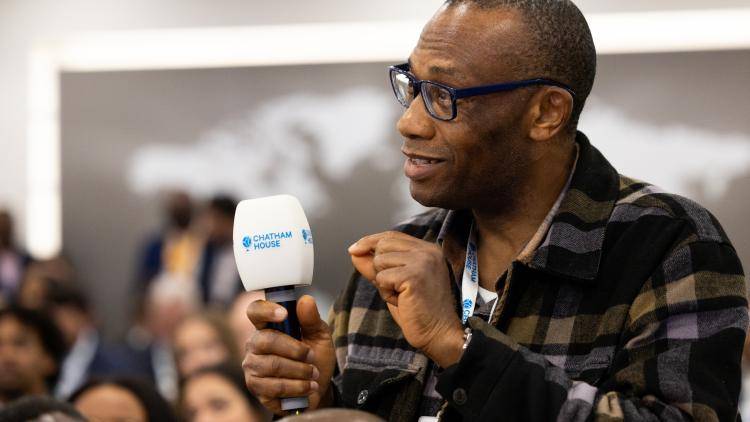
Sorry, questions, yes, you, and please introduce yourself. Do we have microphones, is – are we to yell? Oh, here we go, a microphone, and with the new – thanks to Stephen, we now have the, I just want to say, the merch of Chatham House sponge on the – so, thank you, Stephen.
Maria Kurinna
Good afternoon.
Christopher Sabatini
In case you forgot where you are, you did not know.
Maria Kurinna
Yeah, no. Good afternoon, everyone, my name is Maria Kurinna, I’m Ukrainian former Diplomat and Human Rights Advocate. My question is to Richard. So, Richard, thank you very much for your…
Christopher Sabatini
Yeah, that’s good.
Maria Kurinna
…expertise, obviously, because I’m from Ukraine. I understand the rationale of European strategy and previous administration of US to exhaust Russia and its energy resources, economically as well, militarily etc., at the cost of Ukrainian fight, at the cost of Ukrainian lives of civilians, military and our infrastructure. Currently it’s -16° in Kyiv, people have no light for 30 hours, I mean electricity and no Wi-Fi, no heating, sometimes not even sewage and water. And I understand that Trump, Putin and Xi has never appreciated liberal democracy. So, this rationale to – not to fight with the full potential with Russia was applied to the previous world. So, do you think Ukraine has not enough to provide in terms of IT, military, etc., to be saved, with the biggest army, the highest military production in terms of technology?
Christopher Sabatini
Okay, let’s…
Maria Kurinna
So, yeah.
Christopher Sabatini
So…
Maria Kurinna
Yeah, thank you.
Christopher Sabatini
…did the US mis-invest its resources, military resources, partially you’re asking this on Venezuela?
General Sir Richard Barrons
So, if we’re talking about Ukraine, it’s an extremely difficult story.
Christopher Sabatini
Yeah.
General Sir Richard Barrons
And not one that I would’ve written in the way that it’s turned out. I think in terms of solutions, what’s just happened in Venezuela, and we’re going to go back to this theme of the US returning to its hemisphere, it is an affirmation of news we’ve had for more than 18 months, which is if you’re the US, the problem of Ukraine is a European problem. And there’s no point denying and we now, we’re seeing the actualisation of that, with the US saying not only that they’re not going to pay for the weapons, but then also arguing about whether they’re going to supply them. And not helped by the President of France saying he’s not sure he wants to buy them.
It has been clear for a long time that in the context of the War in Ukraine, Ukraine is simply never going to generate the military force it needs – it would need to take back its territory by force. It doesn’t have the people, and it doesn’t have the material to do it. So, that’s not the war that we’re fighting. But within enough European help, and it’s a marginal decision in terms of money and industry and effort, but with enough European help, Ukraine can be equipped with enough technology and material to impose a cost on that occupation that is, I would say, double the current price, priced at about 1,000 casualties a day, for as long as is necessary. And that also – that ought to militarily ease Russia to culmination, but that is only, in my view, 40% of the problem.
The other 60% of the problem is Europe, and I would say with the US, recognising it’s exhausted many other options of trying to be co-operative, just to make Russia decide to stop prosecuting this war. And that means bearing down on Russia’s economy and politics, and we’re back to the oil…
Christopher Sabatini
Okay.
General Sir Richard Barrons
…price. And the important aspect of this question is not – it’s not just about the safety of Ukraine, about which we should care deeply. This is the very best way of creating a stable relationship, even if quite frictional, between Russia and Europe, with less US help. So, a good outcome in Ukraine, the way I’d describe, fixes European security. A terrible outcome in Ukraine, and we’re on the balance of it right now, destabilises European security in the certainty the US is focused on its hemisphere.
Christopher Sabatini
Okay, let’s stop there and let’s take some more questions. A lot of questions, a lot online. So, Livio let’s go to you next and then, you on the – yes, on my far left. This is no – not a statement on your politics.
Member
Hi, hello, I’m [Liviola Robiday – 49:53] one of the interlocutor appointed for the National Assembly from Venezuela, elected in 2015. So, my question is about the petrol market. So, have you have the knowledge how much petrol oil from Venezuela has been selled in illegal or black market, like cryptocurrency scandal, like PDVSA scandal, for crypto Preveza one, how much has been selled under the table? Because the numbers we have, kind of, legally numbers, Venezuela selling petrol oil in the market, doesn’t match the amount of ships came to pick up them. So, we fully believe as to the government is negotiated our petrol oil illegally, with no marks, no daily books counting them properly. We sell petrol from Cuba most of the time, for many years, even from China, Turkey. We make some boats and they come and come back to Iran, and we don’t know what is there.
Christopher Sabatini
Okay, let’s take it there.
Member
So…
Christopher Sabatini
Let’s – ‘cause we are running out of time. Before we go to the panel, so basically, sort of, do we know where the money went, where the – and more to put – structurally, how do you unwind that? I mean, the problem is with the corruption, it’s difficult to unwind corruption once it’s already in place. Yes, you.
Sidal
My name’s Sidal. I’m a student at [inaudible – 51:07] in the sixth form, and this is a question for General Sir Richard Barrons. You say – near the beginning of the talk, you were talking about how we are approaching a bit of a New World Order that’s a bit – that’s, kind of, dictated by Trump’s obsession with expansion, that’s a little bit imperialist, but you know – with examples including, obviously, Venezuela, Greenland. And closer to the beginning of his tenure, he spoke of making Canada the 51st State, and so, these, kind of, serve examples. Would you say that we could almost draw a parallel between his tenure and, like, the conduct of, like, leaders during the Cold War as they fight to, like, maintain their hemispheres? And if so, who would you say the opposing leader is, or, like, the opposing ideology is, and how would we go about diffusing this, sort of, conflict and allow countries to maintain their sovereignty.
Christopher Sabatini
Great. While you – I’m going to ask two questions from online, too, ‘cause they’re obviously participants here. I think the first one really goes to you, Chris, “Is the US going to control oil prices” – this is by Arthana Chawils – Chawilski. “Is the US going to” – apologies, Arthana, if I mispronounced your name. “Is the US going to control oil prices in the markets for countries in OPEC? What is the reaction of OPEC countries of taking Venezuelan oil by the US?”
And another question by Jule van Dyke, and this is an important one ‘cause I don’t want to lose this important success story. “Now that the EU-Mercusor has de – trade deal has finally reached its final stages, what would the geoeconomics look like in the future for a triad of US-EU-Latin America?” And I want to point that out, ‘cause in the midst of all this, we do have a success story, which is the EU-Mercosor trade deal, which has been overlooked, and is – does represent a real anchor. And I want to go to you, too, on that one, Vanessa.
So, let’s start. Richard, couple of the questions are directed to you, then Chris, then Vanessa, please.
General Sir Richard Barrons
So, I’m going to answer the question here, ‘cause it’s in my ram.
Christopher Sabatini
Yeah.
General Sir Richard Barrons
Which is we know we live in a new era of state confrontation and there isn’t a script, and there are many useful lessons from history, but they’re probably not definitive. And one of the features of the Cold War was there was, I think, one and a half superpowers, but we talked about two, but there was an ideological class. In the world we live in now, this multipolar world, it doesn’t feel too ideological, it just feels about a power contest. Now, we’ve had power contests before and part of the answer to your question is yes, but we’ve never had this on a planet which is as beset with the challenges of population growth and climate change and nuclear proliferation and all the transformation of the digital age in what feels like a zero-sum gain.
So, I think in the short to medium-term, and unless a more powerful statesmanlike logic prevails, we are going to live in a world which is decided by what the powerful choose to do or not to do. And I think in my view, that when that plays out, there will be enormous deleterious consequences and we will end up in a place where most countries realise that behaving like that is mutually self-destructive, because unless we can run the world in a way that recognises that, you know, the planet isn’t coping terribly well with our demands and expectations and we’re creating weapons which we don’t understand, which – and which have the capacity to destroy us, you know, we’re in a really bad place. That ought to generate a different spirit of compassion, co-operation and tolerance, if you’re an optimist. If you’re a pessimist, we’ve just messed it up and we’ve blown the world up. It’s up to you.
Christopher Sabatini
I’ll – I don’t know if I like those choices, but okay.
General Sir Richard Barrons
Yeah.
Christopher Sabatini
Chris.
Chris Aylett
Yes, so to answer the question on the revenues from Venezuelan oil, I mean, I don’t have any particular insight on this, other than, so obviously, a lot has been shipped by the, kind of, global fleet of shadow tankers under sanctions, and then you have the issue of cryptocurrencies. So, yeah, then corruption, it’s very, very difficult to trace and, you know, we would hope that, essentially, now, there is some scope to bring that out into the light a bit more. So, what’s been interesting for me is that the US has, sort of, asserted control, not just to where Venezuela’s oil is going to be going in the future, but also to the revenues from it. They’ve said that the revenues are going to be going to US bank accounts which is to be used to advance the interests of – the foreign policy interests of the US, although the funds will remain a sovereign – the sovereign, kind of, property of Venezuela.
So, not much more has been said about that, but I do worry that that kind of appropriation and the promise that it will be used for the good of Venezuelans so long as it’s in line with what’s good for US foreign policy, that will be an interesting one to watch. But certainly, they’ve talked about the, you know, the benefits of bringing it into the open and transparency and working with international banks to achieve that.
In terms of the other question about control of oil prices, that may potentially have been on their minds. I suspect not. Venezuela is a, now, really quite minor player in OPEC, despite having been one of the founder members, just because it produces so little.
Christopher Sabatini
1% of the global oil.
Chris Aylett
Yeah, it’s really, sort of, kind of, fallen down the list of important players in that respect. I haven’t actually seen any specific reactions from OPEC, partic – potentially for that very reason.
Christopher Sabatini
Okay. One quick question on the first is, you know, this idea that the US will collect the revenue from oil and then redistri – is there any precedent to that? A naïve question, but I mean, it…
Chris Aylett
Not that I’ve seen.
Christopher Sabatini
No, I haven’t – historically…
Chris Aylett
It’s…
Christopher Sabatini
…never heard of anyone. Vanessa, and then I will go to another round of questions in the…
Vanessa Rubio-Márquez
And again, I think to your point, Chris, this is not sustainable. There can be…
Chris Aylett
Yeah.
Vanessa Rubio-Márquez
…fixes in the very, very short-term, unprecedented fixes in the short-term, but if we want to understand, see and think about Venezuela in the medium and long-term, is the system that needs to change, and that goes, again, to the question posed regarding the data and the numbers. Today the data is politically managed. Today the numbers are very untransparent. You cannot even understand how the oil market in Venezuela can perform in the future because you don’t have adequate data, no. It’s been said and there have been some analysis that today Venezuela produces 0.8 million barrels per day and that they can produce 2.5 million barrels per day in ten years, but again, all these calculations are based on flawed and very untransparent information.
General Sir Richard Barrons
Yeah.
Vanessa Rubio-Márquez
So, one of the things that you will need to think about the economy, to think about the oil industry in Venezuela in the future, is transparency, is accountability, and that can only be given with the rule of law, with institutions, with capable government. So, again, that is a prerequisite for anything good happening and anything sustainable happening in Venezuela in the future. So that, I would like to stress out.
And then, on the point on geopolitics and trade deals, I think that what happened between Mercusor and the EU definitely is a new trade deal, a very important trade deal, but more based on the traditional models of trade deals in the past. So, that means, you know, talking about democracy, talking about sustainability and energy and of course, we do see trade barriers. But you will also see other trade deals playing out in the world, as I think USMCA will be the case, in which you will also discuss supply chains, in which you will also discuss the possibility of having tariffs towards third countries that are not considered friends for the region. So, I think that we’re going to see, also, this year, a complete new trade deal coming out of the negotiations between Mexico, the US and Canada.
Christopher Sabatini
Interesting.
Vanessa Rubio-Márquez
Notwithstanding the relevance of what happened between Mercusor and the EU, but new models of trade deals are going to be negotiated and implemented in the coming years, as well.
Christopher Sabatini
Interesting. We have a few more questions, we have a lot of questions online, so I’m just going to take three here and I’m going to throw in one online just randomly. So, we’ll go to you, you and you.
Captain Sven Barckhahn
Yeah, thank you. Captain…
Christopher Sabatini
Oh.
Captain Sven Barckhahn
…Sven Barckhahn, Defence Attaché from Chile. It’s interesting how the discussion shifted from a potential regime change to narcoterrorism and then to oil. There was an optimism perceived the first day. Now there’s uncertainty in Venezuelans living abroad, as well. In that context, what do you think are the mid-term or long-term objectives of the United States? So, how long do you think the US intervention will last, and after a potential democratic elections, will the US continue to control Venezuelan oil? Thank you.
Christopher Sabatini
Your name and affiliation?
Captain Sven Barckhahn
Captain Sven Barkin, Chilean Defence Attaché.
Christopher Sabatini
Oh, good to meet you. Yes, right behind you, there, where…
James Bourne
Hello, and thank you all. James Bourne from Energy Intelligence. We write about energy industries in general now, not just oil and gas. But in the short-term and to anyone on the panel who feels they have some insight how it works aspect, is Delcy Rodriguez in full control? Might the military kick back? Can she tell PDVSA what to do? Is there a union presence there that might sabotage any US efforts, etc., etc.? It all seems she’s being very pragmatic for now, but, you know, what might happen in two weeks’ time? Is there any insight as to the Chavista splits?
Christopher Sabatini
Thank you. I am afraid I might have frightened the question asker before. He – after I called him, he left. So, we have another spot open. So, yes, right there, make it easy, there.
Tim Cole
Thanks. Tim Cole, Cha – member of Chatham House and former Ambassador to Cuba. I have a question about Cuba. It’s resisted US pressure for 60 years. Obviously, now it’s worse with the economic situation in Cuba already very bad, which could get worse because of if Venezuela does pull its support, which it seems to have done, or is likely to do. So, my question is really to Vanessa about Mexican oil. 44% of crude imports to Cuba last year were from Mexico. Is that likely con – to continue, or will they yield to American pressure on it? And finally, a quick comment. I can’t really see a deal happening in Cuba, which Lor – Donald Trump has said he wants, because Marco Rubio clearly wants regime change and that’s not where the Communist Party is going to go.
Christopher Sabatini
Yeah, no, it would – the apparatus would remain, even in the extreme, agree, Tim. Two questions here and then we’ll do a quick round of responses from all of you. I’m going to just random select here, Conan Fabian Borges, “Does Trump’s success in Venezuela – could it be seen as a defeat for Putin, since Russia’s allies may interpret Russia’s lack of reaction as a sign of weakness?” Then I’ll go to Alejandro Duestra, “How serious is the UK and the European Union, is there concern about the US’s new policy in Latin America and what are they prepared to do beyond the free trade agreement with Mercusor?” – to try to – I’m going to add a bit more to Alejandro’s question – to try to bolster Latin American sovereignty? And I’m going to ask – as you answer, I’m going to ask a quick round of responses, what country’s next? It – I don’t think – I’m not comfortable asking that question. Let’s be honest, I never wanted to ask that question, but is there another country, do you think, that could be next, and in the sights, realistically, in some form, for Trump’s intervention? We’re going to start with Vanessa.
Vanessa Rubio-Márquez
Well, I would go to the question of Cuba, and I would say that, yes, Mexico has been increasing its support in relation to oil to Cuba. And I don’t think that in the current context that is sustainable, and definitely, this will be one of the topics that will be part of the dialogue between Mexico and the US. The dialogue between Mexico and the US being as complex as it is, because dialogue between Mexico and the US is about arms flowing south, about drugs frowing – flowing to the north, about migration, about organised crime, about water, about border. So, all of that and including the exports of Mexican oil to Cuba, will definitely be part of the conversations today, the regular conversations, but most importantly, the negotiations around USMCA that are happening as we speak. So, definitely that will be discussed and there will be pressures, for sure, from Washington, in relation to Mexico, to reduce that number, or even at some point in time, to halt it.
Christopher Sabatini
I think in part, actually, Vanessa, not to weigh in here, but I think it’s going to depend on how much Marco Rubio really desires to see a total collapse of Cuba. ‘Cause let’s be honest, if you were to remove those 44 thou – those barrels of oil, it would just provoke complete chaos, potentially, which is probably more than most Florida Politicians would like, given the possibility of a migrant exodus. Richard and then Chris.
General Sir Richard Barrons
I’m just going to make a couple of comments and I’m going to make a prediction, which I know is…
Christopher Sabatini
Okay.
General Sir Richard Barrons
…the…
Christopher Sabatini
Oh, sorry, Vanessa, we left you off the hook. Sorry, Richard. What’s your prediction, next country on – in the crosshairs?
Vanessa Rubio-Márquez
I think the tensions are going to increase with Greenland.
Christopher Sabatini
Good call. Okay, weather’s not as nice as Cuba, but still – go ahead.
General Sir Richard Barrons
So, I’m going to make two predictions. The first is I think the chances of this US intervention in Venezuela turning into an enduring strategic success for the US are really small, because I think they’ll find that it’s much more complicated than they thought, that it’s much more expensive and will take longer to fix than they are – at a price than they’re prepared to pay. And I think economically, they’ll find for the reasons, that it’s not worth the candle.
Christopher Sabatini
Yeah.
General Sir Richard Barrons
And the second poi – observations is that we talk a lot about elections, and I recall this conversation from many other settings, Balkans, Iraq, Afghanistan, so, actually, running an election is a relatively straightforward thing. The really hard part is installing the results of…
Christopher Sabatini
Yeah.
General Sir Richard Barrons
…those elections and turning it into an effective administration that commands popular support. I don’t yet see how that happens in anything like a near timeframe and therefore, I think the tendency will be for Venezuela to reset itself as Venezuela. And I don’t think it’ll matter because I think the US will declare success and move on.
Christopher Sabatini
Yeah.
General Sir Richard Barrons
And when they…
Christopher Sabatini
Yeah, that’s the risk.
General Sir Richard Barrons
…move on…
Christopher Sabatini
That’s the risk.
General Sir Richard Barrons
…I think there is a short hop, which is about dealing with the narcotics challenge they see coming from Colombia, because that feels kinetic and brief, and a dopamine hit on Fox telly. And then I agree the strategic issue is Greenland, but you are then playing with the future of NATO.
Christopher Sabatini
Yeah, so it’s a different game.
General Sir Richard Barrons
Yeah.
Christopher Sabatini
That you won’t have your Argentinas and others that stand down or even applaud it, certainly.
General Sir Richard Barrons
Hmmm.
Christopher Sabatini
Chris, final word and a prediction.
Chris Aylett
Yes. Just very quickly to respond to the point about whether this constitutes a defeat for Putin. I’d say it’s really the opposite, because if you consider it in the context of a National Security Strategy and, sort of, hemispheric dominance, it’s, basically, saying, okay, well, we’re going to – you know, you can do what you like in your hemisphere. Quite clearly, we’re going to do what we like in our hemisphere. And in terms of a prediction, I would agree that Greenland seems a likely candidate, based on the number of times the President has mentioned it, and I agree that it had – could have really catastrophic consequences for NATO and the rest – and Europe.
Christopher Sabatini
Thank you. Well, thank you for joining us. Sorry, you ducked out, well, you missed your chance. The – I’m glad you came back there. The – so, thank you for joining us. Obviously, a lot to watch, a lot to keep track of, not just in Venezuela, not just in Latin America, but globally. I think we, you know, we underestimate the implications at our own peril.
I will say tomorrow, as we – as you will hopefully follow the discussions among Maria Corina Machado and Donald Trump, please don’t pay attention only to the issue of the peace award. I think that’s a – that is a red herring, but what Maria Corina Machado’s going to be delivering and asking for Trump in terms of a moderate process and benchmarks towards, and a timeline for some form of transition that would be a more meaningful democratic transition to establish a, sort of, rule of law and institutional stability that Vanessa mentioned and was all discussed – we all discussed and is essential for oil.
So, please join me in thanking our panellists [applause], and if you’re like me in the last ten days, I hope you can still have a good night’s sleep. It’s been a troubling time. Thank you very much for coming to Chatham House.