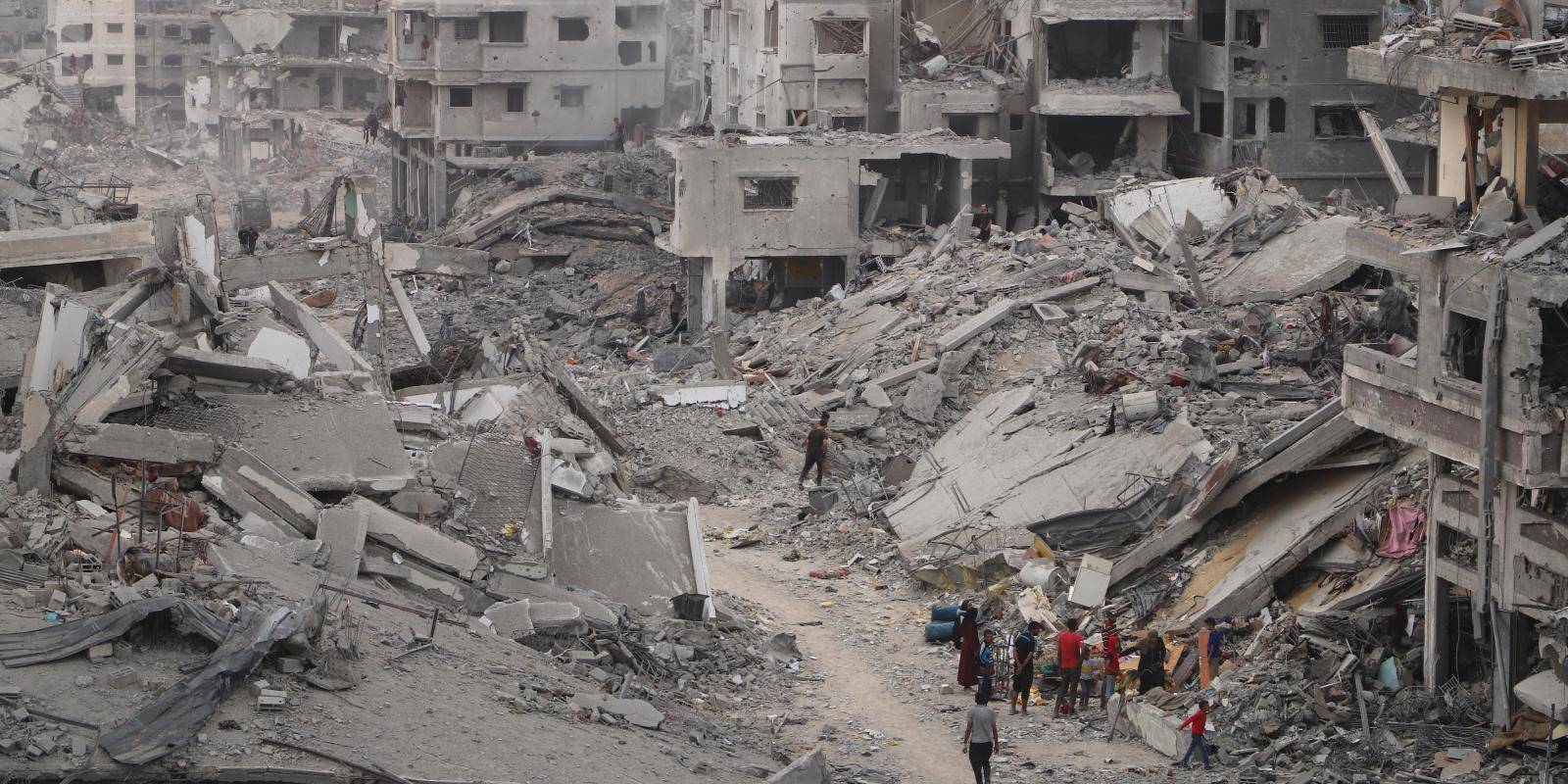

The ceasefire in Gaza, and the release of Israeli hostages and Palestinian prisoners is clearly a momentous occasion. But does this moment mark the adoption of a ground-breaking peace settlement for the Midde East?
For President Donald Trump, the answer was clear. In his view the event marks the end of the Palestine conflict. His overall vision is one of a cascade of peace flowing from the Gaza deal that will fundamentally transform the region.
This view supposes that the end of hostilities in Gaza will soon be followed by the conclusion of further Abraham Accords between Israel and the states of the region. Then, there might follow steps towards regional economic integration and eventually even security cooperation between Israel and its neighbours, ending an era of perennial regional crisis. That would be a historic feat indeed.
However, to move this vision forward, it is necessary to progress the actual peace process. The 13 October summit at Sharm el-Sheikh in Egypt offered an opportunity to translate the general principles contained in the Trump plan into a more fully developed peace settlement.
In fact, the event turned out to be little more than a further celebration of President Trump’s achievements. The US, Egypt, Qatar and Turkey signed a brief declaration. But is there actually a peace agreement in place?
There are three documents thus far. The first is the original 20 point plan of 29 September. It has not been signed, and its 20 principles are largely aspirational. That is to say, they offer a general direction but are too general to be implemented without far more detailed agreement.
Instead, in the next document, called ‘Implementation Steps’ of 9 October, President Trump simply announced the end of the war in the Gaza Strip. (Hamas claims that the president gave additional, verbal assurances against the resumption of the use of force by Israel).

In the document, Israel and Hamas agree ‘to implement the necessary steps’ to end the war, namely a ceasefire, resumption of humanitarian relief, Israeli withdrawals from designated areas in Gaza, and the release of hostages and of detained Palestinians. The agreement is signed by both parties, along with the mediators. It entered into force upon acceptance by the Israeli cabinet on 10 October.
Finally, there is the ‘Trump Declaration for Enduring Peace and Prosperity’ signed by the mediators, the US, Egypt, Qatar and Turkey – but not the warring parties – at Sharm el-Sheikh on 13 October. This document is without any hard substance. It merely invokes broad hopes for the future and the willingness of the mediators to implement the ‘Trump Peace Agreement’.
However, it is clear that no actual peace agreement yet exists. There is only the cease-fire and the rough roadmap offered in the original 20 point plan.
Standard peace-making
In most cases, the standard principles for negotiating peace would see a first step in which the sides agree the base points for a settlement in the form of a declaration of principles – outlining the essence of the overall deal.
There would then follow a framework agreement, where the interests of the sides are carefully balanced to give both an interest in sticking with the agreement. This would be supplemented by detailed annexes on the modalities for implementation, along with the deployment of an international military and civilian presence.
Instead, the Trump Plan has seen an outside power, the US, issue the basic principles for a settlement. Neither side was fully supportive. Both were pressed into acceptance by key Western, Islamic and Arab states.
Prime Minister Benjamin Netanyahu accepted while declaring that he opposes eventual Palestinian statehood, going against an important provision of the plan. Israel also continues to oppose any role for the Palestinian Authority (PA) in relation to Gaza – which is again called for by the Trump plan (after the PA is reformed).
Hamas has agreed not to play a role in the future of governance in Gaza. But it seems likely to re-badge itself, hoping to retain power in the Strip and gain a role in any reformed PA. It also does not seem to have committed to its own total disarmament – a fact that has already led President Trump to threaten forcible disarmament if necessary. It is not clear, though, who would undertake that task. The international stabilization force (ISF) envisioned by the plan lies somewhere in the future.
It is entirely correct that Hamas should not be the key interlocutor in the peace process, going beyond immediate military matters. But it creates a significant problem. Hamas, as the initial party to the settlement, is meant to accept its displacement from negotiations and governance of Gaza in favour of its avowed enemy, the PA (once the PA has been reformed).
In the meantime, there is no clear Palestinian ‘side’ foreseen in the most critical phase of the process. True, the PA’s low standing makes it an unlikely candidate as the key partner in agreeing future governance within the framework of the 20 points. This leaves the option to impose a system of governance and supervision of its activities by the international ‘Board of Peace,’ headed by President Trump. The Tony Blair Institute has generated a detailed blueprint for such arrangements.
