

February brought the demise of the last remaining US–Russia nuclear arms control treaty, the New Strategic Arms Reduction Treaty, that put a cap on deployed warheads. Following on from the Trump administration’s threat to seize Greenland, the territory of a NATO ally, this was yet another nail in the coffin of the post-war settlement.
Renewed talk of its death points us back to its birth – and to the era it was meant to end forever. In any consideration of today’s dangers, the ghosts of the late 1930s are hard to avoid – even if the annual international security conferences were not held in Munich. Historical analogies are most useful when they are specific. We are not on the brink of world war; nor is Britain under threat of bombardment or invasion. Major hybrid and cyberattacks, and possibly a Russian incursion against a NATO ally, remain more likely scenarios.
Ninety years on, warfare, the world map and Britain’s international standing have all been transformed. Yet America’s unreliability and Russia’s belligerence are producing a growing acceptance that the UK, like its remaining allies, must rearm at speed, with all the questions that raises about the social and political costs involved. So what can looking backwards tell us about today?
By 1935, Britain’s political classes faced an invidious choice. It was becoming clear that Nazi Germany was a serious threat; the need to restore the country’s withered military capabilities was evident. But how fast should this be done, and at what cost? Rearming too quickly risked wrecking the economy for a war that might never come. Moving too slowly could leave the country dangerously exposed, while emboldening Germany, which was remilitarizing at breakneck speed.
Two world views
This was a dispute between two world views: one established, one heretical, each defined by what it considered intolerable. The establishment world view had its roots in Victorian economic propriety. By the mid-1930s, it was already in retreat: Britain had abandoned the gold standard and free trade and government had become more interventionist. It remained committed, however, to avoiding the dangers of inflation and borrowing. This was underpinned by a horror at the prospect of war. Its leading advocate was an ex-businessman, Neville Chamberlain. As chancellor until 1937, then prime minister, he raised spending to fund rearmament – but cautiously.
The heretical world view said caution was dangerous, underpinned by a horror at the prospect not of war, but defeat. It sprang from the military ministries and the more martial elements of the Conservative Party and was led by Winston Churchill, who demanded a Ministry of Supply with compulsory powers. In July 1936, he suggested that as much as 30 per cent of industrial production capacity should be given over to arms manufacture, under a proclamation of ‘state of emergency preparations’.
If that meant sacrificing ‘a good deal of the comfort and smoothness of our ordinary life’, Churchill insisted, then so be it. That October, the Joint Planning Subcommittee of the Chiefs of Staff produced an ‘Appreciation of the Situation in the event of War against Germany in 1939’. It deliberately fleshed out their nightmare scenario, stressing the consequences if Germany’s state-controlled war production kept
racing ahead of Britain’s.
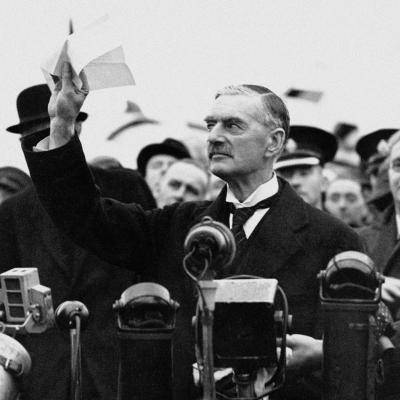
Prime Minister Neville Chamberlain in 1938 brandishes the piece of paper signed by Adolf Hitler that he said promised ‘Peace for our time’. He had thought that ramping up defence industrial production would ‘destroy the [business] confidence which now happily exists, and cripple the revenue’. Photo: History/Universal Images Group via Getty Images.
To Chamberlain, this raised the spectre of a bloated, coercive state, crowding out industry and trampling cherished liberties. As he wrote to his sister a few weeks later, he did not think war was imminent, and: ‘If we were now to follow Winston’s advice and sacrifice our commerce to the manufacturers of arms we should inflict a certain injury upon our trade from which it would take generations to recover, we should destroy the [business] confidence which now happily exists, and we should cripple the revenue.’
A similar divide split the left. At Labour’s 1936 conference, Hugh Dalton – one of the party’s leading figures, and a future Minister of Economic Warfare – warned that breaking treaties was becoming ‘a daily Fascist habit’. It was time to say ‘There is a limit’, and to press ahead with rearming. But Clement Attlee, Labour’s leader, was horrified, declaring that militarism could lead to fascism in Britain itself.
Changing orthodoxy
Over the next three years, this fear of an excessively powerful domestic state was gradually overwhelmed by the need to prepare against the Nazi threat. Defence spending rose from 2.5 per cent of GNP in 1935 to 3.8 per cent by 1937, and kept going up. Borrowing and taxation breached orthodox limits. In March 1939, Hitler invaded Czechoslovakia, trashing the much-hailed deal Chamberlain had cut with him at Munich. The government finally folded – agreeing to create a Ministry of Supply, and to introduce conscription.
One by one, public figures who had resisted the push to rearm found the fear of defeat overriding their fears of war, tyranny and economic disaster. Labour came round to rearmament, partly because doing so removed the taboo on their dreams of state planning. Attlee stopped worrying about domestic fascism, finally bringing Labour in behind Churchill.
One aspect of this change was a newly impassioned reaffirmation of the worth of democracy, after years in which it had been denigrated as a tired, failing system, outshone by the dynamism of the Soviet Union and Italian fascism. Rearmament no longer seemed a threat to the democratic state, but rather the only way to save it.
Another reason for the change of mood was a straightforward frustration with indecision. As John Maynard Keynes wrote in March 1938: ‘We are suffering today from the worst of all diseases, the paralysis of will. And nothing can be more dangerous than that … We just rearm a little more, grovel a little more, and wait to see what happens.’ British statesmen had ‘lost the capacity to appear formidable’.
The cautious approach had its uses. It helped to focus rearmament on air defence, for example, where government-backed research drove innovations such as radar. It succeeded in avoiding an economic crash. But it also left Britain vulnerable in 1940. Either way, tracing the agonized process by which one orthodoxy superseded another, under the pressure of prolonged crisis, provides a frame through which to view Britain’s current security dilemmas.
Today’s challenge
Today’s political classes also face a jarring orthodoxy shift, from the old rules-based order to a new world of clashing power. Will they cling to dying norms, like Neville Chamberlain, unable to believe Hitler wanted war? Or can they adapt, like Hugh Dalton forcing Labour to confront Hitler’s disregard for treaties? And what are the domestic implications of that rethinking?
The immediate challenge is how to approach rearmament. In February 2025, the Starmer government began the process of lifting military spending to 2.5 per cent by 2027; it is now aiming to reach 3.5 per cent by 2035. As the economist Duncan Weldon has noted, with an eye on the 1930s, this level of spending should be sufficient in principle, but ‘2035 is far too distant’.

British Prime Minister Keir Starmer and John Healey, his defence secretary, examine a model submarine at BAE Systems in Barrow-in-Furness. Starmer has talked about raising defence spending to 3 per cent of GDP by 2029. Photo: Oli Scarff/ POOL/AFP via Getty Images)
Since then, amid frustration among leading military figures, defence companies and European allies at the slow pace of elevating defence spending, the prime minister has talked of setting a steeper ambition for this parliament, of 3 per cent by 2029. Once again, Britain faces the dilemma: in a fast-changing threat landscape, how rapidly should it seek to rearm, and at what cost?
Given the parlous state of Britain’s finances, increased defence spending will have to be funded by cuts elsewhere, but such a reordering of priorities will need public support. The prime minister has talked of making Britain’s security ‘a collective national endeavour’, which implies the sacrifice of comfort Churchill once called for. But given historically low levels of trust in politics, fostering such feeling will be forbiddingly difficult.
The shift in public opinion in the 1930s from fear of war to fear of defeat suggests that focusing on nightmare scenarios may be more effective than appealing to national unity. Tan Dhesi, the chair of the defence select committee, has called for ‘a coordinated effort to communicate with the public on the level of threat we face and what to expect in the event of conflict’. In a report last November, his committee backed the 2025 Strategic Defence Review’s suggestion of ‘regular public briefings on attacks against the UK’ – but lamented the government’s failure to act on this.
Winning the public
However, the 1930s suggests another possible basis on which to win public support: the realization that defence spending might help economic revival. The government has said it wants to create a ‘defence dividend’, using the state’s market power to prioritize UK-based business, fostering homegrown technological innovation and nurturing prosperity in Britain’s struggling regions. The 2025 Defence Industrial Strategy outlines Defence Growth Deals, and a rise in Ministry of Defence spending with small and medium enterprises of £2.5 billion by 2028. If this works quickly enough – and if the population attribute any improvement they feel to the government – this might drive up support for rearmament.

A pro-Palestine protest in London. The war in Gaza may be undermining support for higher defence spending among young Britons. Photo: Dan Kitwood/Getty Images.
Using defence spending to achieve social value speaks to the broader shift in orthodox thinking as well. The drift from the rules-based international order to a more nationally focused one implies that national security will need to override the norms of 1990s-style globalized capitalism, and its belief that the state should adopt the methods of business. This may have implications for financing rearmament. In an article for the Council on Geostrategy, Benedict Goodwin suggests that modern public accounting rules have been imposed on the state which are more appropriate to the risk profile of a private company.
These rules insist that the full cost of very expensive equipment such as fighter jets is accounted for at the time it is spent, rather than being spread across the long period in which the equipment is in service. This, he submits, ‘creates a powerful disincentive for governments to enter into long-term defence contracts or innovative financing structures, even when these would be economically rational’. Under the pressure to rearm at speed, this may need revisiting, albeit it with an eye on managing bond market concerns.
Role of private sector
Similarly, the Defence Industrial Strategy has called for UK financial institutions to jettison outdated beliefs and ‘invest in UK-based defence companies, recognizing the social value of these investments and moving away from a world in which defence is seen as unethical.’
Echoing Churchill’s campaigns of the 1930s, this paradigm shift also implies a more coercive role for the state. The Strategic Defence Review recommended that the government take on reserve powers ‘to respond effectively in the event of escalation towards a war involving the UK or its allies’. This would involve the power to mobilize industry and ‘private and commercial assets’, giving the state ‘ready access to private-sector infrastructure for operations’.
However, this raises a question Churchill did not have to consider. How much of our industry is in foreign ownership, and what barriers might this present to any such state intervention? Perhaps the precedent from the 1930s that will both require the most political effort, and deliver the greatest payoff, lies in the reaffirmation of democracy as a reason to defend the country.
In the 1930s, as today, democracy was seen as failing in its promises to improve ordinary people’s lives; autocracies appeared to have greater momentum. Then as now, this corroded liberals’ confidence, and bolstered domestic extremists, especially on the right. The threat of external attack by autocratic enemies was crucial in compelling people to decide that democracy had to be defended. Such threats may yet play that role once more.