What lies behind Washington’s quiet diplomacy with Minsk?

In exchange for sanctions relief, America has gained release for some 500 political prisoners in Belarus and is aiming for 900 more by year’s end. But distancing Lukashenka from Putin is another matter, says Natalya Kovaleva.

The World Today

Published 8 June 2026

Updated 15 June 2026 — 4 minute READ

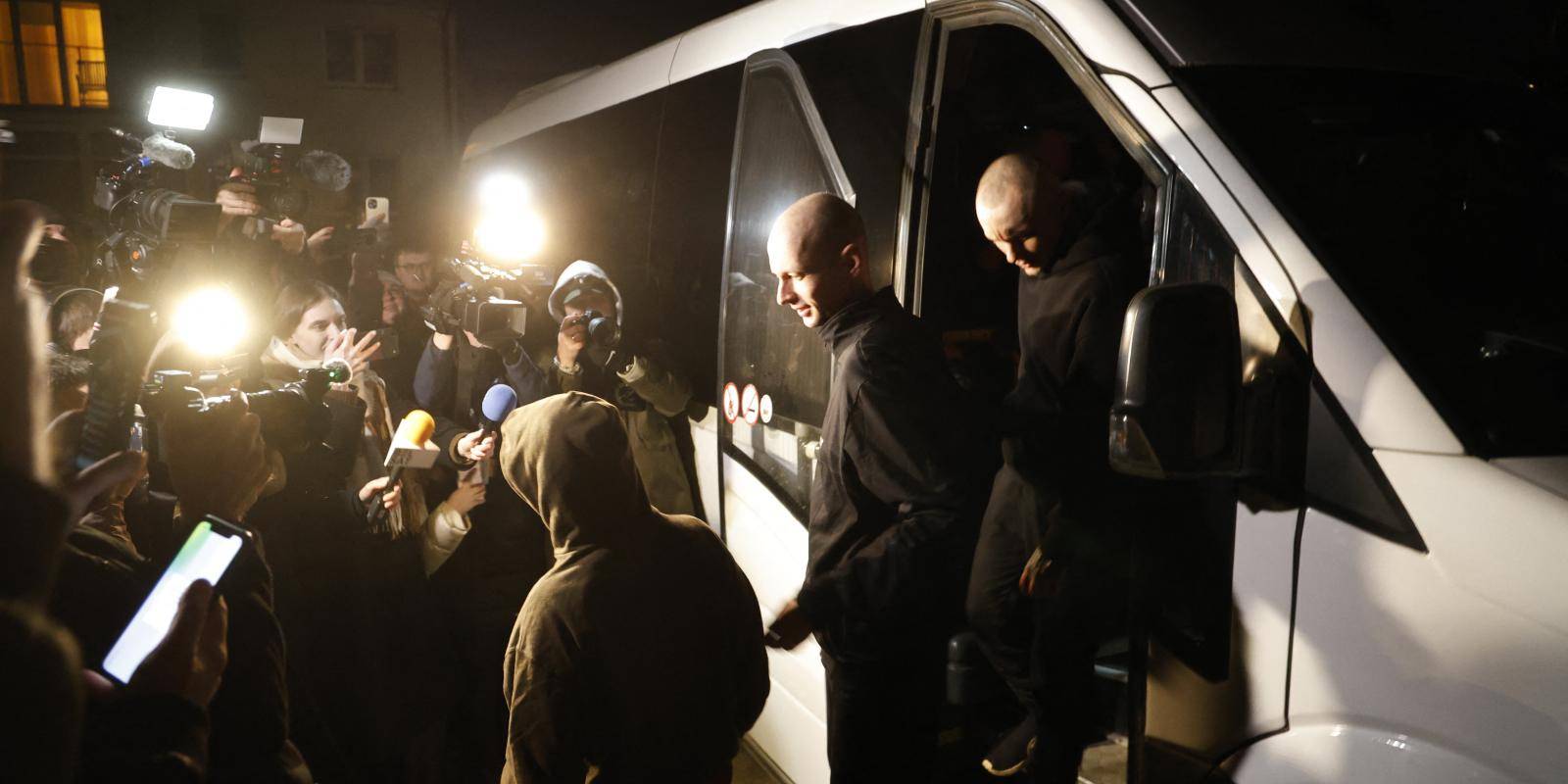
Image — Political prisoners released by the Belarusian authorities after negotiations with the United States arrive in Lithuania in March 2026. Photo: Petras Malukas / AFP via Getty Images.

‘How much am I worth? A ton of potash? A thousand tons?’ Ales Bialiatski, the Nobel Peace Prize laureate, asked after his release from a Belarusian prison in December 2025.

Bialiatski, a human rights campaigner, is one of more than 500 political prisoners who have been released from Belarusian jails as a result of ongoing negotiations between Minsk and Washington over the past two years. The diplomatic exchange has found a steady rhythm: every few months, a US delegation led by John Coale, President Donald Trump’s special envoy to Belarus, arrives in Minsk; Aliaksandr Lukashenka, the Belarusian strongman president, releases a group of political prisoners; and in return, Washington offers public praise and – in reference to Bialiatski’s question – eases sanctions on key sectors of the country’s economy.

Unlike classic Cold War-style prisoner swaps, including the high-profile release of American journalist Evan Gershkovich and others from Russia in August 2024, the incentives behind the negotiations in Minsk are harder to discern. For Lukashenka, a long-term ally of Russian president Vladimir Putin, the arrangement offers a path towards an economic rapprochement with the United States and a chance to restore his international legitimacy after years of isolation. But what is in it for the US? And how might the release of hundreds of political prisoners affect the region’s fragile geopolitical dynamics?

A deal, not a policy

Within a week of Trump’s inauguration in January 2025, Minsk unilaterally freed American citizen Anastasia Nuhfer, a gesture that opened the door to bilateral talks. Three weeks later, Christopher Smith, the US deputy assistant secretary of state, arrived in Minsk for talks with Lukashenka, becoming the most senior US official to visit Belarus in more than five years. During Smith’s visit, three more people – an American and two Belarusian political prisoners – were released.

That paved the way for a sustained diplomatic track between Minsk and Washington. By the end of 2025, three more waves of releases followed. Among them were pro-democracy and human rights activists, prominent opposition figures, foreign nationals, journalists and ordinary Belarusians. All were victims of the repression that followed Lukashenka’s crackdown on mass protests against his sixth consecutive presidential victory in 2020, which drew widespread condemnation. Minsk’s decision to allow Russian forces to invade Ukraine from Belarusian territory in 2022 intensified that isolation, making the regime one of the world’s most heavily sanctioned.

But Lukashenka’s human rights record hasn’t deterred Washington. The ultimate goal, as stated by US negotiators, is the release of the roughly 900 remaining political prisoners in Belarus by the end of the year. ‘We haven’t stopped our work at all until we get every last one of them,’ Coale told reporters in April. A wider deal is also under discussion. Among the reported conditions is the reopening of the US embassy in Minsk – closed since 2022, and without an ambassador for 18 years – the lifting of 80 per cent of US sanctions, and the promise of a visit by Lukashenka to Washington to meet Trump. 

The [US] administration wants to have foreign policy wins, however those are defined.’

Michael Carpenter, the former US ambassador to the OSCE.

It’s less clear how this benefits Washington. ‘The [US] administration wants to have foreign policy wins – however those are defined,’ said Michael Carpenter, the former US ambassador to the Organization for Security and Cooperation in Europe and a former senior director for Europe at the National Security Council under President Joe Biden. ‘And having a repressive regime release political prisoners is a pretty unambiguous win.’

According to Gabrielius Landsbergis, Lithuania’s former minister of foreign affairs, these talks fit into Trump’s broader foreign policy toolkit. Lithuania hosts around 60,000 Belarusians, including Sviatlana Tsikhanouskaya, the exiled leader of the Belarusian opposition, who lived there until January before moving to Poland.

Trump’s response

‘This is the way the Trump administration works,’ said Landsbergis. ‘They try to establish some level of confidence through such talks and then see where it takes them,’ adding that ‘in Venezuela it did not take them very far’.

Trump’s response to the Belarusian leader has been effusive. In March 2026, he offered his ‘warmest thank you’ on social media to ‘Highly Respected President Alexander Lukashenko [sic]’ who ‘gracefully’ released ‘well over 500 [prisoners] since last May’, granting the Belarusian dictator the recognition the European Union has withheld since its refusal to accept the 2020 election result. The US has also eased sanctions over the past year on the national airline Belavia, two state-owned banks, the ministry of finance and three producers of potash – a fertilizer ingredient and Belarus’s major export.

For ordinary Belarusians, the prisoner releases have not resolved the underlying issue of political repression. As negotiations continue, many say that they could be having the opposite effect. ‘By engaging in these sorts of releases and giving very substantive sanctions relief to regimes such as Lukashenka’s, we are encouraging hostage-taking in the future,’ said Carpenter. The ‘revolving-door’ policy – in which some prisoners are freed, while new people are detained – is a growing concern.

The conditions of release tell their own story. The vast majority of those freed since 2025 have been forced into exile – expelled across the border, often without documents and with no way to return. Those released in March 2026 proved a partial exception, with 235 out of 250 prisoners being granted the right to remain in Belarus. Anaïs Marin, associate fellow with the Russia and Eurasia Programme, Chatham House, and a former UN special rapporteur on human rights in Belarus, doesn’t see this as a change in approach. ‘Only the less politically prominent prisoners are enjoying it,’ she said. ‘Nobody knows how long this tolerance will last until new charges are pressed.’

Strategic shift?

The practical impact of US sanctions relief has also been limited. Russia remains one of Belarus’s few trading partners, one it has long since relied on for loans and energy subsidies. Its dependence on Moscow intensified drastically after 2020, as its isolation deepened.

‘The [lifting of US sanctions] may ease pressure on the regime, but it does not fundamentally alter Belarus’s economic situation,’ said Dzianis Kuchynski, diplomatic adviser to Tsikhanouskaya. As long as the European Union blocks Belarusian potash exports through European ports, Minsk has little room for manoeuvre.

He will dance with the Americans, but he will always remember that his main dance partner is in Moscow.

Gabrielius Landsbergis, Lithuania’s former minister of foreign affairs.

Lukashenka is tied to Russia, regardless of the outcome of the current negotiations, said Landsbergis. ‘He will dance with the Americans, but he will always remember that his main dance partner is in Moscow.’ What the engagement produces, then, is less a strategic shift than something much narrower. Coale, Trump’s envoy to Belarus, admitted as much. ‘I’m not going to push any wedge between [Lukashenka] and Putin. That’s a 30-year relationship’ he said. ‘This engagement is 95-per-cent humanitarian.’

content continued

Western pressure is not going to pry Belarus away from Russia, said Carpenter, which makes the humanitarian rationale for this engagement more compelling, he added. ‘If the regime is unlikely to change, then why not use the tools at our disposal to free people who have been unjustly detained? That’s the argument the administration is making.’

What now?

The coming months will test this engagement on several fronts: Trump’s rapidly changing priorities; the potential distraction of the US midterm elections; Lukashenka’s own calculations on his balancing act between Russia and the West; and what happens when all political prisoners are freed.

Democratic states should not bandwagon after the Trump administration and seek to re-engage with Belarus just to avoid being sidelined.

Anaïs Marin, former UN special rapporteur on human rights in Belarus

It will also prompt discussions in European capitals about their policy towards Belarus. So far, the EU has shown little appetite for re-engagement, saying it will not change its position until the regime addresses the reasons sanctions were introduced: continued military support for Russia’s war effort, human rights abuses and hybrid attacks along the EU’s eastern border.

The position of Marin, the former UN special rapporteur, is unequivocal: ‘Democratic states should not bandwagon after the Trump administration and seek to re-engage with Belarus just to avoid being sidelined.’

The release of the remaining political prisoners would satisfy one of the EU’s core conditions. But for European allies still sending military support to Ukraine, there are wider concerns. ‘If we admit that Belarus is a part of Russia’s war effort, and then we re-engage, what sort of signal does that send to Moscow and others?’ asked Landsbergis.

To read more from the summer issue of The World Today click here.