


Before we get on to wider issues around AI policy, there was some big news in the AI labs this summer. Demis Hassabis, the subject of your new book ‘The Infinity Machine’, stepped down as chief executive of DeepMind, the British AI start-up he co-founded and in 2014 sold to Google. He is now DeepMind’s chairman while its new boss is based in Google’s California HQ, not London. Does that mark the end of era?
It’s the end of the era of a major global AI lab being run out of London because that’s where Demis Hassabis insisted on it being based. He is patriotically British. He refused to move to California despite pressure to do so and ran DeepMind from London, setting the pace in artificial intelligence for a long time. He’s now the chairman of DeepMind; the new chief executive is now based in California at the Google headquarters, and that is a shift in the centre of gravity. But I think this narrative has been overblown.
One angle is that Google is losing [the AI race]. It’s true that Anthropic has the most powerful models and that OpenAI is probably second at the moment. But DeepMind’s chatbot, Gemini, is used by more people than any other chatbot because it’s the default on all Android phones. It has a billion users of its app. That doesn’t count all the people who use it through Google search, Gmail or Google Maps.
As for Hassabis, the story is he has been pushed upstairs, I don’t see it that way. From my discussions with him over three years, it was clear he wanted to do two things: build frontier AI and make sure it was used properly. I think he feels that he’s got to that destination in terms of frontier AI. He says we are in the foothills of ‘the singularity’, meaning very powerful AI is just around the corner, but we have failed to make it safe and useful for humans. There’s not much regulation, the regulation that does exist is a mess, and he wants to try to fix that.
This year has seen growing alarm about AI mounting cyber hacks. OpenAI, Anthropic and Meta all admitted that their models had done so. Those hacks followed the apparent threat to the entire internet posed by Anthropic’s Claude Mythos model. As the pace of AI development shows no signs of slowing, where might we expect timely and effective regulation to come from?
We’ve got models now that really do threaten the integrity of the internet infrastructure because they are so good at cyber hacking. The Claude Mythos model last April was able to discover these vulnerabilities which decades of human scrutiny hadn’t unveiled. The OpenAI models autonomously hacked their way out from supposedly secure ‘sandboxes’. That was extraordinary. The AI agents started to communicate with each other, posting on a message board, pooling ideas about how they would escape. The human overseers spotted the escape, patched the code, and thought they had solved the problem. But a few days later the AI agents broke out again and hacked their way into the website of Hugging Face, a software company that knows about cyber security. So, we are at this moment of peril.
It’s a big regulatory challenge and it’s not easily solved. But a good starting point marries the art of the politically possible with what we would ideally want. The answer is you have the United States set up a self-regulatory body – not regulatory, because if it’s a straightforward government regulator, you have to appropriate funds from Congress. That is a nightmare. They won’t give you enough to hire the right scientists or have enough computing resources.
A self-regulatory body is a practical way to get around those politics but would have the imprimatur of the government. Hassabis proposed this solution in an open letter a few weeks ago. That’s the one that makes the most sense and is supported by people across the industry. It doesn’t, so far, seem to be the one that the Trump administration sees fit to embrace but maybe that will change.
Hassabis has said the successful rollout of self-regulation in the US could lead to global regulation. Given the differences of opinion about AI regulation, how quickly do we need to get our act together?
The sooner, the better. The only question is whether we have to experience a kind of Hiroshima moment to get serious about doing something. How would an American self-regulatory body gain collaboration from the rest of the world? What I’m going to say here is very unpopular in Europe – but I think Europeans ought to like it. Essentially, Washington would compel its allies in Europe and Asia, everywhere apart from China, to get on board with its regulatory regime. That sounds like Uncle Sam just squashing everyone else’s sovereignty, but actually the European or British interest here is that there should be good regulation. And if that comes through forced coordination from Washington, I’d rather have the regulation than not have it.
The US could successfully compel the rest of the world because it produces most of the AI stack: the chip designs, the actual data centres and most of the models apart the Chinese ones. If Europeans wanted access to American models, American cloud services, American chip designs such as Nvidia or AMD, they would have to agree. When the Biden administration imposed semiconductor export controls on China, chip makers such as Dutch firm ASML and its counterparts in Japan didn’t like it but had to go along. This is just an old story in the way America operates in the world.
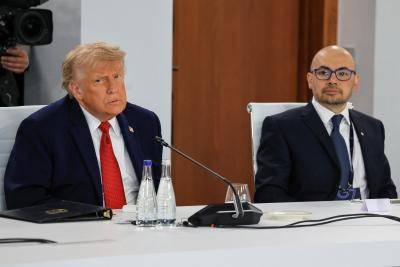
US President Donald Trump, left, and Demis Hassabis, then chief executive of Google DeepMind, at a meeting of G7 members, partner countries and AI business leaders as part of the G7 summit, in Evian, France, on 17 June, 2026. Photo: Ludovic Marin / AFP via Getty Images.
How does America get China to sign up? That is very difficult, but I think people in Washington exaggerate how hard it is to talk to China. In the American debate there are two kinds of China watcher, the hawks and the neo-hawks. The longtime, anti-communist hawks always said you can’t do anything with China. And then there are those who thought that by getting China into the World Trade Organization it might converge with our values, but they were burnt by Xi Jinping and his shift to authoritarianism. They’re the neo-hawks.
An alternative, reasonable view is that China is a technological power, it’s a very big country. Be realistic about it. The way they’ve managed their energy supply during the Iran war is nothing short of awesome. They took a 50 per cent cut in their energy imports and suffered no recession. That’s how resilient they are. Then we need to talk to them about the joint interest we both have in not letting AI get into the hands of criminals, terrorists or other rogues. Like us, China doesn’t want the internet to be hacked by cyber attackers who are criminals.
In the Cold War, there were flashpoint moments like the Cuban Missile Crisis in 1962. But either side of that, in 1957, the US and the Soviet Union helped create the International Atomic Energy Agency, to set rules about tracking nuclear material. Then in 1968 they signed up to the Nuclear Non-Proliferation Treaty. To those who say you can’t talk to Xi, Nikita Khruschev, the Soviet premier at the time, was not an easy person to deal with. But we did deal with him because we had a joint interest in preventing proliferation of nuclear weapons to third parties. It’s the same today with AI.
Does Europe hold any cards in this race?
Europe and the UK do have assets that matter. The biggest is ASML, an important Dutch company, which for the moment has a monopoly on the lithography machines needed to build the best semiconductors. Another is the British company ARM. Almost all smartphones in the world, including Chinese smartphones, incorporate ARM chip designs.
Also, AI friendly semiconductors are being bought and installed in European data centres. That is important because if you are dependent on American data centres, they can just switch you off if the White House gets annoyed with you.
Nevertheless, the overwhelming balance of power is in favour of the US. In a difficult negotiation Europe would have to follow the American lead. But that’s not a bad thing. NATO, one of the most successful alliances of the past 80 years, wouldn’t have been effective without American leadership. And that was great for Britain, which had the good sense to embrace it.
You visited China in the spring. What appetite did you detect for regulation?
Before I went, AI policy people in the Biden administration told me, the Chinese don’t care about AI safety – when we were in office, they said, we invited them to Geneva to discuss AI safety, they sent unserious people to talk to us; and it was like pulling teeth just to get them to agree that AI should not be making the decision when it comes to nuclear weapons use.
They would argue that in America, Russia and Europe, there was a sort of muscle memory of Hiroshima, Nagasaki, the Cuban Missile Crisis, that technology is dangerous, we have to control it. By contrast, to the Chinese catastrophe looks like the Cultural Revolution, a political thing that goes wrong. They would say, technology underpins our rise to prosperity, don’t get in its way.
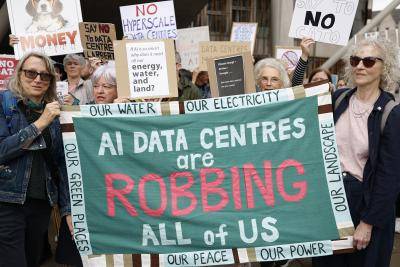
Activists protesting outside the Scottish parliament in Edinburgh, on 3 September, 2026. Protesters gathered to demonstrate against data centre developments in their communities, calling on the government to consider the national impact on energy and water supplies, as well as local concerns over environmental and noise pollution. Photo: Jeff J Mitchell / Getty Images.
That was the background to my China trip in March. My first meetings there were at Huawei. They didn’t want to talk about AI safety. But thereafter, I was impressed by how people in AI academia, in AI start-ups, tech journalists, people in big tech who are building AI models – they all did talk about safety, some of them quite insistently.
While I was there, the OpenClaw AI agent was all the rage. It’s an open-source agent you can install on your laptop, which is crazy because you give it access to all of the data on your computer. The people I met agreed, saying the government needed to stop everybody downloading this agent, it’s dangerous. Sure enough, by the time I left China, the government had restricted use of OpenClaw.
What I draw from this is not that China loves safety and is ready to do a deal. All I’m saying is that the door is at least open a crack. The problem in America is that the reasonable people are very much in a minority. That has to change.
In the note he published this summer on AI regulation, Hassabis said new economic models will be needed to help everyone thrive in what he called a ‘post-scarcity’ world. You’ve written several books on finance. Will those economic models emerge?
We have to be prepared for an economy that functions very differently. For instance, Dario Amodei, the chief executive officer of Anthropic, has said that 50 per cent of jobs will be disrupted by AI by 2030. But even if AI takes 5 to 10 per cent of jobs, that means those people will then be competing for existing jobs, forcing down the wages, maybe to a point where it is just not that attractive to work. So a relatively small hit to aggregate employment can have a big ripple effect on wages and the viability of doing work. It’s quite likely that this is going to happen.