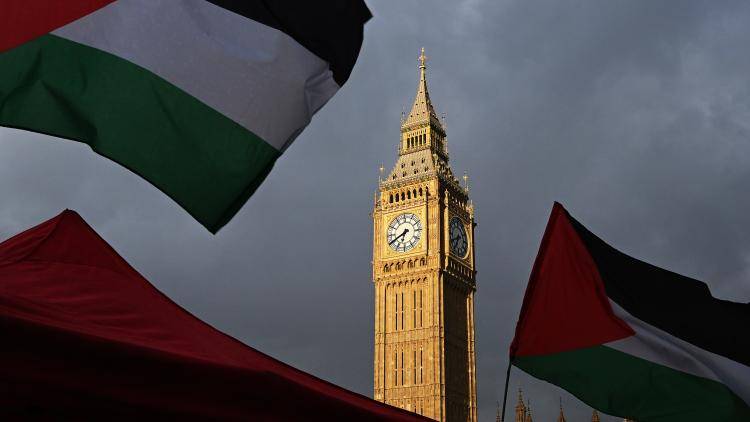
On 21 September, Canada, the UK, and Australia joined 147 other countries in recognizing the state of Palestine. On 22 September France, Belgium and others also announced their recognition. This marks a major foreign policy shift for key allies of Israel, whose long-standing position has been that statehood should be an outcome of a negotiated settlement.
Reacting to the recognitions on 21 September, Palestinian President Mahmoud Abbas said it would allow the ‘State of Palestine to live side by side with the State of Israel in security, peace, and good neighbourliness’.
But Israeli Prime Minister Benjamin Netanyahu reacted as expected by condemning the move: ‘To those leaders who recognize a Palestinian state after the horrific massacre of October 7: You are giving a huge reward to terrorism. And I have another message for you: It will not happen. A Palestinian state will not be established west of the Jordan River.’
Recognition has been a consistent demand by the Palestinian Liberation Organization (PLO), and its diplomatic missions. Now that their demand has been realized, what should the Palestinians do?
Hope
There is still no sign of any meaningful progress to reach a ceasefire agreement in Gaza and no viable post-war-plan that is agreed upon by all key actors.
European and Arab countries are vital players and must keep up diplomatic and economic pressure. But establishing a Palestinian state still broadly hinges on Israel and the US.
To make it a reality, Israel and third parties would need to comply by the International Court of Justice ruling of July 2024 to end the unlawful occupation of Palestinian territory. And the US would have to stop using its veto power to block ceasefire resolutions in the United Nations – and revive a peace process. Both currently seem like impossibilities.

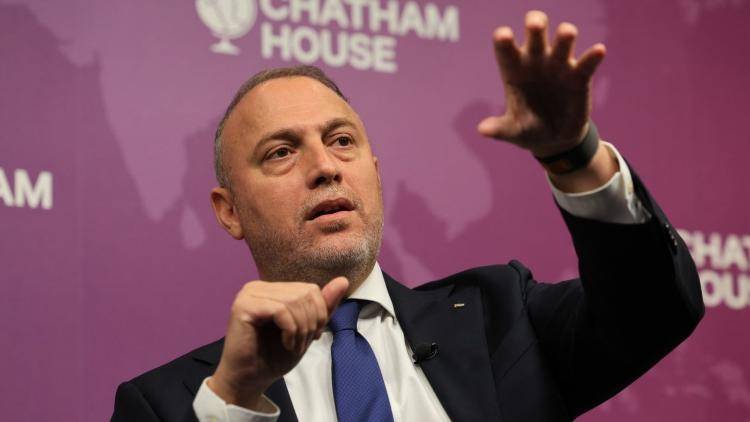
Zizette Darkazally speaks at Chatham House’s event discussing Palestinian recognition
Many Palestinians therefore see the recognition mainly as a signal of hope, where hope is in short supply. They realize however that in the short term the war in Gaza will continue to rage and the threat of Israeli annexation of the West Bank may accelerate as a result of recognition.
The Israeli government reacted furiously to recognition statements. Israeli Finance Minister Bezalel Smotrich, a far-right member of Netanyahu’s coalition, said: ‘The only answer to the anti-Israeli move is sovereignty over the homeland of the Jewish people in Judea and Samaria’ – using an Israeli term for the West Bank.
A Palestinian plan
Regardless, moving forward statehood requires important steps from Palestinians. The groundwork was laid in July, when France and Saudi Arabia convened a UN summit under the umbrella of The Global Alliance for the Implementation of the Two-State Solution.
The summit’s concluding statement, known as the New York Declaration, committed to empowering a sovereign and economically viable Palestinian state. Notably, its plan entrusted governance, law enforcement and security across all Palestinian territory solely to the Palestinian Authority, which like the PLO is led by Palestinian President Mahmoud Abbas.
That provides an important foundation. Palestinians now need to push countries supporting a two-state solution for more clarity on an agreed constructive reform package. Canada’s recognition statement listed a number of defined actions, including to hold general elections in 2026. But terms such as ‘fundamental reforms in governance’ are too open to interpretation. That may hinder progress, preventing a common understanding of the path forward.
Palestinian leadership must also work to reset the internal political and national agenda through an inclusive process. All political factions and government institutions should come together under the umbrella of the PLO, which officially represents Palestinians worldwide.
Refugees in neighbouring countries and the diaspora must be included in this reset, alongside Palestinians in the West Bank and Gaza. Palestinian leadership, institutions and society should then move to translate the New York Declaration into a detailed, workable national action plan with clear objectives, structures, timelines, roles and responsibilities.
Elections
Preparation for national elections across the occupied territory – including East Jerusalem – should be a timebound priority, coupled with a clear commitment by the international community to accept elections results. Elections are a democratic obligation and a necessary means to renew the legitimacy of Palestinian institutions, break the political stagnation and consolidate state-building efforts.