

The war in Ukraine has taken several unexpected turns in recent weeks. On 16 October Russian President Vladimir Putin phoned US President Donald Trump and appeared to have secured a summit in Budapest.
Expectations that Ukrainian President Volodymyr Zelenskyy would quickly gain delivery of US Tomahawk missiles fell away, amid reports that his White House meeting with Trump the next day descended into a ‘shouting match’ as Trump pressured the Ukrainian leader to give away territory in order to achieve a peace settlement.
Then, just as suddenly, the winds blew in a different direction. Putin’s foreign Minister Sergey Lavrov reportedly refused a ceasefire along the current frontline. The Budapest summit was off, and on 22 October Trump imposed sanctions on Russia’s two biggest oil companies, saying ‘Every time I speak with Vladimir I have good conversations, and then they don’t go anywhere.’
Of Putin’s ambitions in Ukraine, Trump said: ‘I always felt that he wanted the whole thing, not a piece of it,’ adding, ‘We don’t want him to have the whole thing.’
Looking beyond the immediate twists and turns of recent days, Professor Marc Weller, Programme Director of the International Law Programme at Chatham House and a veteran mediation expert, here draws on his experience in negotiating deals to examine what a longer-term settlement may look like.
What is Trump trying to achieve?
Clearly, Trump hopes to build on the momentum created by his much-lauded success in obtaining the Gaza ceasefire. His initial focus was on a 30-day ceasefire as a bridge towards negotiating a substantive settlement.
Moscow argues that a ceasefire is impossible until a settlement that accommodates all its war aims is achieved. By way of compromise, in April, the White House offered a set of eight ‘final’ principles that would shape any final settlement as a way towards a ceasefire. Ukraine accepted with minor amendments, Russia refused.
Trump says he remains hopeful that the new oil sanctions will not need to remain in place for long as there might soon be movement, and a delayed summit.
What is Russia’s position?
In June, the sides detailed their official negotiating positions.
Moscow maintains all the maximalist demands it has made since its full-scale invasion:
Ukraine would have to be neutralized, its army cut down and its military equipment limited.
No foreign military presence on its territory and no foreign arms supplies.
The international community would need to recognize de jure the annexation of Crimea, Luhansk, Donetsk, Zaphorizhzhia and Kherson into Russia. Ukraine to withdraw fully from these territories.
Accept Russian as an official language on all territory of Ukraine.
Ukraine to hold elections.
All sanctions to be lifted.
The ‘root causes’ of the conflict would be addressed within the wider Europe (which is code for revising NATO’s expansion after the end of the Cold War).
What is Ukraine’s position?
While it had originally insisted on regaining control over all its territory, it accepted that a ceasefire would be based on the existing line of confrontation between the armed forces.
This would leave the contested territories under Russian control but no de jure recognition of their incorporation into Russia.
Ukraine could obtain EU membership while leaving NATO membership to consensus within the alliance (which the US has already ruled out).
There would need to be effective security guarantees provided by troops from NATO states in case of further aggression from Moscow.
There must be reparations and accountability for war crimes.
The return of abducted children, prisoners of war and other detained individuals.
The discussions of the sides with Trump have focused on two critical aspects of disagreement: territory and security guarantees.
‘Swapping’ Territory
Zelenskyy has come under intense pressure from Trump to accept a broad ‘land swap.’ The US president had understood that Russia would offer to withdraw from parts of Kherson and Zaphorizhzhia if Ukraine agreed to let Moscow incorporate all of Luhansk and Donetsk (the Donbas), including those parts it has not managed to conquer thus far. Trump added that the US would take a lead in managing the Zaporizhzhia nuclear power plant, with energy flowing to both sides.
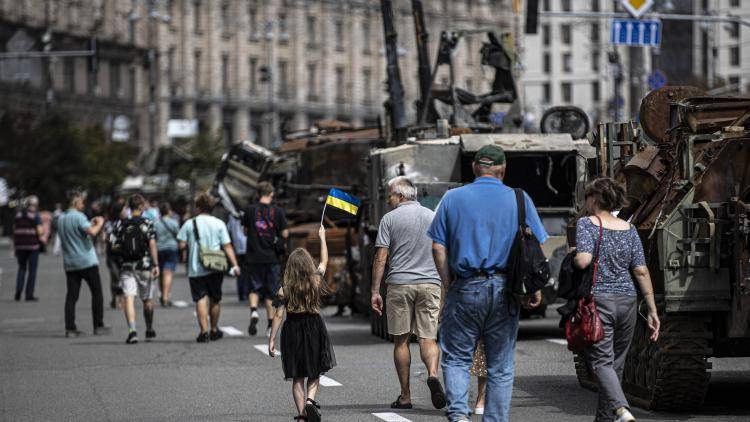
Zelenskyy insisted that the victim of aggression should not be made to give up even more of its own territory as a price for peace. Surrendering more of your own territory in exchange for what is, or should already be, your territory, is hardly a ‘swap’.
Ukraine will continue to resist giving up the parts of the Donbas that it has successfully defended at huge cost for well over three years, not least as these include key cities and fortified territory that protect Kyiv.
Zelenskyy can point to the fact that his public would probably not endorse a deal surrendering the major cities in the region and their pre-war inhabitants to Russian control. Any final peace deal is to be subjected to a referendum in Ukraine.
There is the possibility of more minor adjustments of the line of control – if the sides agree to it. Ukraine would probably seek to regain the portions of the Sumy region that Moscow has taken. Moscow may be compensated with technical ‘corrections’ of the line, for instance to ease deconfliction of forces, ceasefire monitoring or the lives of local populations.
If the prospect of a summit is revived, there is however a risk that Trump will press once more for a deal that demands more concessions of Ukraine than it feels it can or should accept, leading him to blame Zelenskyy for the failure of his peace mission.
Can a settlement recognize the Russian conquest?
Moscow cannot ever achieve the de jure recognition of the supposed annexation of the five Ukrainian provinces it is demanding (all of Luhansk, Donetsk, Kherzon and Zaporizhzhia, in addition to Crimea that was taken in 2014).
Any change of territory brought about through the use of force is internationally unlawful and no agreement between the parties obtained under the shadow of the gun can heal this defect. Ukraine could always legally disown such an agreement in the future. Indeed, Ukraine points to its own constitution that prohibits giving up territory, at least de jure.
True, this is a self-imposed limitation. However, it has been constructed in a way that is eternal – there is no possibility of removing this clause from the constitution, short of a revolutionary abolition and replacement of the entire constitution. Moreover, international law actively prohibits recognition by third states of forcible annexation.
Still, in April Trump offered for the US to recognize at least the incorporation of Crimea – a controversial step providing a face-saving concession to Putin, if it still remains on the table.
The issue of security guarantees
Kyiv is convinced that any cessation of violence will only be temporary, until Moscow has been able to refresh and reconstitute its armed forces to take all of Ukraine.
After Alaska, Trump reported that Moscow was ready to accept ‘Article 5-like’ (of the NATO Treaty) security guarantees for Ukraine. However, it is not evident that NATO states would be ready to commit themselves to the automatic participation of their own armed forces in the defence of Ukraine – the kind of effective deterrence that might be required – in case of further attack. This would be a direct armed confrontation with Russia – the very contingency that even Ukraine’s closest allies have been most keen to avoid in the present war.
In fact, NATO’s famed Article 5 is less automatic than is ordinarily supposed. Its strength lies in the credibility of the political undertaking of all members to guarantee their mutual security, rather than its technical, legal wording.
Russian foreign minister Sergey Lavrov has poured cold water on the sense that Moscow would accept effective security guarantees for Ukraine. Any guarantee could not be directed specifically against Russia, he asserted, because Ukraine might in future be the one re-igniting the conflict.
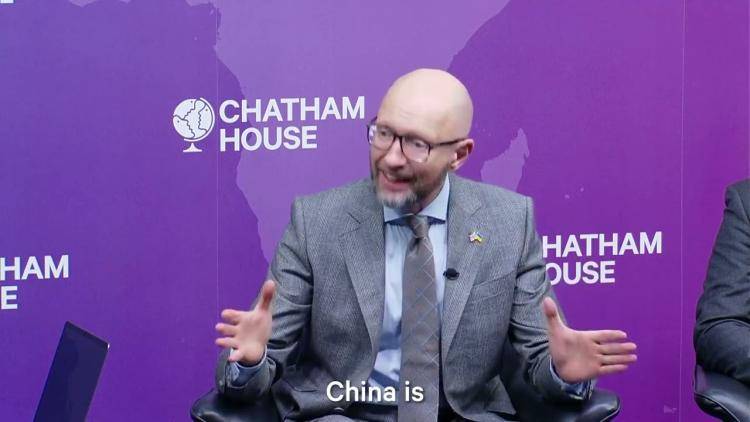
The former prime minister of Ukraine speaks at a Chatham House event on 3 October 2025 entitled: ‘Is the Russia-Ukraine war winnable?’
Second, the guarantee (in Russia’s view) would be administered by a kind of mini-UN Security Council composed of its five permanent members and other guarantors. Any decision to activate the guarantee would need to be made by unanimity among the participating states. Hence, Russia would be able to veto its application.
Even if it could be agreed that the state accused of having mounted an aggression would not participate in the vote, close allies like China or possibly other guarantors Russia might insist on, like Belarus, could still disrupt the required unanimity of the guarantors minus one.
Evidently, such an arrangement is not acceptable to the West, and certainly not to Ukraine. Kyiv obtained a similar arrangement in the 1994 Budapest memorandum, which turned out to be entirely ineffective in the face of Moscow’s aggressions of 2014 and 2022.
