

For the second time this year, a surprise cabinet reshuffle by Ukraine’s President Volodymyr Zelenskyy has caused international headlines. Prime Minister Yulia Svyrydenko has resigned – at Zelenskyy’s request – triggering the automatic dissolution of her cabinet. The popular defence minister, Mykhailo Fedorov, was stripped of his role after only six months in office. Fedorov’s dismissal has sparked protests across Ukraine calling for him to be reinstated. Zelenskyy’s decision not to reappoint him has turned the reshuffle into a political crisis.
Zelenskyy defended his decision as a necessary step to resolve a paralyzing internal conflict between Fedorov and Commander-in-Chief Oleksandr Syrskyi. In an attempt to quell the protests, Syrskyi has now been sacked and replaced with joint forces chief Mykhailo Drapatyi, seen as an ally of Fedorov. Zelenskyy also says he has offered Fedorov a ‘prominent position within the government’ but details are yet unclear. Although this will help defuse the crisis, the pairing of Drapatyi leading the armed forces alongside Fedorov driving tech innovation is viewed by many as essential for driving their reform agenda forward. This is now likely to become the focus of the protests.
Competing visions of war and governance
This animosity between Fedorov and Syrskyi reflects a fundamental ideological clash over how Ukraine should fight and govern itself. Critics view Syrskyi as an embodiment of the archaic, centralized Soviet-style approach that prioritizes artillery and ground assault infantry – and tolerates high casualty rates. Public condemnation of this old-guard military culture has recently intensified following investigative reports exposing the mistreatment and systemic abuse – even fatal – of recruits within a regiment reporting directly to Syrskyi.
Conversely, Fedorov champions an asymmetric, tech-driven approach to warfare designed to outsmart a larger adversary. His track record includes scaling domestic drone production, negotiating the shutdown of Starlink terminals used illegally by Russian forces, and introducing ‘after action reviews’ (AAR) to boost Ukraine’s missile interception rates. Fedorov also promoted pay raises, a new fixed-term contract system, and mechanisms to address soldiers going AWOL. But he was ousted before all his reforms could be realized and there is now widespread frustration that progress on these vital changes will stall.
Perhaps even more importantly, Fedorov’s reforms disrupted an opaque system long exploited by corrupt generals for personal enrichment. His introduction of competitive tendering and digitized procurement tracking made it increasingly difficult to inflate supply contracts and hide illicit kickbacks. Fedorov had also called for integrating battalion-level performance metrics into resource allocation and operational decisions.
Zelenskyy’s political calculus
While Fedorov has never publicly expressed presidential ambitions, his political capital is growing. A recent survey by the Kyiv Institute of International Sociology revealed that public trust in Fedorov surged from 38 per cent to 50 per cent over the last six months, whereas trust in Zelenskyy remained stable at around 61-62 per cent.
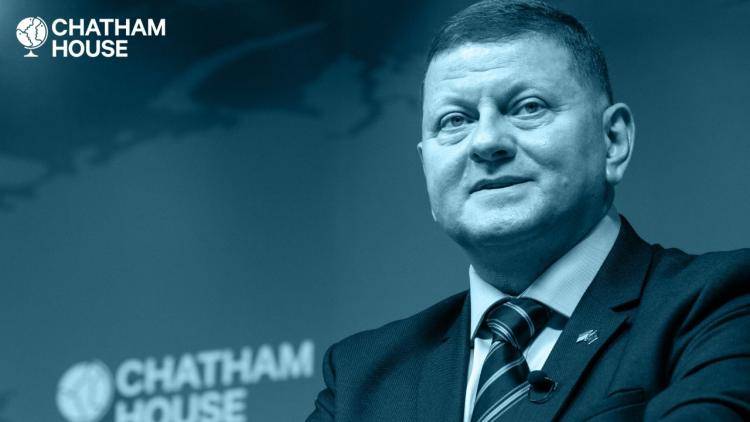
Ambassador Zaluzhnyi at Chatham House
However, public sentiment is shifting: a May 2026 poll indicated that 67 per cent of Ukrainians expect Zelenskyy to be replaced once the war ends. Although Ukraine is constitutionally barred from holding elections under martial law, Zelenskyy has consistently sought to neutralize potential political rivals through dismissal or co-optation.
Zelenskyy’s most formidable political rival remains General Valerii Zaluzhnyi, although his political momentum appears to be waning. An early June poll showed that if presidential elections were held immediately, 32 per cent of Ukrainians would still vote for Zelenskyy. Conversely, Zaluzhnyi’s support dropped from 25 per cent to 16 per cent over the same period. Notably, Zelenskyy dismissed Zaluzhnyi as commander-in-chief and made him ambassador to the UK in February 2024 – around the time when Ukraine’s presidential elections would have normally occurred.
In January 2026, a massive energy sector corruption scandal forced the resignation of Zelenskyy’s powerful chief of staff, Andriy Yermak. In the resulting government reshuffle – which also elevated Fedorov – Zelenskyy appointed former military intelligence chief Kyrylo Budanov to his administration to restore public trust. This restructuring happened amid persistent pressure from Washington for Ukraine to establish a path towards democratic elections. Budanov’s inclusion is politically significant: he consistently ranks as one of the top three most trusted political figures, with data in late 2025 suggesting he could defeat Zelenskyy in a hypothetical runoff election.
Ultimately, sidelining capable and popular officials has become a distinct pattern of Zelenskyy’s leadership style – even more so as discussions about potential autumn elections heat up behind closed doors. But this time it backfired.
What happens now?

The timing of Zelenskyy’s decision is particularly baffling. Fedorov’s 40-day operation to isolate the Russian-occupied Crimean Peninsula had reached unprecedented momentum, and any bureaucratic slowdowns could now leave frontline brigades vulnerable. Russia is also preparing for another potential wave of mobilization after its autumn Duma elections.
EU Defence Commissioner Andrius Kubilius, meanwhile, called Fedorov’s sudden removal a ‘big surprise’, emphasizing that he was the driver of Ukraine’s tech-first model and asymmetric drone strategy. Ukraine had just signed the EU-Ukraine Defence Industrial Partnership, establishing a framework for joint production and integration of combat-tested drone and counter-drone technologies with European manufacturing capacity. Fedorov had also recently submitted an application to route EU funds towards US and European anti-ballistic missile technology for Ukraine to help mitigate critical air defence shortages.
In Ukraine, active-duty soldiers and veterans have reported internal pressure designed to suppress support for Fedorov and the protests over his removal. For the demonstrators, Zelenskyy’s initial alignment with Syrskyi represented a regressive path toward opaque, Soviet-style governance, protecting vested interests of defence companies that may be losing contracts as a result of Fedorov’s strategy and reforms.
The new commander-in-chief, Drapatyi, is widely respected in Ukraine as a highly effective, accountable battlefield commander committed to military reform and soldiers’ well-being. It remains to be seen if Fedorov will accept Zelenskyy’s latest offer of a ‘prominent position’. He has already refused an offer to serve as an adviser overseeing defence technology and military reforms.