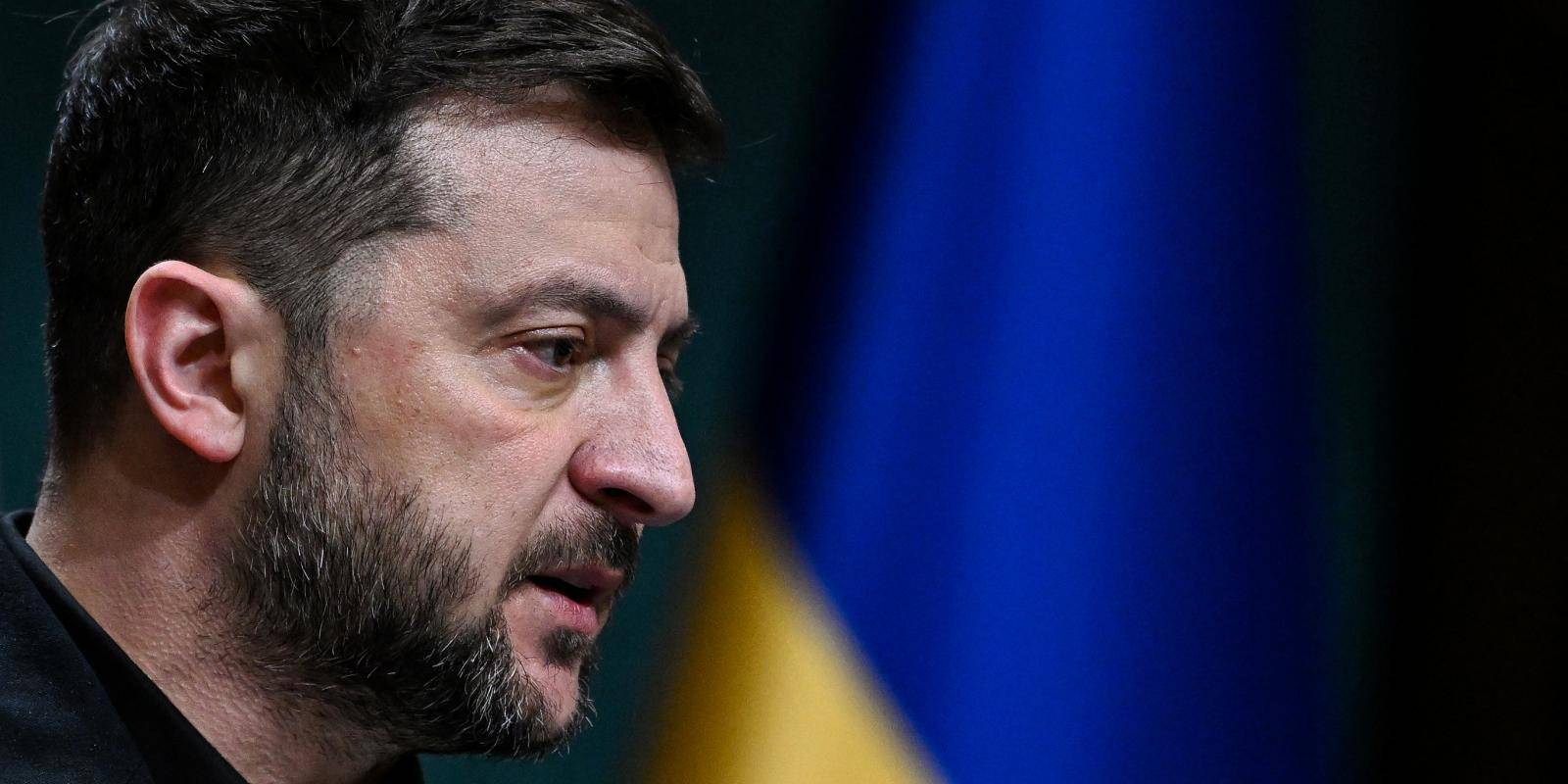


Ahead of the fourth anniversary of Russia’s full-scale invasion of Ukraine, US President Donald Trump has put pressure on Ukraine’s President Volodymyr Zelenskyy to sign on to a peace proposal or risk losing US support.
The White House’s 28-point draft plan was put together by Trump’s envoy Steve Witkoff and his Russian counterpart Kirill Dmitriev and presented to Zelenskyy on Thursday by US Army Secretary Daniel Driscoll.
The plan, as leaked to the news media, includes difficult concessions for Ukraine – ceding territory including the eastern Donbas region and reducing the size of its army. Trump reportedly gave Zelenskyy a deadline to accept by Thanksgiving Day (27 November).
Zelenskyy, who has since had talks with European leaders, said in a televised address to the nation on Friday: ‘Now is one of the most difficult moments of our history. Now, the pressure on Ukraine is one of the heaviest.’ He added: ‘Ukraine can face a very difficult choice – either losing dignity or risk losing a major partner.’
Russian President Vladimir Putin said: ‘We have this text and received it through existing channels of cooperation with the US administration. I believe that it can also form the basis for a final peaceful settlement.’
Here is early analysis from Chatham House experts, who are monitoring developments in the aftermath of President Trump’s latest intervention in the war.
Orysia Lutsevych, Deputy Director of the Russia & Eurasia Programme and Head of the Ukraine Forum
The 28-point plan looks like a brainchild of the Kremlin.
It takes all the Russian official goals of its so-called ‘special military operation’ and presents it to Kyiv as the American peace plan. It resembles more a demand for capitulation, especially as it imposes limits on Ukraine’s sovereignty and pushes to cede territory in the Donbas region that Russia has failed to conquer militarily. It dictates to Ukraine when to hold elections, the size of its armed forces, and denies the right, in the future, to become a member of NATO.
This is another example of a masterful Russian operation to alter the negative military-political situation that Putin faces, via the semblance of negotiating peace. His army is currently making excruciatingly slow progress at enormous cost.
Europe is launching a massive rearmament programme that will substantially contribute to both deterrence and the defence of Ukraine. The goal of these back-room Witkoff-Dmitriev ‘negotiations’ is to obstruct this resolve.
Playing for time
Putin plays Trump for time. His goals are to impede the enforcement of oil sanctions that come into force on 21 November 2025, and to delay the adoption of the secondary sanctions bill currently at the US House of Representatives.
Kyiv will engage with this plan. Ukraine negotiators will try to course correct. This could only work if Zelenskyy presents a joint position backed by the European ‘coalition of the willing’. They will take it point by point and either reject or modify. There will no wholesale deal.
Paradoxically, the domestic corruption scandal that casts a shadow over Zelenskyy’s inner circle will embolden him to stand even more strongly in defence of Ukraine’s national interest. This will restore some trust in his leadership. His call for unity, in the face of one of the most difficult times since the start of the war, will resonate well given the external pressure to accept humiliating conditions of peace.
Keir Giles, Senior Consulting Fellow, Russia and Eurasia Programme
There is no peace process. This is not negotiations over peace: it is the transmission of surrender demands from Russia with the active facilitation of the United States.
The key difference between the currently circulating ‘28-point list’ and previous iterations of US/Russian surrender demands for Ukraine is the inclusion of points that to the unwary or uninformed might look as though they represent meaningful concessions by Russia – plus, of course, the payoff for the US in the form of use of Russia’s frozen assets abroad.
That may be what is encouraging the US to claim that it would not be a simple capitulation by Ukraine to all of Russia’s demands.
It is not a realistic plan. As well as being one-sided (just one simple example – the text says Ukraine must not strike Moscow or St Petersburg, but has no such prohibition on Russia striking Kyiv), the main characteristics of the text we’ve seen so far is that so much of it is nonsensical, unenforceable, or so vague as to be meaningless.
That has much in common with previous Russian ‘ceasefire’ drafts that have been enforced on the victims of Russian aggression, as in Georgia and Syria; but in addition the text we have seen so far has a role and obligations for unspecified ‘Europeans’, with whom none of this has been agreed.
The question is: Will Russia try to occupy Ukraine later if the plan is approved? Yes, that is the whole point of the military aspects of the surrender terms, to leave Ukraine defenceless for when Russia decides it is ready to have another go.
Europe is not involved because the United States has not seen the need to involve Europe, despite the fact that the terms as laid out would be disastrous not only for the future of Ukraine itself but for security of the continent as a whole. European involvement would probably have been inconvenient and unwelcome for the Trump White House, as there might have been insistence on a workable and durable settlement instead of what we have so far.
Professor Marc Weller, Programme Director, International Law Programme
How sovereign would Ukraine be under this proposal?
Russia had demanded that Ukraine becomes a permanently neutral state. Instead, according to the draft, Ukraine would merely enshrine in its constitution that it will not join NATO. Conversely, NATO would agree to include in its statutes a provision that Ukraine will not be admitted in the future.
At present, Ukraine’s constitution provides for the opposite: the ‘irreversibility of the Euro Atlantic course’ of Ukraine. Changing this would be very difficult, requiring at least a two thirds majority in parliament.
NATO would be very unlikely to change the North Atlantic Treaty of 1949 with the aim of excluding the possibility of membership of a particular country.