

President Donald Trump’s keenness for bilateral diplomacy was on full display during his tour of East and Southeast Asia last week – and so was his disdain for the patient diplomacy of multilateral forums. The Asian leaders he met were ready for this, successfully using the opportunity to curry the president’s favour.
However, deep uncertainty remains over the reliability of the US security posture in Asia. Uncertainty is stoked by Trump’s highly personalized style of ‘America First’ diplomacy. Moreover, while US–China relations have stabilized after Trump met Chinese leader Xi Jinping in South Korea, the two superpowers remain on a collision course in Asia.

When it comes to US regional defence aims, however, not all this uncertainty is bad. Its key strategic aim in Asia is to encourage its key regional allies to spend more on their defence – and they are obliging. South Korea’s President Lee Jay Myung has pledged to increase his defence spending by 8.2 per cent next year. Japan’s new Prime Minister Sanae Takaichi has already stated that Japan will hit a 2 per cent of GDP defence spending target early.
The US is therefore pursuing a balancing act. On the one hand, it is encouraging hasty defence build-ups in countries that could help deter China. On the other hand, the US risks inadvertently bolstering China’s claim to be a more stable regional presence.
The evidence from Trump’s latest tour of Asia is that this US approach to the region is working but at a cost – and that the US administration risks drawing the wrong lessons around using local partners and allies to balance China’s regional presence.
Fleeting visits
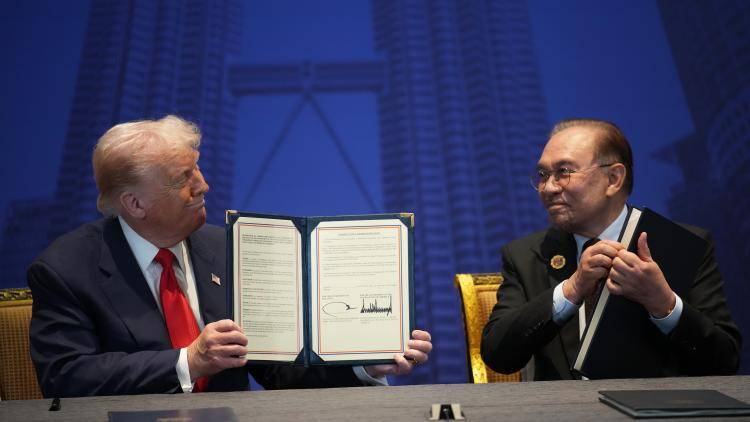
Trump used his visit to the ASEAN Summit in Kuala Lumpur to preside over the signing of a joint declaration involving the prime ministers of Thailand and Cambodia, whose armed forces briefly fought each other in July. Trump wanted to call this a peace agreement but the Thai foreign minister was more circumspect, calling it ‘a pathway to peace’. Trump left before the ASEAN summit itself, ceding the diplomatic ground to Chinese Premier Li Qiang, who addressed the gathering.
US Defence Secretary Pete Hegseth also attended the ASEAN Summit and used the opportunity to sign a 10-year defence framework agreement between the US and India, with Indian counterpart Rajnath Singh – confirming that for the US, bilateral defence diplomacy is its primary short-term rationale for engaging countries in Asia.
Trump travelled on to Japan to meet new Prime Minister Sanae Takaichi. Takaichi secured a warm response from Trump after burnishing Japan’s credentials in growing its defence sector.
The final stop on the president’s itinerary was Gyeongju in South Korea, host city to this year’s APEC summit. There, he met President Lee and notably gave his blessing for South Korea procuring nuclear powered submarines for the first time, with the vessels to be built in US shipyards.
Trump skipped much of the summit that followed, though he did meet Xi Jinping, to stabilize the deterioration in US–China relations, and announce a ‘trade war truce’. That included a pledge by China to withhold export controls on rare earths for a year. The likely scenario is the persistence of ‘a cycle of escalation and de-escalation’ in the US–China rivalry.
Asian states will breathe a sigh of relief over the truce, and the level of US engagement in Asia on display during Trump’s visit. But the medium-term outlook points to an uncertain future, including continuing uncertainty over how the US will develop its role in Asia.
Will Asia feature prominently in the forthcoming US National Defence Strategy?
The forthcoming US National Defence Strategy (NDS) could assuage some of this uncertainty – or heighten it. The NDS is expected to reorient some US military attention towards the ‘America First’ objectives of defending the homeland and prioritizing the Western Hemisphere. Recent US unilateral military action against alleged drug boats, and the deployment of a US aircraft carrier battlegroup to pressure Venezuela’s government, indicate what this might entail.
Regions that could see a reduction of US military presence include Europe and the Middle East. Where Asia fits into this picture remains uncertain. According to a US Department of War statement in May, ‘the NDS will prioritize defence of the US homeland, including America’s skies and borders, and deterring China in the Indo-Pacific’.
