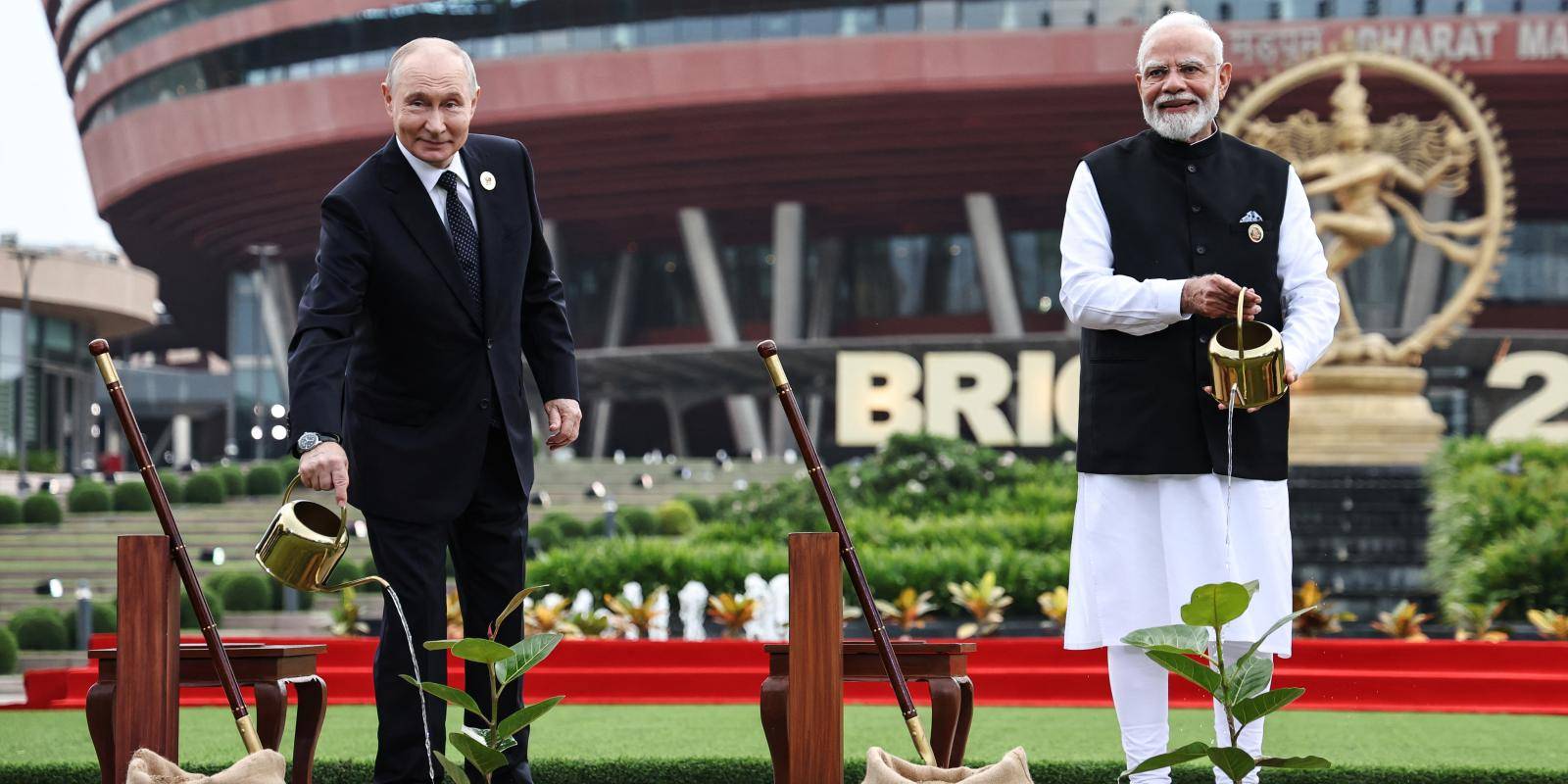

The past fortnight has seen President Vladimir Putin undertake plenty of summit diplomacy. Throughout he has shown no sign he is open to compromise on Russia’s war aims in Ukraine. On the contrary, escalation has accelerated.
Europe seems inclined to read this increased aggression as a sign of desperation on Moscow’s part. But that is a miscalculation. In reality, the Kremlin’s strategy of blended diplomatic impassivity and calibrated escalation may be stronger than it looks.
No backing down
US envoys Steve Witkoff and Jared Kushner spent more than three hours with Putin in Moscow on 5 September, discussing how to end the war. The Kremlin hailed the discussions as ‘highly useful’ but gave no indication that it was ready to relax its demands: Ukrainian territorial concessions and restrictions on Kyiv’s future security alignment. Days later, an offer by President Volodymyr Zelenskyy to meet Putin at December’s G20 summit in Miami was rebuffed.
Meanwhile, Russian attacks have intensified. On 13 September, a Russian drone struck railway infrastructure near Yahodyn, shortly after a train carrying Boris Johnson, former CIA director David Petraeus and others had passed through the area. Whether they were deliberately targeted remains unknown. What is certain is that the strike was part of Russia’s largest drone barrage in months and followed intensified attacks on Ukrainian transport, energy and civilian infrastructure.
Many European officials argue that Moscow’s behaviour shows it is running out of options in Ukraine. Indeed, Russia’s position is uncertain. It is suffering extraordinary losses. Its territorial advances remain slow and costly. And Ukrainian forces have regained ground in several sectors.
Yet the conclusion that Russian escalation betrays desperation is closer to wishful thinking than reality. Putin behaves like someone who still believes time is on his side and that he retains room for manoeuvre. His recent diplomacy offers a useful interpretative framework.
Putin can (still) afford to ignore friendly advice
Kazakh President Kassym-Jomart Tokayev’s July intervention on the Ukraine war rightfully attracted considerable attention. Sitting alongside Putin in Omsk, Tokayev said the conflict should be frozen and negotiations resumed. The Kremlin promptly rejected the idea of a freeze.
Narendra Modi went a step further in Bishkek on 31 August, at the summit of the Shanghai Cooperation Organisation (SCO), telling Putin publicly that the world needed to ‘move from endless war to end of war’. Yet Modi also addressed Putin as his ‘friend’, praised the strength of Russia–India relations and less than two weeks later, during the BRICS summit, discussed a bilateral trade target of $100 billion with Putin.
There is no reason to doubt that governments like India and Kazakhstan genuinely want the war to end. But that does not mean they are prepared to make their relations with Russia conditional upon it.
This distinction explains much of Putin’s confidence. Despite its criticism, India continues to treat Russia as a key strategic partner. And, while Kazakhstan has carefully diversified its foreign relations, it has preserved a close relationship with Moscow. Meanwhile the New Delhi BRICS declaration criticised unilateral sanctions and trade restrictions while avoiding directly confronting Russia over Ukraine.
These sustained partnerships may provide Moscow with something it needs almost as critically as support for the war in Ukraine: economic integration in Asia, diplomatic legitimacy, and a respected role in influential international groupings.
Russia is valuable to China too
Chinese President Xi Jinping told Putin at the SCO summit that the foundations of their bilateral relationship would only become stronger.
Russia is often described by Europeans as China’s ‘vassal’. This captures a genuine economic asymmetry: China’s economy is roughly eight times larger than Russia’s. And Russia conducts at least 34 per cent of its international trade with China, whereas Russia accounts for only around 4 per cent of China’s.
But it is missing an important aspect of the partnership, which cannot be measured through bilateral trade alone. Beijing has reasons to keep Moscow strong enough to remain an independent power. Russia has a nuclear arsenal, a permanent UN Security Council seat, vast energy and commodity resources, and a strategic position straddling Central Asia and the Arctic. Most importantly, Moscow is willing to challenge what remains of the US-shaped world order.
Chinese involvement in Russia’s war economy shows that the relationship is more consistent than many in Europe may think.
Documents reported this month by Politico suggest that a Chinese state-owned firm shipped carbon fibre used in Geran attack drones to Alabuga-Volokno, a sanctioned subsidiary of Rosatom (Russia’s state-owned nuclear conglomerate). An earlier investigation by the Robert Lansing Institute documented Chinese engines and components in Russian drones. Last year, Reuters reported that Chinese drone specialists were working with Russian manufacturers.
This does not prove that every transaction was ordered by Beijing. Nor is it evidence of ‘limitless’ Chinese support. Xi has no interest in becoming hostage to Putin’s decisions and Beijing will continue to calibrate its exposure very carefully. It does show, however, how misleading it is to equate China’s rhetorical caution over Ukraine with distance from Russia.
For Beijing, Moscow remains the useful disruptor-in-chief. Its actions help an alternative international system emerge, through groups like the SCO and BRICS, in which US and European power carry less weight. And even though these groups’ members disagree profoundly about what a more multipolar order should look like, they offer increasingly clear diplomatic expression to China’s ambition.
India may not share China’s vision of global order, but neither does it see an advantage in isolating Russia. Nor does Kazakhstan or any other BRICS member. This has proved a comfortable enough ambiguity with which Putin has learned to live.
More realism is needed in Europe
These past few months of Russian escalation against Ukraine and Europe, and diplomatic consolidation with Asia, should teach European leaders a lesson: Their effort to shame governments into choosing between Russia and the West has clearly reached its limits – if not failed.
The European Union (EU)’s relations with India may offer a better model. This has seen the EU strengthen commercial ties with India while lowering its tone over New Delhi’s relationship with Moscow.

This makes sense: there is considerable scope to deepen relations with India and Central Asia. Europe can offer investment, technology, access to the single market, and critical-mineral partnerships. It can also offer transport routes that reduce dependence on Russia, such as the Trans-Caspian corridor.
By using such an approach, Europe can adjust to a new reality, working patiently to widen the space between Russia and its partners rather than assume that the separation is already underway.
On China, the EU has already sanctioned a growing number of Chinese companies involved in sanctions circumvention and Russia’s military-industrial complex.
The success of Europe’s own long game may hinge on how far the EU is prepared to extend those sanctions and hit strategic supply chains when the evidence points to direct involvement by larger or state-owned Chinese suppliers.
Russia’s escalation in Ukraine indicates that Putin still wagers he can outlast Ukraine’s supporters. He remains confident that Russia is sufficiently connected to the rest of the world to absorb Western pressure. And he sees his position as bolstered by what he believes is a US weakened by war with Iran. Putin’s summit diplomacy of the past few months suggests that, at least for now, he has some reason to be confident.
But Europe does not have to accept his wager. What it must do is understand the underlying long-term dynamics and respond accordingly. If Putin is playing the long game, perhaps it is time Europe does too.