How Beijing might rule the South China Sea within a decade

William Matthews and Ben Bland create a speculative ‘backcasting’ scenario: ‘It’s the year 2035 and China dominates the region’. They describe how that might come to pass – and how to avoid it.

The World Today

Published 15 September 2025

Updated 12 March 2026 — 9 minute READ

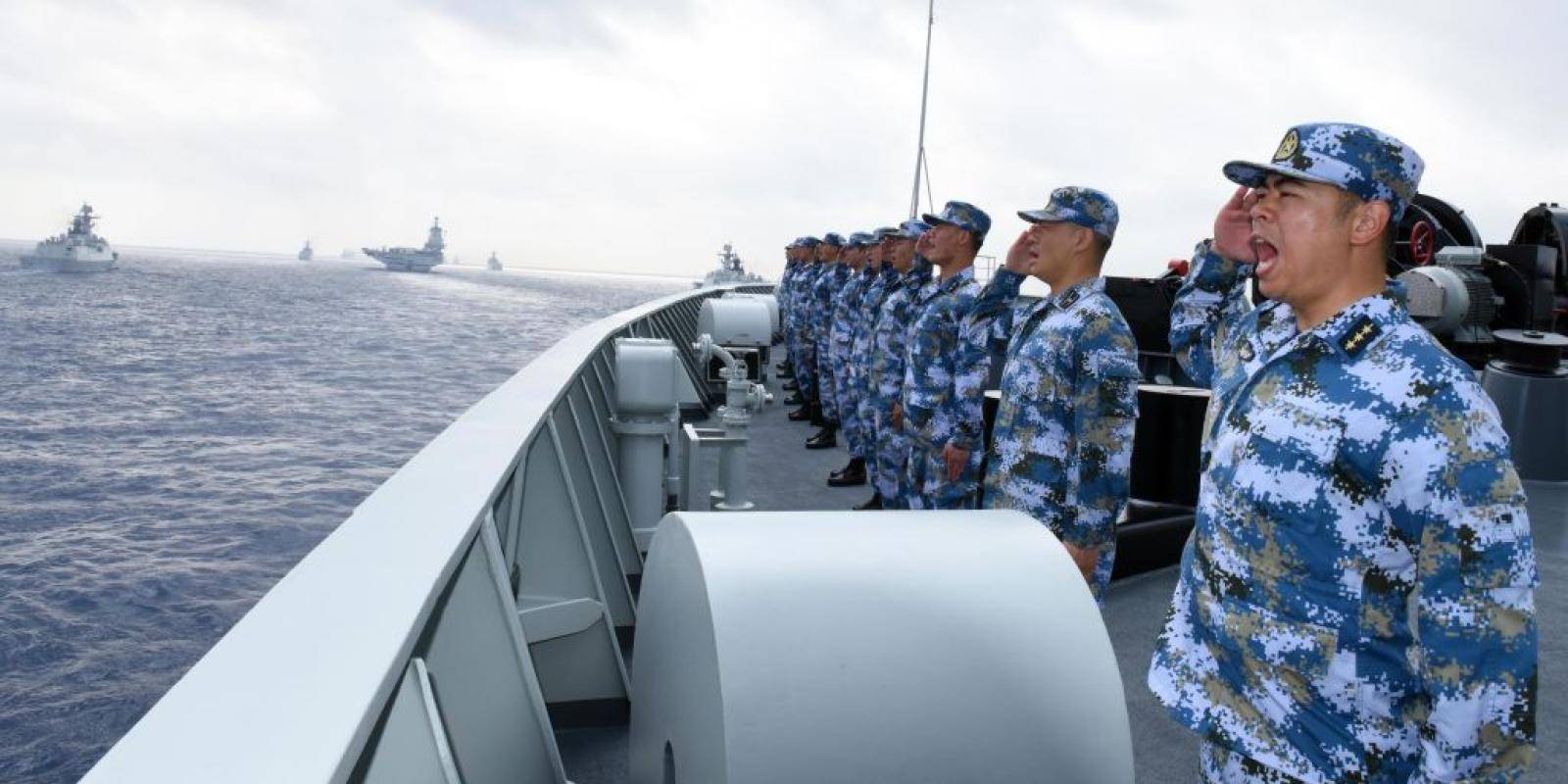
Image — A PLA Navy fleet takes part in a review in the South China Sea in 2018. Photo: Getty Images.

William Matthews

Former Senior Research Fellow, Asia-Pacific Programme

15 September, 2035: As the Zhejiang, an 80,000-ton nuclear-powered aircraft carrier, drifted into Manila’s port yesterday, the Chinese delegation was given a warm welcome by thousands of watching Filipinos. Officially, the visit was to mark the fifth summit of the China–Philippines Dialogue on Maritime and Climate Security. In effect, it represented the moment China achieved a decades-long ambition: control of the South China Sea.

Philippine recognition of China’s claims was unthinkable only 10 years ago.

On the flight deck of the Chinese navy’s most advanced ship, leaders of both countries announced a raft of new climate aid pledges by Beijing with a joint statement endorsing the Maritime Community of Shared Future for the South China Sea. The deepening ties between the two countries mark the Philippines’ official recognition of the waters within the 10-dash line as China’s sovereign territory, leaving Vietnam the sole Southeast Asian nation contesting Beijing’s claims in the South China Sea.

Philippine recognition of China’s claims was unthinkable only 10 years ago. That was before Washington’s unilateral decision to tear up its defence pact with Manila – part of an attempt to curry favour with isolationist voters in the run-up to the 2030 mid-terms. That put to rest any lingering hope of serious US opposition to China’s increasingly aggressive intimidation of Philippine vessels in the region.

The Spratly Incident

Earlier in 2030, intimidation resulted in the sinking of a Philippine fishing vessel and the death of several crew members in a ramming incident with a Chinese People’s Maritime Militia unmanned patrol vessel. China denied any involvement. The diplomatic silence across Southeast Asia was palpable. Few external powers now challenge China’s position in the South China Sea. The routine joint exercises that the United States, Japan, France, Britain, Australia and others often held alongside regional partners are now distant memories.

No non-Chinese military vessel has crossed the 10-dash line, which demarcates the area of sea over which China claims sovereignty since the Spratly Incident in 2031. Following the joint recognition of China’s territorial claims by Brunei, Indonesia, Malaysia and Thailand at the inaugural summit for the Maritime Community of Shared Future for the South China Sea in 2029, Beijing’s rhetoric on the South China Sea changed. Increasingly, it made reference to ‘grave and devastating’ consequences for any foreign power ‘seeking to undermine the eternal historical truth of China’s inalienable sovereignty over the South China Sea’.

In 2031, the Australian government quietly sought to test China’s resolve amid the winding down of US commitments in the region, Japan’s increased focus on its own disputes with China in the East China Sea and the inability of European countries to maintain naval operations so far from home. An unmanned Royal Australian Navy Large Optionally Manned Surface Vessel, equipped with a US-made Aegis air-and-missile defence system, crossed the 10-dash line on a course towards the Spratly Islands. 

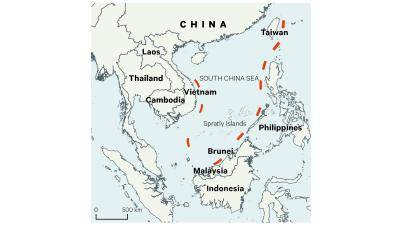
The 10-Dash Line: China’s disputed claim to the South China Sea
map of South China Sea

This map is based on maps circulated by the Chinese government in 2009 and 2023. It is an approximate representation and not exactly to scale. The boundaries and names shown and designations used on the map do not imply endorsement or acceptance by the authors or Chatham House. Map boundaries from World Bank; the extent and location of Spratly Islands is an approximation based on a 2015 US State Department map.

The most authoritative accounts suggest that its presence triggered a swarming response from Chinese drones, which overwhelmed the vessel’s defences and sank it. China denied ordering such an attack. Australia acknowledged an accident involving one of its vessels and launched an inquiry into the cause, results of which have never been made public. The incident would become the first and last attempt by any power to deploy a naval vessel across the 10-dash line since China completed the rollout of its Zheng He vessel identification system.

content continued

This system makes use of China’s BeiDou, the world’s most advanced satellite navigation and positioning system, in tandem with continuous air-and-sea-borne drone patrols operating autonomously from stations across reclaimed islands in the South China Sea as well as those located in the Chinese province of Hainan, Cambodia and Brunei. Since 2030 this has allowed China to track the movement of all shipping in the region.

Providing that they comply with monitoring, all commercial vessels are allowed to transit the South China Sea without incident; indeed, many shipping companies welcomed the Zheng He system as guaranteeing clear and stable conditions in the region – in contrast to earlier disputes. Fishing and resource exploitation is another matter. Beijing’s permit system has long been a headache for external players, who can generally only gain approval for operations within the 10-dash line as the junior partner in a joint venture with a Chinese company.

Cheap Chinese energy

The Spratly Incident marked a turning point. It underscored the new reality in the South China Sea: navigation is by China’s consent, and the superiority of Chinese military technology discourages any attempt to change this. By 2030 it was increasingly clear that even US manufacturing and research could not keep pace with China when it came to the military balance in the East and South China Seas. The People’s Liberation Army Navy now numbers well in excess of 350 vessels to the US’s 230. 

China’s air force, the largest in the world by some margin, operates two models of sixth-generation fighter while its US counterpart, announced in 2025, has yet to be deployed. China’s military dominance of the region is clear. But it was China’s economic and technological superiority that led the South China Sea to fall fully under Beijing’s control.

The unwillingness of the US to invest in alternative energy sources means that the region is likely to remain heavily dependent on Chinese energy for decades.

By the end of the 2020s China’s projects in the South China Sea extended far beyond land reclamation for military purposes. Thousands of square kilometres of the sea became host to huge solar and wind farms, massively expanding China’s electricity generation, now exceeding that of the US by four times.

For Southeast Asian nations, this brought the promise of cheap and plentiful Chinese energy, at a time when their natural resources were dwindling and they were under public pressure to show they were mitigating the increasingly damaging impacts of climate change. Chinese-dominant companies have proved crucial for the region’s green transition.

China is by far the world’s leader in renewable and civil nuclear energy technology. The chronic unwillingness of the US to invest in alternatives, and the inability of other once-significant players such as France and Japan to match China’s scale, mean that the region is likely to remain heavily dependent on Chinese energy for decades to come. Meanwhile, China’s own efforts to adapt to the effects of climate change have combined with its growing control of the South China Sea to make it a key provider of both climate mitigation and disaster relief.

The mass rollout of smart grid technology made integrating Chinese wind, solar and nuclear energy provision an obvious choice for countries keen to secure cheap and reliable energy, given their long-established reliance on Chinese digital infrastructure, from 5G networks to ‘smart city’ initiatives. As countries such as Thailand and Malaysia discovered years ago, adoption of such technologies meant that further digitization was both cheaper and easier if they stuck to Chinese providers.

Some still point to international law as a means to roll back China’s claims – few today take such appeals seriously. 

This extended to the information space. More and more sub-sea cable providers from outside the region proved incapable of responding effectively to grey-zone threats – efforts to destabilize nations through actions such as sub-sea cable-cutting, disinformation and artificial land building. Over time, Chinese companies moved in to replace them – and while governments beyond Southeast Asia were vocal in observing how China’s own cables remained unaffected, little was done to gather evidence or offer a robust response.

Criticism from governments within the region was soon mitigated by the arrival of ultra-fast internet connectivity. Brunei, Cambodia, Laos and Malaysia enjoy some of the fastest connections in the world – alongside many countries in Central Asia and Sub-Saharan Africa – in exchange for compliance with Chinese internet regulation and censorship. 

The true extent of Chinese dominance in energy and digital infrastructure is best demonstrated by the fact that all governments in the region, bar those of Singapore and Vietnam, have now switched from US to Chinese providers for cloud storage, computer operating systems and office software. If one is willing to comply with Chinese standards, these products are both cheaper and superior to those of any western competitor.

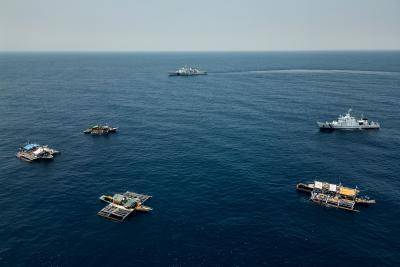
A Chinese Coast Guard ship with hull number 4203 is seen closely shadowing the convoy of Filipino fishing boats and a Philippine Coast Guard ship, on 16 May 2024, less 80 Nautical Miles from the island of Luzon, in the Philippines.

A Chinese Coast Guard ship is seen shadowing a convoy of Philippine fishing boats and a Philippine Coast Guard ship on 16 May 2024, less than 80 nautical miles from the island of Luzon, part of the Philippines. Photo: Martin San Diego for The Washington Post via Getty Images.

Some analysts have argued that the fate of the South China Sea could have been different had other powers – especially America – made alternative choices. They typically cite the failure to offer robust deterrence or impose costs on China for its grey-zone activities. Some still point to international law as a means to roll back China’s claims – few today take such appeals seriously.

In reality, China has been able to achieve a level of dominance unthinkable a decade ago through its economic and technological leadership, which has provided the physical power necessary to establish the South China Sea as its widely recognized sovereign territory. China was able to offer others energy, digital systems and climate change relief that no other country could provide so cheaply or at such scale. To their cost, its competitors failed to take this seriously.

What is backcasting?

The speculative article above is based on a 2035 scenario designed for a ‘backcasting’ exercise exploring China’s evolving influence in the South China Sea. It is not a prediction of what may happen. Instead, unlike forecasting, where participants project what is likely to happen based on the current status quo, participants in backcasting are presented with a hypothetical scenario. 

Without questioning its credibility, they must work out what conditions would need to be met for it to occur. The aim is to lead participants to question their assumptions by exposing them to unexpected possibilities.

The scenario described here is based on one which Chatham House’s Asia-Pacific Programme presented to two groups taking part in backcasting exercises held in Britain and Malaysia. Each group included a range of policymakers and experts from fields including security, international law, economics and maritime trade – and proved highly effective in highlighting differences in perspective and policy priorities between the two regions. 

How can the 2035 scenario be prevented?

China has systematically expanded its presence in the South China Sea through extensive land reclamation, resource exploitation and the development of military sites such as airfields on contested islands. It currently has territorial disputes with Brunei, Indonesia, Malaysia, the Philippines and Vietnam, claiming sovereignty over an area marked on official maps by a nine-dash line that encompasses most of the South China Sea.

In our scenario we refer to the ‘10-dash line’, a version which has appeared more recently and extends the area to cover Taiwan, which Beijing also claims. China has become increasingly intimidating towards rival claimants such as the Philippines, by using China Coast Guard ships to harass fishing vessels, for example.

content continued

This scenario was designed to present a ‘worst-case’ but plausible account of China dominating the South China Sea by 2035 at the expense of other claimant states. The exercise involved discussing how this could be prevented. While much public focus in the West is on the legality of China’s territorial claims, in practice our backcasting participants did not see this as important. Despite rulings against it, China has continued to press its claims. The question is one of hard power and influence. 

The key driver of China’s success was seen as its economic and technological influence in the region.

China’s growing military power was a factor in the discussion, but the key driver of China’s success was seen as its economic and technological influence in the region. China is able to provide infrastructure, digital connectivity and clean energy technologies in ways other powers cannot match – and this creates a strong incentive to gradually align with Beijing’s interests. So how could the 2035 scenario be prevented? We arrived at the following recommendations:

  • Regional governments should put aside their own differences to present a united front against China’s assertiveness. One reason for China’s success has been its strategy of dealing with individual countries, but Beijing would probably be forced to reconsider its actions if it met collective resistance.
  • Such resistance can only be credible if backed up by hard power. This could include provision of equipment for maritime patrols and surveillance – but this would need to come from outside the region.
  • Ultimately, Southeast Asian countries need a more diverse set of economic relationships if they are to resist China’s dominance in the long run. Again, the role of outside players – Australia, Europe, Japan, South Korea, the US – is vital. If such countries can offer genuine, affordable and effective alternatives to Chinese energy technology and digital systems, that would go a long way to limiting China’s influence.
  • These countries should recognize that providing such alternatives is in their interest. As China’s power grows, it is likely to become emboldened in asserting its interests beyond the South China Sea, even if this is detrimental to the trade, security and resource interests of other countries.