

All ceasefires are fragile because they come on the heels of bloodshed, suffering and devastation; and in most cases one or more sides fail to achieve their objectives fully despite paying a heavy price along the way. This is very much the case with the ceasefire between Israel and Hamas in Gaza, with the protagonists facing each other in close proximity while distrusting each other immensely.
This is not a ceasefire that either the leadership of Israel or Hamas wished for, mainly because it creates the space for an earnest questioning of their culpability for the two disastrous years they have inflicted on each other and on their own societies. As the maxim by a Soviet ‘culture’ ministry official goes: ‘When the cannons are heard, the muses are silent, when the cannons are silent, the muses are heard.’
It is a saying which aptly captures the suppression of dissent in times of war. Hence the struggle by both sides’ leaderships to hold on to power, or to maintain some relevance within their respective societies. Part of it is directed inwards, as in the case of Hamas carrying out summary street executions of opponents.
And on the Israeli side it is the manipulating of the narrative of the war as total victory, returning to its toxic attacks on the democratic gatekeepers and political opponents. Thus far, it is unclear whether the ceasefire violations by both sides have been a deliberate attempt to test each other and, in the process, also to test Trump’s and the other agreement guarantors’ patience.
The fragility of a ceasefire typically occurs in its early days, when it is prone to unforeseen and unintentional incidents. In Gaza, the lack of clear rules of engagement and a monitoring mechanism makes it more prone to such occurrences. Moreover, the transition from full-blown war to a ceasefire is tricky, especially when the sides still believe that there is some unfinished business.
So far it is also unclear whether the slow process of Hamas’s return of the hostages’ bodies is a genuine case of logistical difficulties in identifying their temporary place of burial, or a cruel mind game that Hamas is playing with the Israeli government – fully cognisant of Israeli society’s sensitivity to this issue, and of the tension that it maintains between the Israeli government and its people until the last hostage is returned.
Regardless of the reason, it strains the stability of the ceasefire, the fragility of which became even more apparent last Sunday, when Israel conducted airstrikes that killed 26 Palestinians in retaliation for what it claimed was a Hamas attack that killed two of its soldiers. This was despite Hamas’ denial of any involvement in the incident.
Reduced violence, for now
It is not a small achievement that, at least for now, the truce has reduced the level of violence and consequently the death toll. It also saw the return of all the surviving hostages, and most of the deceased ones, and allowed for humanitarian aid to enter in much larger quantities.
Nevertheless, the fact that there is still a substantial loss of life and not all the hostages are back, puts not only the ceasefire under strain but also challenges Trump’s bold claim that the war has ended.
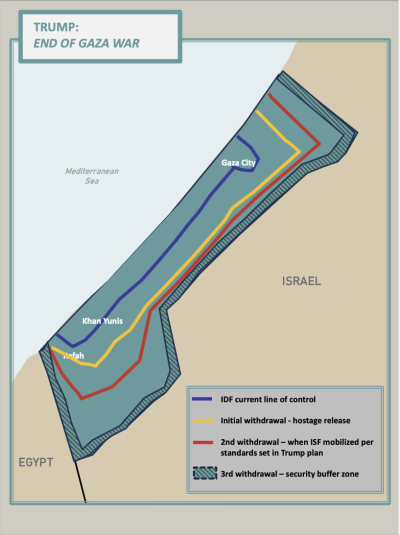
A map showing ‘President Donald J. Trump’s Comprehensive Plan to End the Gaza Conflict’. Source: The White House via X.
Isolated incidents are difficult to prevent entirely due to bad habits that die hard, and because of the close proximity of the sides in this tiny territory. Despite Israeli withdrawal to the Yellow Line, an immediate deployment of an international force is required to monitor the situation.
But this is only part of the story. Netanyahu is under pressure from his ultra-nationalist partners in the coalition who opposed the deal from the outset and are now seeking an excuse to resume hostilities.
For now, Israel enjoys the backing of the Trump administration. Trump threatened the use of ‘heavy force’ to ‘straighten out Hamas’ if it continues ‘to act badly, in violation of their agreement with us.’
Yet, we know from CBS’ 60 Minutes’ Witkoff – Kushner interview that Netanyahu, despite the display of cosiness between himself and the US president during his recent visit to Israel, was put on notice by Trump.
According to them, Trump felt personally betrayed by the strike on Doha that was harmful to US interests, and concluded that the Israeli government was ‘getting a little bit out of control in what they are doing.’
The level of the Trump administration’s White House’s irritation with the political intrigues in Israel reached a new level when right-wing lawmakers voted to pass a preliminary reading of a bill that would apply Israeli sovereignty to all West Bank settlements.
Although this was done despite Netanyahu’s opposition, and is merely symbolic, the vote took place during the visit of US Vice President JD Vance, to the Israeli prime minister’s embarrassment and Vance’s annoyance.
The latter’s response was scathing, branding it a ‘very stupid political stunt, and I personally take some insult’.
President Trump added his voice to this criticism, and in response to a journalist’s question, replied that ‘Israel’s not going to do anything with the West Bank’, clearly signalling who calls the shots on the matter.
Netanyahu is currently between a rock (Trump) and a hard place (his political partners). But he fears the former most.
The stream of American senior officials, starting with Vance, followed by US Secretary of State Marco Rubio, and the constant presence of Witkoff and Kushner in Israel, aims to ensure that Netanyahu doesn’t sabotage the first phase of Trump’s so-called peace plan, or hinder its progress to the subsequent phases.
It is left mainly to the other guarantors of the deal – Qatar, Egypt, and Turkey – to keep a watchful eye on Hamas to fulfil its side of the agreement. In a bizarre quid pro quo, in return for Israel and Hamas going ahead with the plan – or at least not hindering it – the very countries that twist their arms to do so give them a helping hand in remaining relevant. The real test will come when issues such as Hamas’s disarmament or a complete Israeli military withdrawal from Gaza are negotiated in earnest.