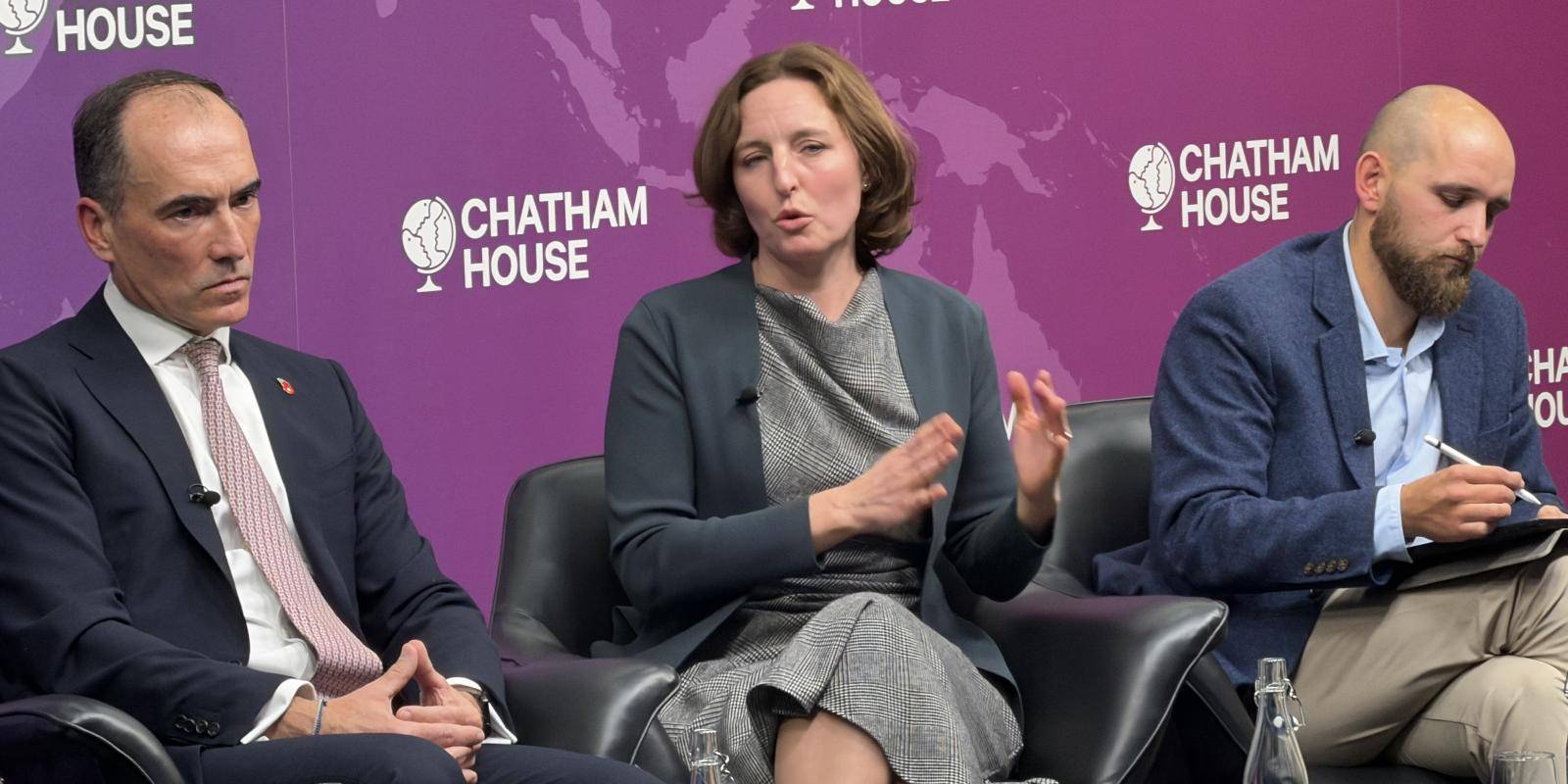

On US midterm election day Chatham House convened a panel of experts to discuss what they were seeing, and what lies ahead for US domestic and foreign policy.
The in-person and online event – one of many convened by the Royal Institute of International Affairs – was part of its ongoing coverage of the US and its relationships with Europe, China and the rest of the world.
You can watch the full discussion panel here: US midterm elections 2026: What happens next?
Here are some key takeaways:
A foreign policy election
Dr Andrew Payne, Research Director of Chatham House’s Europe, Russia and the Americas Programmes, and author of ‘War on the Ballot: How the Election Cycle Shapes Presidential Decision-Making in War’.
‘This is actually a foreign policy election, a foreign policy election of the likes that we haven’t really seen since 2006, when you had another very unpopular war in the Middle East that led to a significant backlash against George W. Bush,’ he said.
‘The top issue is inflation and the cost of living. The Chicago Council [on Global Affairs] had a poll out that said that that was 37 per cent, by far and away the top issue.
‘And on the surface that supports this conventional wisdom that voters know little and they care even less about international affairs. These are events which are geographically and metaphorically very distant from the daily lives of voters. So when they go to the polls, they think about things like the price of gas, like the price of groceries.
‘To put it another way, James Carville, the political strategist, in 1992 famously said that elections in the US are about “the economy, stupid.”
Experts discuss the US midterms at Chatham House.
‘So on the surface, I think that is that is all true, but the key exception, when voters really do start to sit up and pay attention to foreign policy, is when the costs of the administration’s foreign policy choices come to bite. And I think whether it’s tariffs, whether it’s the war in Iran, voters really are feeling the effects of some of the choices that this administration has made.
‘A couple of data points: that same survey I mentioned says 86 per cent of Americans say that the war – the war in Iran that is – has increased the cost of living, 81 per cent say the same about tariffs. When YouGov asked survey respondents why gas prices were going up in their area, 41 per cent said the war in Iran was to blame. That was more than twice as many as the next most popular answer, which was President Trump.
‘So I would make the case that it still is kind of “the economy, stupid”. But in this cycle, more than we have seen for 20 years, the economy really is a foreign policy issue in a very real sense.’
The lame duck era, and succession
Ludovic Hood, Senior Fellow with the Hudson Institute’s Center for Peace and Security in the Middle East and a former US foreign service officer for 20 years.
‘We’re very much going into lame duck era for Donald Trump. And that’s going to be painful for him. I’m sure you’ve all tracked him enough, and the kinds of things he’s sensitive to and about,’ he said.
‘I think the likely results of this election will be a clear repudiation of how Trump has governed in the past two years versus his first term. In some ways some of his economic policies – for example investing in US companies – are more, if you will, Democratic than they are Republican.
‘I think a lot of long-standing Republicans are a little bit uncomfortable or aghast at a lot of the policies of the last two years, notably tariffs and notably some of the quasi, I’ll say, the socialist investments that the Trump administration has made in US firms.
‘I think a lot of American long-standing Republicans would like to see a return to more of a free markets economic freedom approach. And then there’s just the governing style. And we can talk about that for a long time. But I think there’s been a lot of drama. And I think a lot of people are fatigued.’
He added:
‘We throw the term civil war around, but in DC parlance, both parties are going to go through some intense soul searching and public arguing about about the direction.
‘The end of the Trump era is largely the end of the MAGA era. Trump is the magic ingredient. JD Vance will try and pick up strands of the MAGA tent, but it’s going to be a fairly small sub-tent, if you will. He just doesn’t have the appeal. And he’s also been quite ideologically flexible over the years if you go back in time.
‘He is the self-appointed standard bearer for some MAGA values. But don’t forget, Trump is in many ways, as I said, not only a realist when it comes to foreign policy and international affairs, but he’s more of a pragmatist, and he does go with his gut quite a lot. And he’s a bit of a contrarian, a disruptor. It’s very hard to pin an ideology on that.
‘Vance is trying to sort of be a standard-bearer for an ideology that almost quite isn’t there, if you will… I personally don’t think that JD Vance will get the nod, and that someone else – Rubio, Cruz, or someone else – there’s a fairly long list of senators and governors who have publicly said they are interested, or have used the usual vague language to pretend they’re not when they clearly are.
‘And I think you’ll see the Republican Party, for lack of a better term, become conservative again.’
Affordability
Laurel Rapp, Director of the US and North America Programme at Chatham House:
‘The polling over these past months has aligned very much with what Ludo is suggesting here. There is high levels of concern about cost of living, affordability. And that is across the Republican and Democratic voters. That is not a partisan issue. Questions about housing costs, access to health care, rising costs of food tied to inflation. So these are sort of across the partisan spectrum. That is a shared view.
‘When you start to break it down on the right and the left, you’re seeing different priorities. On the left, you see greater access to health care as something that they would like candidates to pursue. Climate change, questions about the US role in the world as it relates to the Iran war, stopping the Iran war.
‘When you look to the right and you’ll see a lot of Republican candidates in these final days reflecting some of these Republican voter attitudes focused on crime, on immigration, on social stability issues, and warnings. And that’s something we’ve seen the president also weave into his message a little bit. But to Ludo’s point, the president in these final days has not really hammered on these messages of affordability, has called that a hoax over the past couple of months.
So when you pull voters across the political spectrum, they will say affordability is really important to me. And then when asked, ‘Who do you trust? Which party do you trust to help get the economy back on track?’ a majority will say that the Democratic Party is more trusted on this. So I think we’re seeing a lot of those headwinds surging to the Democrats in these final days.’