Could Vietnam’s new South China Sea bases open a ‘Pandora’s box’ of competitive island building?

The scale of Hanoi’s land reclamation operations is fast surpassing Beijing’s in the contested Spratly Islands, write John Pollock and Damien Symon.

The World Today

Published 16 March 2026

Updated 17 March 2026 — 4 minute READ

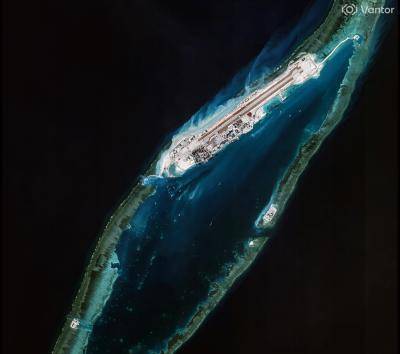
Image — Amboyna Cay, Spratly Islands, November 2025: Lying near Barque Canada Reef, the island is south of the Spratly Islands near features occupied by Malaysia. Photo: Vantor.

Damien Symon

Geo-intelligence researcher, The Intel Lab

Vietnam is rapidly expanding its military bases on reefs and shoals in the South China Sea, including the building of harbours and airstrips, new satellite imagery shows. 

The land reclamation work expanded to all 21 reefs, shoals and sandbanks controlled by Hanoi in the contested Spratly Islands. The archipelago falls within the Exclusive Economic Zones of six countries – Vietnam, China, the Philippines, Taiwan, Malaysia and Brunei – all of whom have competing claims over the Spratlys as well as military outposts.
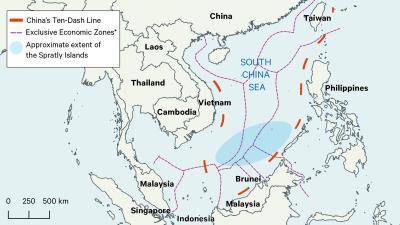
Map showing the South China Sea and the Ten Dash line

The map shows an approximate representation of China’s contested ‘Ten-Dash Line’, and other Exclusive Economic Zones (EEZs). The boundaries and names shown and designations used on the map do not imply endorsement or acceptance by the authors or Chatham House. See full citation at foot of page*

China asserts sovereignty over roughly 90 per cent of the South China Sea, bounded by the disputed ‘Ten-Dash Line’. The location of the Spratly islands is strategically significant, with an estimated one third of all global shipping passing through these waters. Their proximity to lucrative fishing grounds and untapped oil and nature gas reserves has also heightened tensions between claimant states – sometimes resulting in violent maritime clashes.  

Vietnam’s land reclamation programme, first identified in 2022, follows China’s own efforts launched a decade ago to transform its reefs in the Spratlys into military bases. According to the Asia Maritime Transparency Initiative (AMTI) the scale of Hanoi’s recent operations suggests it is quickly catching up.

Content continued 01

Vietnam’s latest moves

The scale of Vietnam’s construction approaches that of China. The latest monitoring by AMTI from March 2025, shows that Vietnam has dredged roughly 3,310 acres of coral reef since 2022; the same data reveals China dredged 4,650 acres. 

Early this year, Vietnam launched dredging and landfill operations at its five remaining outposts in the Spratlys, making it likely, analysts said, that its construction rate has surpassed China’s.

Hanoi’s efforts in 2022 were focused on a handful of reefs but operations have since expanded across the archipelago. A notable amount of work is underway on the Union Banks shoal, where Beijing and Hanoi clashed in 1988; the Tizard Banks shoal, disputed by China, Taiwan and Vietnam; and along a string of reefs near Malaysia.

Overhead shot of a reef in the South China Sea

Barque Canada Reef, August 2025: Land reclamation has turned Barque Canada Reef into Vietnam’s largest feature in the Spratly Islands. When complete the reef will feature Vietnam’s longest airstrip in the South China Sea measuring nearly 3.2km and capable of supporting a variety of aircraft including transport and combat planes. Photo: Vantor.

Vietnamese operations are currently visible at Ladd Reef; South Reef; Central London Reef; Grierson Reef; Collins Reef; Lansdowne Reef; Abonya Cay and Petley Reef. Small concrete outposts have been supplemented by large-scale artificial islands at all these locations.

Once the work is completed, Vietnam is expected to expand military facilities at each site, as it has done in the past on islands already reclaimed. On Barque Canada Reef for example, where dredging operations were first visible 18 months ago, satellite imagery now shows the building of an airstrip nearly 3.2km long.

content continued 02

Eight harbours have been formed at other outposts. Munitions storage and possible firing positions for artillery or rocket systems have also been identified at the new expanded reefs, said Greg Poling, director of AMTI. ‘This is consistent with previous reporting that stated Vietnam had rocket systems deployed on many of the [other] islands. Most also have trench networks to counter any amphibious assault.’

The overall programme is dramatic and shows that Vietnam is spending large amounts of money on defending its positions in the Spratlys.

Bill Hayton, associate fellow, Asia-Pacific programme, Chatham House.

‘The overall programme is dramatic’ said Bill Hayton, associate fellow of the Asia-Pacific programme, Chatham House. ‘It shows that Vietnam is spending large amounts of money on defending its positions in the Spratlys. The addition of a new runway at Barque Canada Reef greatly enhances Vietnam’s capabilities. It also looks as if the other features will acquire extra docks, helicopter pads and weapons storage facilities. In time, we may see signals intelligence facilities added to the bases as China has done on its artificial islands,’ he added.

Content continued 3

Counterweight to China

Analysts say that Vietnam’s aim is to counter China’s assertiveness in the South China Sea. Hanoi has a longstanding pattern of ‘engaging in bursts of construction and upgrades in response to shifts in Chinese posture,’ said Poling. China recently increased its presence in Vietnam’s Exclusive Economic Zone, particularly around oil and gas fields at the southwestern edge of the Ten-Dash Line, he said. The new Spratly outposts will make it easier for Vietnam to patrol the waters.

content after newsletter

This has opened a Pandora’s box that could lead to competitive island building across the South China Sea.

Nitya Labh, Schwarzman Academy Fellow at Chatham House.

In October, Beijing launched a coastguard vessel to patrol some of the reefs where Vietnam has built new facilities. As tensions simmer, Vietnam’s escalating rivalry with China over the Spratlys could have knock-on effects.

‘Vietnam’s efforts to stake out its maritime claims by building artificial islands breaks from the consensus approach of ASEAN [Association of Southeast Asian Nations] to China’ said Nitya Labh, Schwarzman Academy Fellow at Chatham House. ‘If there is no ‘rules-based order’ and no one to defend it, there is little to stop other countries building their own islands as well,’ she added. ‘This has opened a Pandora’s box that could lead to competitive island building across the South China Sea,’ she added. 

content continued 4

*Full map citation: Exclusive Economic Zones (EEZs) displayed are a select sub-set of the Flanders Marine Institute’s Maritime Boundaries Geodatabase (2023). Many of these EEZs are disputed, some of which are represented by simplified median lines. China’s ‘Ten-Dash Line’ is an approximate representation based on a 2014 US State Department map. Base map made with Natural Earth data.

To read more from the spring issue of The World Today click here