


How do you feel about the broad direction of AI?
Stuart Russell, distinguished professor of computer science, University of California Berkeley and president of the International Association for Safe and Ethical AI: We are pushing hard on capabilities with titanic investment levels, but with no plan for how to control systems far more powerful than ourselves. There is a 70 per cent chance capabilities will plateau and the AI bubble will burst, and a 30 per cent chance that we get to artificial general intelligence / artificial superintelligence, with then a very high chance of catastrophe unless governments intervene soon.
Shikoh Gitau, chief executive of Qhala, a Kenyan digital consultancy and a leading voice on AI in Africa: I’m an AI optimist, because in Africa, we have little choice but to be. The biggest fear around AI is about it taking away people’s jobs, their humanity. The other question is, what can AI do for the continent? For instance, in Kenya, we have one doctor for every 5,700 people. But there is widespread smartphone penetration and internet coverage across Africa. With the right AI tool, one doctor can provide world-class care via mobile devices to more than 5,700 people. It’s the same with children’s education.
Alejandro Mayoral Baños, co-executive director of Access Now, a civil society organization for digital rights: AI is no different from other digital technologies in one respect: its impact depends on who has the power to shape, control and benefit from it. I am neither optimistic nor pessimistic about the technology itself. The question is whether communities can develop and use AI for their own self-determined purposes, or whether control stays with a handful of companies and already powerful countries driven by profit and geopolitical interest.
Anton Leicht, fellow with the Technology and International Affairs Programme at the Carnegie Endowment for International Peace: I feel as dazzled by the potential upside as daunted by the risks, while still deeply uncertain as to whether we’ll get the policy right. I hope we find out more as we continue muddling through.
Alex Krasodomski, director of the Digital Society Programme, Chatham House: Given time, this technology will create an extraordinary set of tools in science, art, education and work. My fear is that we won’t give it that time, instead accelerating into market corrections, misapplications, zero-sum competition and perhaps even catastrophic misalignment with humanity.
Yao Xu, secretary-general of the Centre for Global AI Innovative Governance and associate professor, Fudan University, China: I am cautiously optimistic about AI’s broad direction. It could greatly expand scientific discovery, productivity and access to public services, but societies will have to absorb two serious shocks: rapid disruption in labour markets and the risk that people become too dependent on machines for judgment, learning and original thought.
What is the likely effect of AI upon each of the following sectors over the next five years?
Alex Krasodomski: The gap between the intelligence explosion enabled by AI and its deployment is under-appreciated. It’s going to take more than five years’ work for abundant, cheap intelligence to be translated into the kinds of measurable gains we would expect to see in public services or science.
Yao Xu: In medicine, AI will improve diagnosis, drug discovery and clinical work, although data and liability will slow adoption. In the creative arts, it will reshape production and distribution more than creativity itself. Personalized tutoring will spread in the education sector, and in transport, autonomous vehicles will reshape logistics. In the world of security, intelligence, cyber operations and autonomous systems will rapidly change.
Shikoh Gitau: I’m bullish about AI accelerating the speed of research using locally available staff in Africa. It will also be important in understanding the human genome from an African perspective, and at a much lower cost.
Alejandro Mayoral Baños: Rating sectors on a scale of 1 to 5 creates precision that does not exist. Adoption varies in nature, pace, subsector and consequence within each sector, across national jurisdictions, and according to the specific applications in question.
Baños declined to rank these effects. Gitau declined to rank IT. Russell and Leicht declined to comment
How optimistic are you that labour markets will adapt to the effects of AI without significant disruption?
Alejandro Mayoral Baños: Personally, I am moderately confident societies will adapt, as they have to earlier waves of technological change. (Access Now does not focus on ‘future of work’ policy). My concern is the structural conditions. Wealth and technological capacity are already held by only a few companies and countries. The disruption may have less to do with AI than with the inequalities of the societies where it is deployed.
Anton Leicht: In the long run, viewed globally, I feel optimistic. Macroeconomic fundamentals will still favour plenty of work for plenty of humans. But the rearrangement of the economy will proceed much faster than in past transitions, and we have few policy answers to manage it. Disruption will be great, yet temporary.
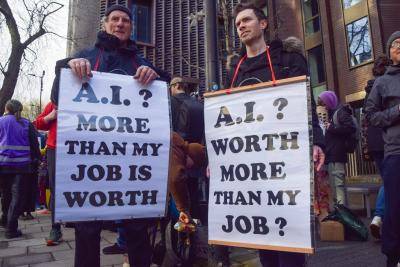
Protesters with anti-AI placards outside OpenAI offices in London. Photo: Vuk Valcic / SOPA Images / LightRocket via Getty Images.
Alex Krasodomski: I expect very significant disruption, followed by unevenly distributed adaptation. Work that depends on human ingenuity, creativity or skill will not be eclipsed overnight by an intelligence explosion, and converting intelligence gains into gains in science, national security, production and so on will create a lot of new jobs. But exposure varies. Economies built on tradeable services such as those of the Philippines, Kenya or India face painful disruption, and I don’t expect the new jobs to appear where the old ones disappeared.
Stuart Russell: Not at all.
Yao Xu: I am not optimistic. Wealthier countries may soften the shock through retraining and social protection, but many governments lack the money and administrative capacity. Because labour markets and supply chains cross borders, disruption in the least-prepared countries will spread through migration, trade and political instability.
Shikoh Gitau: Labour markets have no option but to adapt. But I am certain AI is going to create entirely new jobs in the next two years. Anthropic, OpenAI and others are sending engineers to their customers’ offices to help them adapt their AI models. In other words, they are launching what amounts to consultancy businesses, which shows where the world is heading.
How likely is it that popular concerns about AI will lead to profound political consequences?
Alex Krasodomski: AI development is increasingly seen as necessary by political and economic elites and as a threat and burden by everyone else. Data centres are the physical manifestation of the AI revolution and its local costs in electricity prices, land and water usage. They are already consequential electoral issues in mid-2026.
Anton Leicht: AI will be the deciding political issue of the decade. This technology will touch the most politically sacrosanct parts of voters’ lives: their jobs, their personal safety and that of their children, their economic welfare and the integrity of their government.
Shikoh Gitau: In America and perhaps Europe there may be big political consequences, but not in Africa. There, people will want data centres because they will create jobs.
Stuart Russell: If AI succeeds, few young people have a meaningful future beyond basic subsistence. Already AI is hated. There is a wall-sized Le Monde poster near my apartment in Paris that reads: ‘Tout le monde déteste l’IA’ (‘Everyone detests AI’).
Yao Xu: As people see AI giants gaining influence over information, employment and public policy, many will feel that the existing political system is losing control. The reaction may split between two extremes: demands to stop or tightly restrict AI, and support for technology leaders who promise to bypass traditional institutions altogether.
Alejandro Mayoral Baños: Political consequences are highly likely, but they will come as much from the political, economic and social context in which AI is developing as from AI itself. We are already seeing narratives about AI justify opposing responses: stronger regulation and public oversight versus deregulation, surveillance and competitiveness framing. The political challenge is whether democratic institutions can build the expertise and accountability to govern technologies moving at this speed.
Who will dominate AI by 2035, the United States or China?
Yao Xu: Neither – and no country should. The US may retain advantages in capital, chips and cloud platforms, while China may lead in industrial use, scale and open models. But AI will reach too deeply into economies and public life for one power to control it safely. By 2035, a more distributed system would be more realistic and more desirable.
Alex Krasodomski: China, if domination here means diffusion.
Anton Leicht: The United States, due to its current decisive lead in chip design and the effects of that lead. More revenue means more computing power; more usage means more data and better models mean greater acceleration of research and development. The US will start this flywheel effect before China has enough chips to catch up.
Shikoh Gitau: China, hands down. They already are dominating. So much digital infrastructure in Africa is Chinese, not to mention ubiquitous Chinese electric vehicles, tablets, software. The use of Kimi AI, a Chinese chatbot, is widespread – it looks like Claude but is in some ways superior and cheaper. Also, many thought that the US government’s decision to compel Anthropic to withdraw its Fable and Mythos models was diplomatically and politically wrong. How can African businesses rely on American AI models if the US government can decide effectively to shut them down?
Alejandro Mayoral Baños: At Access Now, we would push back on the premise. Framing AI’s future as a contest between two states reproduces an arms race narrative and treats technological leadership as zero sum. The two approaches share more than the rivalry suggests, though they diverge in one important respect: China’s open weight models give Global South countries more room to build their own systems. Nothing requires AI to be organized around two centres of power. Regulatory frameworks, public investment, open technologies and decentralized infrastructure could produce other centres across Europe, Latin America, Africa and Asia.
Stuart Russell: The United States.
Is it too late for middle powers and developing countries to build their own AI?
Anton Leicht: In theory, no; in practice, yes. Given the gaps in infrastructure, we should expect an attempt to catch up to the frontier AI models to cost in the order of trillions; too much for regional markets to fund, too ambitious for the current cast of middle-power governments to attempt.
Alejandro Mayoral Baños: No. Access to a model alone does not provide genuine autonomy. This requires control over architecture, source code, training pipelines, weights, data and the ability to modify and deploy independently. Middle powers and developing countries do not need to reproduce the scale of large companies. They can invest in open technologies, regional infrastructure, local datasets and the capacity to adapt models to their priorities. They can also set standards for accountability, transparency and human rights.
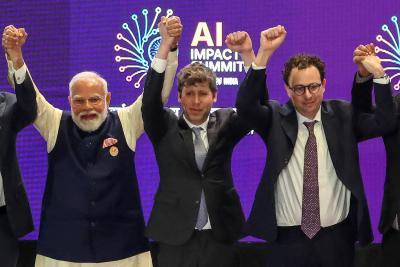
India’s prime minister Narendra Modi, left, with OpenAI chief executive Sam Altman, centre, and Anthropic chief executive Dario Amodei at the AI Impact Summit in New Delhi on 19 February, 2026. Photo: Ludovic Marin / AFP via Getty Images.
Yao Xu: No, but they do not all need to build a frontier model from scratch. The international community can make AI development more inclusive by providing affordable computing access, open models and practical training as public goods. The best assistance will deliver a finished product and allow local people to be able to build and improve the next one themselves.
Shikoh Gitau: Instead of competing with the Americans and Chinese, middle powers have the opportunity to build what we call ‘minimum viable intelligence’ – AI models that serve a specific need. For instance, we released a benchmark study last year that showed that the big AI models were not catering for diseases that are prevalent in Africa, such as HIV and sickle cell disease. So, we have collected data sets and built models that align with what Africa needs.
Stuart Russell: No, but stop obsessing about ‘sovereign stack’. No country has a sovereign stack, including the US and China. It makes sense to build one’s own user-facing model, but trying to start at the bottom with semiconductor plants, for instance, is madness.
Alex Krasodomski: No. The task facing middle powers is to be clear on what they mean by ‘their own AI’, to choose when to hedge, when to align with the US or China, when to cooperate with other middle powers and when to invest in sovereign, domestic capacity.
Should the world regulate AI? If so, what existing model might serve as a starting point?
Stuart Russell Yes. Use the International Atomic Energy Authority as a model and implement a licensing regime. Prove your AI system is safe before you are allowed to develop or deploy it.
Yao Xu: Yes. The European Union Artificial Intelligence Act’s risk-based approach offers a useful starting point, but rules should respond to what a system can do and how it is used, not to the nationality of its developer. High-risk uses need serious testing and clear accountability, while the United Nations can help establish common principles that countries adapt.
Alejandro Mayoral Baños: What we need is regulation grounded in the international human rights framework. That means giving people control over their data and over how the content they see on platforms is curated. Industry has spent enormous resources lobbying against exactly these things. Policymakers have to resist that pressure and put people first.
Shikoh Gitau: This is a can of worms. It’s a very powerful technology so we need guardrails. My worry is who defines regulation because the world is far from agreement on what that should look like.
Alex Krasodomski: Yes. Red lines on the use of AI in certain contexts such as mass surveillance are already being deployed. Red lines on AI systems’ behaviour are now the priority to tackle the kinds of incidents seen this year in which AI systems appeared to manipulate, deceive and carry out cyberattacks.
Anton Leicht: The US will regulate AI. It’s unlikely that the rest of the world will get much of a say. Banking regulation should be our initial starting point: the appropriate focus being the enormously powerful frontier labs. Their decision-making matters more than their output. Regulation should aim at auditing and shaping this decision-making.
Is open-source AI a risk or an opportunity?
Alex Krasodomski: Open source and open weight AI is an opportunity. No middle power that is serious about fostering an AI ecosystem domestically and aligned with its own interests and values should restrict access to open weight models. Open weights also support verification and inspection, with one caveat: once they are out in the wild, they cannot be recalled, making pre-release scrutiny even more important.
Stuart Russell: Below middling levels of capability, probably a net benefit. As they become more capable, open-weight models become much more dangerous than closed-weight models. For instance, imagine if five billion people had free access to an open-weight model more powerful than Claude Mythos, which Anthropic withdrew access to – how long would it take until one of those five billion decided to use it to try to bring down the critical infrastructure of a country?
Yao Xu: Mostly an opportunity. Open-source models give smaller countries, universities and businesses a way to lower costs and tailor systems to local languages and needs. Some models can be misused, so safeguards are necessary, but closing the technology would concentrate power in a few companies and countries without removing the underlying risks.
Anton Leicht: At present, largely a risk, sadly. Most of our approaches to making AI systems safe depend on features that can be removed from open-source systems.
Shikoh Gitau: It’s an opportunity, particularly if the alternative is constantly paying for tokens. An open model allows you to download them – so you have a back-up should it be shut down, and power over your data.
Alejandro Mayoral Baños The greater systemic risk is allowing a few companies and countries to control increasingly consequential technologies. The question is not whether a system is labelled open, but what people can access, audit and independently deploy. Broader access carries real safety risks. So does concentration. Social media has shown what happens when a handful of actors control infrastructure and the rules governing it.
How likely is it that AI will be the primary cause of a major incident that threatens global security in the next five years?
Alejandro Mayoral Baños: I would be cautious about naming AI as the primary cause of such an incident. The pressing concern is that AI accelerates existing tensions. They come from inequality, concentration of power, armed conflict, authoritarianism, surveillance, discrimination and weak governance. If AI is seen as the primary threat, policy responses narrow to controlling the technology and ignore the structural conditions that enable harmful deployment.
Anton Leicht: Our ability to make AI systems powerful is far outpacing our ability to make them safe and reliable and there are no clear policy interventions that will change that fact. Small things keep going wrong right now, big risks keep drawing closer and a major cybersecurity incident caused by misused or uncontrolled AI agents by the end of the decade seems highly likely.
Shikoh Gitau: It will happen, but I don’t think AI will go wild and carry something out autonomously. It will be a human manipulating a catastrophic outcome.
Yao Xu: AI is more likely to intensify a crisis than to cause one by itself. It may make a cyberattack, military miscalculation or disinformation campaign more damaging, but the original failure will usually lie in political decisions and weak safeguards.
Alex Krasodomski: AI is already being deployed into high-stake areas including war zones, critical infrastructure and financial systems, while the gap between the capabilities of these tools and our ability to control them is growing. Unfortunately, it may take precisely such an incident to accelerate governance efforts.
Russell declined to comment
Do the anticipated gains of AI outweigh the environmental costs?
Yao Xu: On balance, yes, if data-centre growth is planned as part of the energy system. China’s Eastern Data, Western Computing initiative assesses projects against grid capacity, water use and regional needs, while companies compete to offer more efficient plans. This mix of public planning and market competition helps explain why data centres have caused less public anxiety in China than in the United States.
Anton Leicht: Yes. The environmental costs of AI might be substantial by the standards of a normal technology, but the extraordinary impact that AI will likely have on productivity and innovation – including on environmental issues – will by far outweigh the costs. Right now, the best way to emit a ton of CO2 is powering a frontier AI data centre.
Shikoh Gitau: We are smart enough to build environmentally sustainable infrastructure. For instance, Nvidia’s chips are becoming smaller and less power hungry.
Stuart Russell: Yes.
Alejandro Mayoral Baños: Expanding AI infrastructure drives demand for energy, water, critical minerals and data centres, intensifying extractive pressures felt most acutely by communities already facing environmental and economic inequality (Access Now does not work on environmental so I am cautious in my assessment in this area). The question is not what AI produces, but what it takes to build and run it, where those resources originate and who bears the consequences.
Krasodomski declined to comment