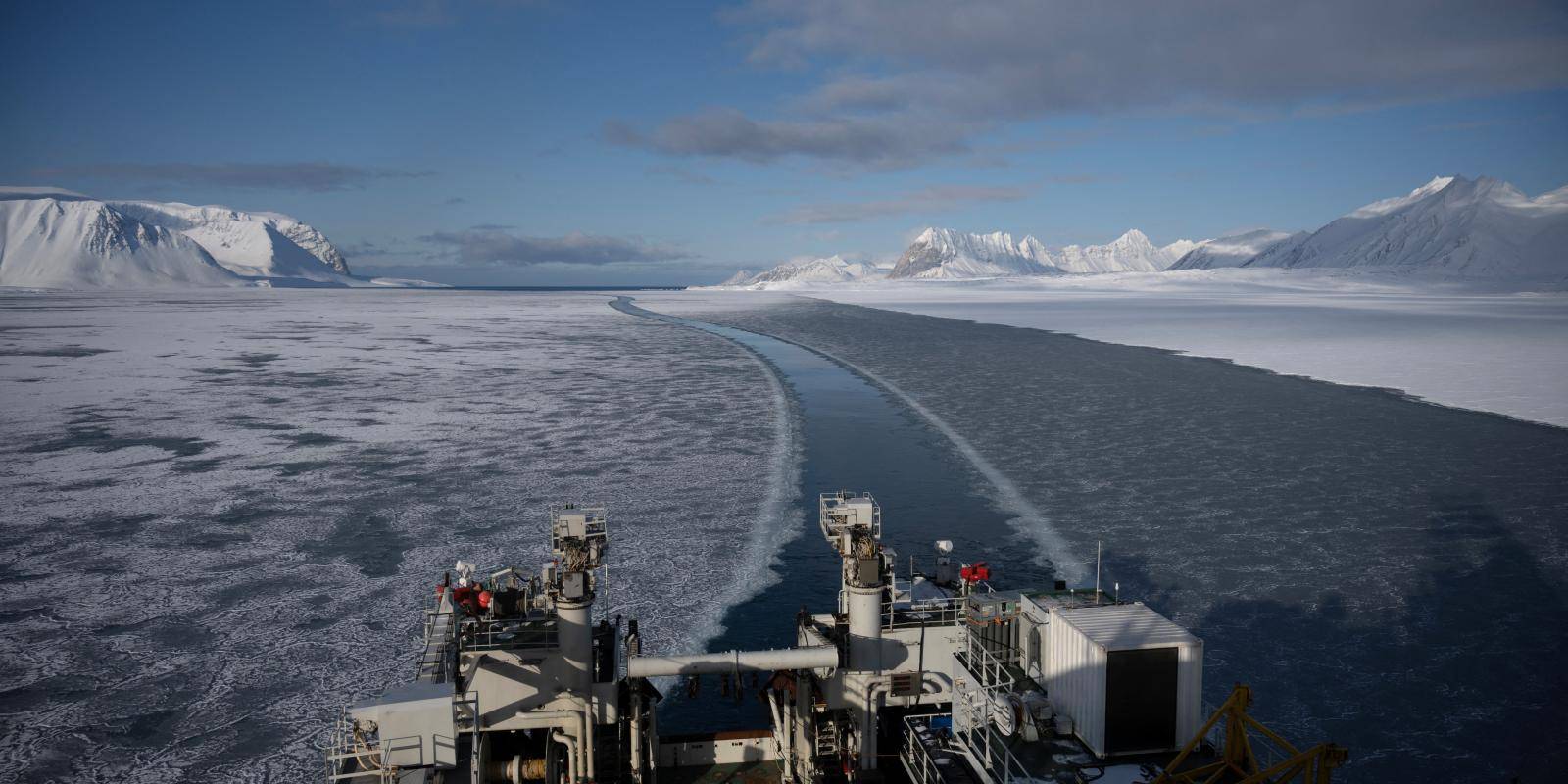

The Trump administration has once again churned up the frozen waters of the Arctic. This time by ending federal support for an annual Arctic climate report. On 10 August, the National Oceanic and Atmospheric Administration (NOAA) announced it will no longer produce the well-respected Arctic Report Card, which for two decades has collated, analyzed and published key data on the health and changes of the greater Arctic environment. More than 100 international scientists and organizations have fed NOAA information ranging from ice coverage measurements to sea depth and weather patterns, expanding US situational awareness and scientific leadership of the Arctic.
Trump’s team now says that someone else must take the lead.
While detrimental to both the US and the greater Arctic research community in the short term, this is an opportunity for an allied Arctic nation or organization to take the lead – with the potential to gain both a strategic and data edge. The Arctic is in the crosshairs of almost all top geostrategic interests – including energy, defence, tech, transportation, minerals and fishing – and is changing quickly as ice melts and previously unnavigable areas open.

Controlling data collection, priority-setting and analysis at a time when data is one of the most valuable assets to have should be high on the list of many nations. It certainly is for China. Although it is a non-Arctic nation, China has seven polar research stations – compared to America’s four – a fleet of dual-purpose ice breakers, and prioritizes polar research within its annual $1 trillion research budget.
It is ironic that the Trump administration is diminishing the US position in the Arctic research community while at the same time raising the alarm about Chinese and Russian ambitions in Greenland and the North Atlantic. US military leaders know well that their ability to defend against submarine and other incursions in the north will depend on a continuous research and development process using every scientific input available.
Even the US’s own Arctic Research Commission has stressed the link between national security and research. In 2025, it identified research topics within four key sectors – military, community, energy and economy – which ‘inform both domestic and foreign policy, ideally, in a mutually reinforcing manner, and are often interlinked’. The key to securing the vast North American Arctic area is cutting edge research and knowledge, from reinforcing US national scientists to linking arms with partners, allies and indigenous communities.
This is not the first time the Trump administration has made counterintuitive policy moves in the Arctic. Key to Trump’s foreign policy doctrine is the concept of geographical spheres of influence. US control of Greenland – an autonomous territory of US ally Denmark – as a geographical security imperative has become a regular talking point for Trump. It has also inspired significant new European and Canadian activity in the region.
European governments are stepping up under the rubric of increasing Arctic security against Russian and Chinese expansion. This is a good outcome from an unnecessarily tense standoff with their American ally. Indeed, underneath it all, Trump’s concern about Chinese and Russian activity in the Arctic is well founded. And it requires concrete European Arctic leadership and action.
Such recent action includes a growing strategic presence in Greenland. Norway, France, Canada and the European Union all have (or soon will have) diplomatic offices in Nuuk. Meanwhile, European leaders and their defence teams have met regularly this year to discuss Arctic security and Greenland, while the seven Arctic NATO members (Canada, Denmark, Finland, Iceland, Norway, Sweden and the US) gather as a NATO subgroup. In May, following a NATO foreign ministers meeting in Sweden, they called out the shift in American policy in a joint statement noting the increased role played by Europe and Canada.
More recently, Denmark announced that it has begun to rotate groups of new conscripts through Greenland for training, while the UK sent a carrier strike group to the North Atlantic/High North as part of NATO’s new Arctic Sentry mission, completing its first phase in July.
This increased activity is well timed. Russia and China are taking historic steps this summer that signal future intentions.
In an unprecedented operation, Russia is sending a convoy of tankers carrying up to one million tonnes of oil along a rarely used route north of 81.5°N, accompanied by nuclear-powered icebreakers. Meanwhile, six Chinese carriers have signed up to use Russia’s northern sea route (NSR) this month to avoid the treacherous Red Sea. For the first time, the ships will go from Ningbo-Zhoushan to Felixstowe, saving an estimated 22 days. Crucially, it is also the first time Chinese ships will have access to predictive rather than observational ice data from the Chinese Ministry of Transportation – made possible thanks to China’s years of investment in Arctic research.
This should be a wake-up call for the US and its allies. Domain awareness is and will continue to be the linchpin for success for all nations with interests in the Arctic. To take the lead, European allies and Canada should focus on three key areas.
One, they should extend and resource initiatives that enhance shared domain-awareness assets: satellite coverage; underwater sensor arrays in the GIUK gap (the open waters between Greenland, Iceland and the UK) and the Barents Sea; and maritime patrol aircraft rotations. A priority satellite project could be the Hybrid Alliance Layered Operations in Space (HALO), launched at this year’s NATO summit, through which seven European allies and Canada have agreed to connect and integrate their military satellites into a shared ‘mega constellation’ architecture. For underwater awareness, both the UK’s new Atlantic Bastion and NATO’s Arctic Sentry programmes are building underwater sensing technology networks. In the air, Germany and Denmark have new or planned Boeing P-8 capabilities to add to substantial operations already run by the UK, Norway and Canada.
Two, Arctic research and development should be prioritized in national planning and budgeting processes. This should include establishing a joint Europe–Canada Arctic data consortium – within or tightly connected to the existing research architecture to avoid duplication of efforts – to take on the Arctic Report Card work and build a top-in-class digital research infrastructure. European and Canadian leaders should also reorient the Arctic Council to overcome the stagnation stemming from Russia’s suspended engagement following its full-scale invasion of Ukraine, compounded by a consensus system that makes formal workarounds difficult. They must also work to resolve a key Arctic research dilemma: the current lack of Russian data.
Three, NATO’s Arctic seven should establish a shared policy position on Chinese and Russian control of the NSR, which could include building Arctic maritime support systems and physical infrastructure to erode Russia’s monopolistic claim. As one proposal highlights, ‘the goal is not confrontation, but normalization, so that the rules of the High North reflect global interests – not unilateral control’.
As Norwegian polar explorer Roald Amundsen famously said: ‘adventure is just bad planning’. While there was arguably never a time for adventure in the Arctic – it’s too brutal, too vast and too changeable – now is the moment for European Arctic nations and Canada to take the lead in both Arctic research and security. One without the other would be a foolish adventure.