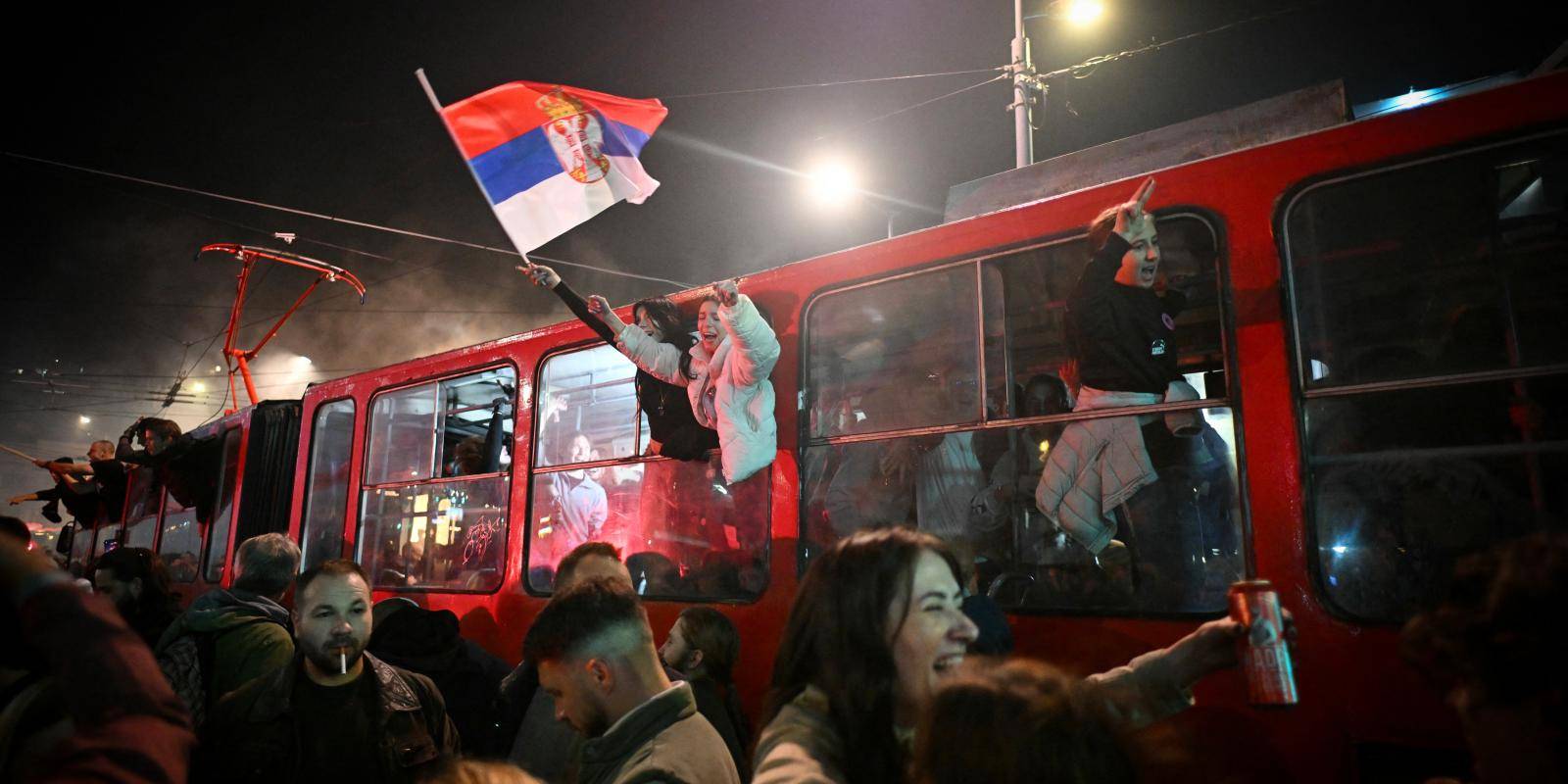

Six months after Viktor Orbán’s defeat in Hungary, another European strongman has fallen, conceding an election he expected to win, in a consequential turning point for the country and for Europe.
President Aleksandar Vučić, in power since 2012, called Serbia’s snap parliamentary vote after nearly two years of student protests, and admitted defeat on Sunday.
With almost all ballots counted, the Student List secured more than 53 per cent of the vote and around 140 seats in the 250-member parliament. Turnout approached a historic 70 per cent, the highest since Yugoslavia’s break-up in 1992.
For the second time this year, a European populist with what looked to many like an unassailable grip on power has recognised electoral defeat, paving the way for a peaceful transition. The consequences of Vučić’s departure, however, particularly with regard to Serbia’s relations with Europe and Russia, remain difficult to predict.
History was born in a railway station
How could the seemingly unshakable rule of Vučić be brought to a sudden end by a movement that barely existed two years ago?
History is sometimes born in what looks politically unremarkable.
In 2024, the canopy of a recently renovated railway station collapsed in Novi Sad in northern Serbia, killing 16 people. Rather quickly what at first looked like a tragic accident became, for many, a case study in perceived corruption during the Vučić era - no matter how much the government denied accusations of favouritism and lack of transparency over contracts issued for earlier renovations.
The tragedy ignited a protest from students across Serbia. It did not take long for teachers, then farmers and ultimately ordinary citizens to join them. What began as a leaderless protest movement gradually developed into a formidable political organisation, becoming a pole of attraction for anti-government voters.
The Studenti u blokadi (‘Student Blockade’) movement quickly combined mass demonstrations with grassroots campaigning, including in provincial communities long dominated by Vučić’s Serbian Progressive Party (SNS).
The movement’s electoral list ‘Studentska lista-Studenti pobeđuju’ (‘Students’ List - Students Win’) brought together 250 candidates, including academics, doctors and artists, with cardiologist Ilija Srđanović at its helm.
Their defeat of Vučić brings an end to twelve years of his personal dominance as prime minister (2014-2017) and president (2017-2026).
European leaders who for years had more or less treated Vučić as a guarantor of stability in the Balkans – even as Serbian democratic institutions deteriorated – will monitor the next developments very carefully. European Commission President Ursula von der Leyen and Enlargement Commissioner Marta Kos have already welcomed the result and offered support.
Moscow loses a political partner, but ties will remain
For the Kremlin, the result comes as another setback after Orbán. The circle of pro-Russians amongst European leaders is growing increasingly thin – Slovakia’s Fico the last man standing.
Vučić had cultivated close relations with Moscow for years, refused to join EU sanctions following Russia’s invasion of Ukraine and benefited from Russian diplomatic support over Kosovo.
But his position was more ambiguous than Moscow’s public praise suggested. Under his rule, Serbia defended Ukraine’s territorial integrity, including Crimea, and provided Ukrainian forces with Serbian ammunition.
A change in that balancing-act policy appears unlikely. The Student List has explicitly ruled out sanctions against Moscow, pledged to preserve military neutrality and rejected NATO membership. On Monday, its representative Jovo Bakić reaffirmed that Serbia’s foreign policy towards Russia would remain unchanged. The Kremlin has also adopted a careful tone, signalling a wish to retain good relations with Belgrade.
Such caution from the student movement reflects political realism at a time when the geopolitics around the war in Ukraine is more uncertain than ever.
Russia supplies around 2.2 billion cubic metres of gas to Serbia annually at favourable prices. A renewal of the existing Russian gas agreement, which expires in December, cannot be excluded at this stage. Russian companies also hold a majority stake in NIS, which operates Serbia’s only oil refinery and plays a key role in securing the country’s petrol and diesel supplies.
It is also unlikely that the next government will ignore Moscow’s continued diplomatic backing over Kosovo. Moscow can also veto Kosovo’s admission to the United Nations, or abstain.
Given the popularity that Russia retains among parts of the Serbian electorate, it is easy to understand why the student movement has thus far shown reluctant to break with Moscow. That same realism could complicate Serbia’s prospects of joining the EU.
A new opening for Serbia’s EU accession talks?
Serbia’s EU accession process has been effectively stalled for almost five years. In July, eight member states blocked the opening of another negotiating cluster, citing democratic backsliding and insufficient alignment with European foreign policy.
In a process that could be compared with that in Hungary, the new government could restore the EU momentum through reforms of the judiciary, public procurement and media freedom.
The stumbling stone, however, would remain Belgrade’s refusal to join European sanctions against Russia. Kosovo would be another obstacle: the Student List firmly rejects its independence, while Brussels requires Belgrade to normalise relations with Pristina.
The movement’s caution doesn’t just reflect its political realism. It also stems from the diversity of its supporters. It is, after all, the nature of big-tent political movements to adopt a cautiously conservative stance on foreign policy, given the heterogeneity of their electorate. In the case of the students’ supporters: a mix of pro-European liberals and conservative nationalists united against Vučić, with little in common on foreign policy. However, surveys suggest that three-quarters of Student List supporters favour closer relations with the EU rather than Russia.
The most direct implications of a political renewal in Belgrade will be for the Balkan neighbourhood. In Bosnia we can foresee a withdrawal of the political support Vučić provided to the nationalist Milorad Dodik, former president of Republika Srpska. Relations with Montenegro could also improve.
None of those changes is guaranteed. But Serbia now has a historic opportunity to rebuild its standing in the region, provided its new leaders can agree on the direction of travel.
The harder test is yet to come: to govern
The Student List now faces an immediate paradox: what got them so far will only get them so far. Its decentralised organisation helped it grow from a local protest mobilisation into a massive national movement in only two years. Governing will demand something different: clearer leadership and collective discipline.
Yet most of the movement’s representatives have little experience of government and parliament - if any. The identity of the next prime minister is still unknown, although names have been circulating, such as former central bank governor Dejan Šoškić.
The parallel with Hungary is, again, interesting: the new government will have to confront entrenched networks of the outgoing ruling party within public institutions. The next few months will be crucial to sustain the political momentum, as presidential elections are due before the end of this year.
The next test, once a government has been formed, will be to maintain a stable parliamentary majority as the first difficult policy decisions arise.
Addressing student protesters against Slobodan Milošević in Belgrade in March 1991, Serbian literary giant Borislav Pekić reminded them that ‘the essential thing is not to watch the clock. Victories are not won in a second, or a day, or a year’.
Thirty-five years later, their successors have achieved what few thought possible: ending Vučić’s rule overnight. The challenge now will be to turn this electoral victory into lasting democratic change. Watching the clock will be essential.