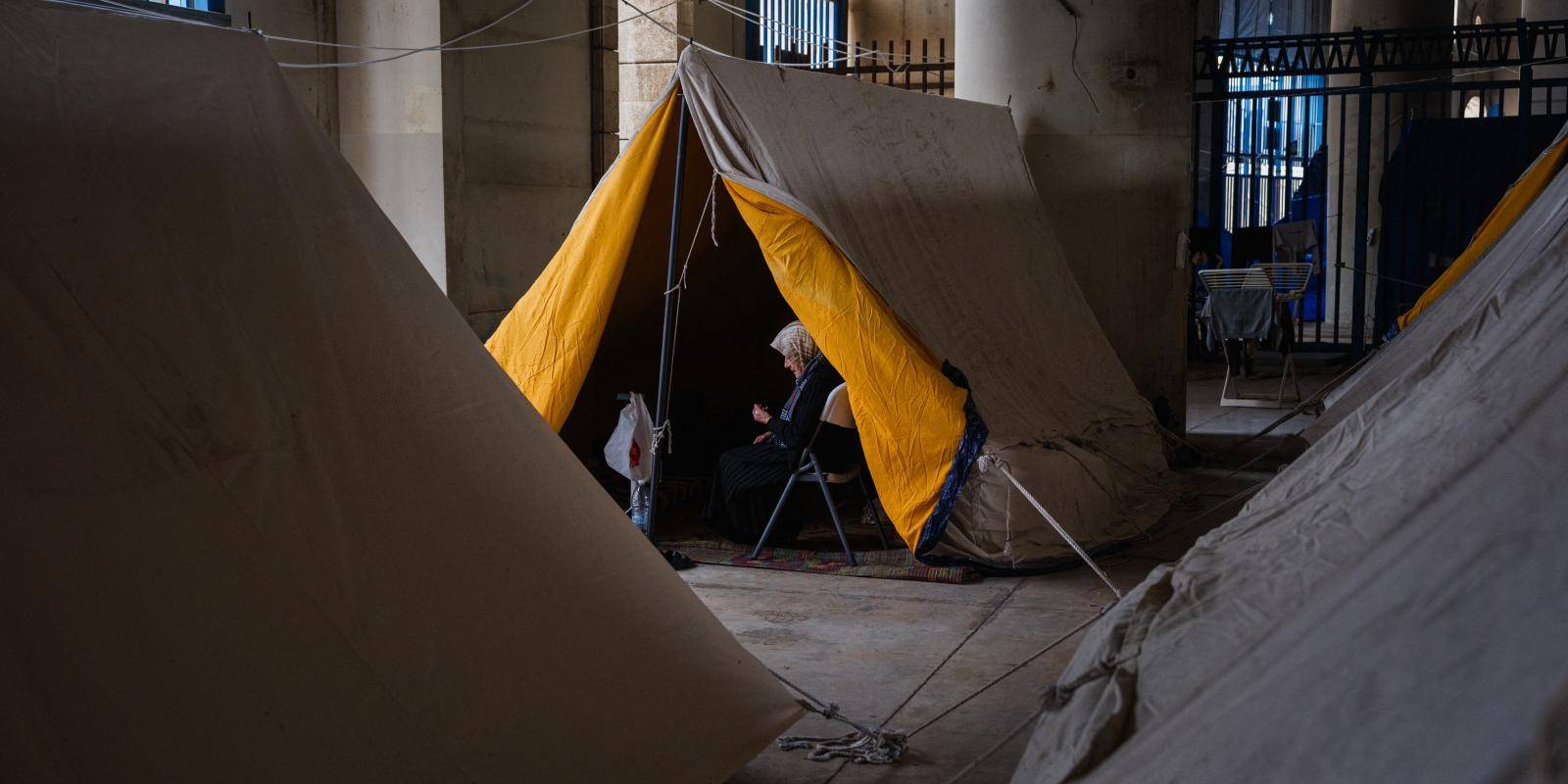

Beirut’s Sports City was built in the 1950s to host major regional games. In July, rows of tents lined the galleries beneath the abandoned stadium’s upper tier, sheltering hundreds of families displaced from southern Lebanon by an Israeli war against the Lebanese militia Hezbollah that began in March this year.
This was the second war in two years – the first followed Hamas’s 7 October attack on Israel in 2023. Though a ceasefire agreement is holding, Ali Adame, who has lived at the Sports City stadium with his wife for four months, does not know when he can go back to his village of Joueia.
His home has been destroyed, and basic services such as water and electricity are no longer available. ‘Of course we’ll go back, we’re just waiting for things to be sorted out,’ he said. ‘Those who go back find destruction, ruins and martyrs. There’s sorrow everywhere. But this is our fate.’
His family are among 300 people that in July were still in the shelter that is run by the Lebanese Red Cross with support from the Ministry of Social Affairs. While most displaced people in Lebanon are renting or staying with family members, those in shelters are some of the most vulnerable.
Adame is receiving treatment for his health conditions at the shelter, but he believes that going back to Joueia is his duty as a Shia from southern Lebanon. ‘The south for us is sacred,’ he said. ‘They destroy it and we go back and rebuild. This is the path we will walk. The land there is precious, it has cost us blood.’
Cost of recovery
The challenge of Lebanon’s post-war reconstruction is immense. Hezbollah joined the Israeli-Gaza war by launching rockets into Israel, triggering a full-scale Israeli offensive the following year. The group’s leader Hassan Nasrallah was killed and its armed forces significantly weakened. Yet Hezbollah launched further rockets into Israel in response to the United States’ air-strikes on Iran earlier this year, causing a second war. Many displaced by the 2024 offensive hadn’t returned, while others were displaced for a second time in two years.
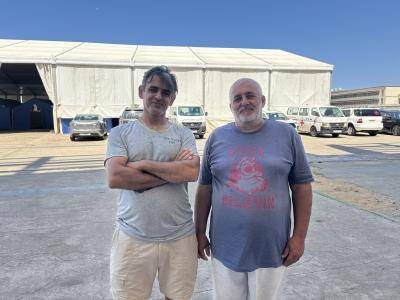
Ali Adame, right, with fellow displaced person Hassan Abdel Hadi. Adame has lived in Sports City stadium for four months since his home was destroyed. Photo: Lemma Shehadi.
The chance of help from beyond Lebanon’s borders is slim. After Hezbollah’s devastating war with Israel in 2006, Saudi Arabia and Qatar were the main contributors to the fund to rebuild southern Lebanon and Beirut’s southern suburbs known as the Dahiya. But support on this scale from the Gulf or the international community is unlikely to be forthcoming this time without the disarmament of Hezbollah. For decades, the Iran-backed militia has operated as a state within a state, dragging the country into armed conflicts with Israel, supporting the Assad regime during the Syrian civil war and killing its critics and opponents in Lebanon.
The Lebanese government is itself bankrupt from a financial crisis in 2019 that led to soaring inflation. Its banks have frozen depositor’s assets since then. The government’s priority before these two wars was to seek an International Monetary Fund package that would allow repayment to depositors.
Crisis for Lebanon’s Shias
Hezbollah’s disarmament is key to an Israeli withdrawal, and to rehabilitating the country in the eyes of the US and international community. The Israeli military currently occupies a buffer zone that stretches 10km into Lebanese territory.
Yet efforts by Lebanese president Joseph Aoun’s government to negotiate disarmament do not look promising. Hezbollah insists that its armed resistance is needed and that the Lebanese army is not strong enough to protect the south from Israeli occupation.
Over a million people – more than 15 per cent of the country’s population – have been displaced from the south in the past two years, and Lebanon’s government faces a long-term displacement crisis it can ill afford. Beirut and its surrounding towns in the Mount Lebanon area absorbed the largest share of displaced populations – 37.5 per cent and 32.4 per cent respectively – according to the government’s Disaster Rescue and Management Committee (DRM).
Though large numbers have returned to cities in southern Lebanon since the June ceasefire, it is not yet known how many will eventually be able to go back to their homes and villages. Of the nearly 17,000 living in government-run shelters, the majority are in Beirut and the district of Metn to the east.
Statements from officials including the Israeli defence minister Israel Katz suggest that up to 600,000 people could be prevented from returning if Israel does not withdraw from its so-called Yellow Line buffer zone, in southern border villages south of the Litani river. And this is unlikely to happen if Hezbollah refuses to give up its arms.
Shortfalls in international funding, as foreign aid budgets are squeezed, are adding to the problems. The 2026 UN Flash Appeal sought to raise $308 million, of which only 60 per cent had been secured by May this year, against a 90 per cent coverage rate in 2024, according to the DRM.
The government is having to deal with other consequences as well. ‘People will need a lot of support, there will be pressure on younger people to go to work instead of going further in their education,’ said Mark Daou, a Lebanese reformist party MP. ‘Emigration will be rampant. The number of young men killed is high - many of those are married or of working age. You have widows and kids who need to be provided for.’
The crisis strikes at the heart of Lebanon’s Shia communities which – like Adame – are native to Jabal Amel, the hills surrounding the Litani river.
The researcher and archivist Abbas Hadla says it is the first time that the people of Jabal Amel have no idea when they will be able to return. ‘The Israelis in this war … left villages that aren’t suitable for life,’ he said. ‘This gives people the impression that it’s more than an occupation, that there could be a demographic change happening.’ And this is in a country where such demographic movements have had a significant political impact in the past.
US–Israel war
The unpredictable Iran–US ceasefire talks loom large over all of this. Iran has sought to include an Israeli withdrawal from southern Lebanon as part of its agreement, and experts fear this could help Iran consolidate its control of the country and make Hezbollah’s disarmament less likely.
Others hope the ongoing direct negotiations between Lebanon and Israel in Washington will result in an Israeli withdrawal from southern Lebanon with reparations to help rebuild, in exchange for guarantees to Israel’s security and Hezbollah’s disarmament. A phased withdrawal is being worked out. In July, Israeli forces retreated from two villages within the buffer zone after an agreement with Lebanon.
The talks have two possible outcomes, according to Daou, the MP. The first is a peace agreement with ‘major financial incentives’. The alternative is a ceasefire that prolongs the state of war. ‘[People] would accept an agreement for years to come that would allow them to reconstruct their livelihoods, their villages, their land and everything else,’ he said. ‘If it’s only a military containment like a ceasefire, then the state of war remains and people will be afraid to go back.’
A long crisis
There are signs people are giving up hope of returning home. ‘We’ve entered a long crisis,’ said Mohammed, owner of a spice shop who fled his town of Qabrikha with his wife when the war started earlier this year. He is now living in a rented apartment in Beirut and works as a handyman.
His town is within the Israeli-occupied buffer zone on Lebanon’s southern border, demarcated by the Yellow Line. ‘Nobody dares go back and rebuild. We don’t know if the war has really ended,’ he said.
Mohammed was first displaced during Israel’s war with Hezbollah in 2024, and though his shop was destroyed then, he went back. He was forced to flee again in March, when Hezbollah launched rockets into Israel, triggering the latest war.
This time, it was his wife’s hair salon in Qabrikha that took a hit, leaving nothing for them to go back to. His son, who is in the Lebanese army, works in a town north of Beirut. ‘Our plan now is to move to a new place entirely. The issue in the south will be a long one, it’s not safe. We’ve fled twice now beneath the airstrikes and bombs. We’re not always going to be lucky.’
Driving his decision is the lack of clarity from authorities about whether it is safe to return. ‘It’s clear from the [political] parties and the municipalities that we have not yet moved on to a new phase,’ he said. ‘There’s no decision on what to do about the people whose homes have been destroyed. They haven’t replaced the electricity generators, or the water networks. They bought water tanks and placed them in the town square.’
Yet Mohammed feels tensions in Beirut as he searches for a more comfortable apartment for his family. In the 2024 war, many refugees were taken into people’s homes. But people now are more cautious after Israel attacked buildings outside of Hezbollah strongholds that had been rented by Iranian or Lebanese militants. ‘People are scared. Not just of who they rent to, but who could come to visit those people. It’s not discrimination, it’s fear,’ Mohammed said.
Preserving Shia identity
The cumulative effect of decades of conflict and displacement means the recovery of the south will not just be about rebuilding, but will have psychological and cultural dimensions, according to Hadla, the archivist, who is director of Umam, a research centre based in the Dahiya. Umam’s founder Luqman Slim, a Shia critic of Hezbollah, was assassinated in 2021, days after he received death threats for his work looking into Hezbollah’s connections to the Beirut Port explosion of 2020.