

This article is published as part of ‘The World Tomorrow’, the magazine’s new strand for fresh ideas about the direction of global order.
On 18 October 2017, delegates at the Chinese Communist Party’s National Congress listened to their leader announce a new political doctrine, ‘Xi Jinping Thought on Socialism with Chinese Characteristics for a New Era’. It discussed party discipline, national security and the direction of travel for China, among other topics. But as Xi outlined his doctrine for a de facto new state ideology, he also expressed something that none of his predecessors, not even Chairman Mao, attempted: a global strategy for China based primarily on his own thought.
It was a remarkable moment in the history of Communist China’s foreign policy. In late 1978, Deng Xiaoping ushered in China’s ‘reform and opening up’ era. In the three decades that followed, China’s foreign policy adhered to another dictum of his – that China should ‘hide its capabilities and bide its time’. His successors Jiang Zemin and Hu Jintao largely did just that, shying away from anything approaching a global strategy. This approach served China well as it led to western policymakers helping China to modernize and emerge as a potential superpower.
Xi Jinping Thought
That all changed with Xi Jinping Thought. Since taking office in 2012, Xi had consolidated power; but it wasn’t until his speech on the eve of his second term that he defined more clearly ‘the China Dream of National Rejuvenation’, with his vision of consolidating the party’s control over everything as an instrument for China to forge a ‘common destiny for humankind’ by 2050.
It set out Xi’s plan to return China to global preeminence. Xi believes such preeminence will emerge if China can pull off a double pivot in its global strategy: establishing its leadership of the Global South and gaining control of Taiwan. The two are inextricably linked with his ambition, ultimately, of transforming the world order. Yet as important as it is to understand these goals, it is equally important to grasp Xi’s approach to foreign policy – something that the United States and other western powers often fail to.
A conventional ‘realist’ assessment of China’s foreign policy emphasizes its national interest and its power relative to other nations. Xi and his regime certainly make those calculations. Yet, such an assessment risks failing to see that Xi’s ideological preferences and the security of the Chinese Communist Party (CCP) trump all other considerations in Beijing’s global strategy. This makes China under Xi an unusual kind of realist actor, one which I and Olivia Cheung examine in our new book China’s Global Strategy under Xi Jinping – the term we use for Xi’s vision is ‘Sino-centric party state realism’.
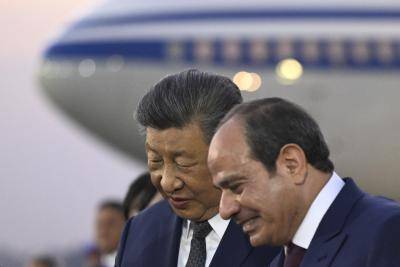
China’s leader Xi Jinping, left, with President Abdel-Fattah el-Sisi of Egypt upon his arrival in Cairo on 1 September, 2026. Key to Xi’s global strategy is his influencing of Global South countries. Photo: Khaled Desouki / AFP via Getty Images.
An understanding of what Sino-centric party state realism means for China’s global ambitions is crucial for western powers seeking to compete with and challenge Beijing. Many fail to apprehend the true nature of these ambitions. For instance, recent American administrations have made the mistake of thinking that China wishes to replace the United States as the global hegemon and impose a new world order. That isn’t the case, as I’ll argue below.
It is also necessary to recognize that Beijing has no interest in enabling us to understand China’s global strategy – its interest is in getting us to understand it in ways that benefit China. But first, it is helpful to examine a key concept in this strategy.
A ‘common destiny for humankind’
In the CCP’s official English translation of this concept in Xi Thought, the Chinese leader sees across the world an opportunity to build ‘a community with a shared future’. This phrase is routinely repeated by western policymakers, analysts and news media. It is an anodyne statement, deliberately so, and, arguably, framed to disarm and mislead. A faithful translation of the Chinese is ‘a common destiny for humankind’, which reveals a more concerning vision. A ‘common destiny’ for all does not emerge organically in a community of free and equal agents choosing to share a future; it needs to be forged by a leader, China.
How might China forge this ‘common destiny’? By, in Xi’s words, the ‘democratization of international relations’. In this framing, China is not seeking to replace the existing international order or the US as the global hegemon with the legacies that would entail, such as undertaking the role of the world’s police officer. Instead, Xi’s ambition is for China to take over the leadership of the international order by securing the support of the Global South, thereby executing its first pivot.
Global South countries represent a clear majority in the UN General Assembly and by population count. The modified order would be Sino-centric, based on Xi’s understanding of the traditional Chinese concept tianxia (see sidebar at foot of the article) – in theory at least, a fundamentally different model of global leadership to the American-led rules-based order.
To expedite this ‘democratization’, China does not work to export its Leninist political system; rather, China’s aim is to help countries of the Global South resist the US and the West imposing their liberal-democratic political model on them. In pursuit of this goal, Xi has deployed enormous diplomatic and economic resources.
Since 2021, he has announced four global initiatives, on development (2021), security (2022), civilization (2023) and governance (2025), complemented by the Belt and Road Initiative (BRI), China’s global infrastructure and economic development strategy. In this process, China’s relations with the US have been relegated to a lower priority, contradicting the belief in Washington that Beijing is fixated on outcompeting Washington. Instead, Beijing pursues its global ambition by cultivating support from the Global South, which is defined loosely to include almost every nation outside the ‘democratic West’. By this formulation, when Chinese preeminence is accomplished the end of US hegemony is simply a by-product.
Wooing the Global South
Xi’s four global initiatives have attracted relatively little attention in the West. The US and Europe are not the intended audience. But the initiatives do appeal to the weaker democracies and autocratic regimes of the Global South whose leaders appreciate that Xi’s suite of initiatives not only commits China not to interfere in their domestic affairs but also gives them protection against others – the US and its allies primarily – from doing so. For example, at the Boao Forum of April 2021, Xi said: ‘We must not let the rules set by one or a few countries be imposed on others, or allow unilateralism pursued by certain countries to set the pace for the whole world.’
This is why many Global South leaders understand the Chinese rhetoric of the ‘democratization of international affairs’ implies a transformation of the international order from one imposed by a self-righteous and democratic US, as they see it, to a more hands-off alternative shaped by authoritarian China.
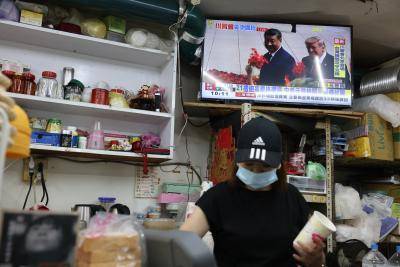
A TV news report broadcast in a restaurant in Taipei, Taiwan, shows the meeting between Donald Trump and Xi Jinping in Beijing in May. Xi told the US president their two countries should be ‘partners not rivals’. Photo: I-Hwa Cheng/ Getty Images.
The attraction is reinforced by China’s offer of otherwise unavailable development loans without conditionalities such as accountability and transparency, via the BRI scheme. The scaling back of the BRI in recent years may have reduced the size of these loans but it remains substantial at close to $124 billion for 2025. The refined approach has made Chinese development projects more sustainable and subject to less abuse, without significantly reducing their value in cultivating support.
The other demand Beijing makes of Global South countries is to give verbal support for its claim over Taiwan, which is cost-free to them. Little wonder that Xi’s global initiatives gain traction in more and more Global South countries.
China has also used the support of Global South countries to expand and consolidate its control over important parts of key international organizations, of which the most important is the United Nations. For example, at the United Nations Department of Economic and Social Affairs and the Human Rights Council, Beijing, with support from its Global South partners, has fundamentally changed how they operate and made them responsive to Chinese preferences in the past two decades.
In this way, Beijing is building momentum for further changes within the UN, at a time when most western democracies are neglecting it and reducing their overseas development budgets. The unrelenting enhancement of Chinese influence at key international organizations is meant to enable China to make more decisive changes when it is ready.
The Taiwan pivot
The second pivot in China’s global strategy is to take Taiwan, in defiance of the US commitment enshrined in its Taiwan Relations Act (1979) to help the country defend itself against an externally imposed change in its status. Taiwan matters not so much because it is the top producer of critically important advanced microchips but because it lies in the middle of the strategically vital First Island Chain in the Pacific Ocean and has only remained beyond Chinese control thanks to US protection.
In Beijing’s approach to Taiwan, Xi has made a paradigm shift. To all his predecessors, including Mao, Taiwan was unfinished business from the Chinese Civil War (1946–1949), but none saw a need to specify a timeline for its incorporation into China. In contrast, Xi has made Taiwan central to his China Dream of National Rejuvenation, making 2050 the deadline for taking it.
Beijing’s preferred outcome is to demonstrate overwhelming military superiority that pressures Taipei to submit to ‘reunification’ and thus remove the American raison d’être for intervention. Should this tactic fail, it will use force. The calculation is that success by either means will reveal US impotence to counter a spectacular Chinese move to take control of the First Island Chain. That would not only enable China to project power deep into the Pacific but would force key US allies such as Japan and South Korea to calculate if they can still rely on their respective defence treaties with the US for their security.
If achieved, the taking of Taiwan, and the discrediting of the US in the process, would mark China’s assertion of its global preeminence. Crucially, it would link the dual pivots of its global strategy, ushering in an appeal to China’s supporters in the Global South to make significant changes to key international organizations.
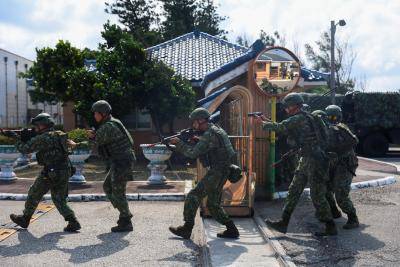
Taiwanese army troops participate in the Han-Kuang military exercise, at a power station in Penghu County, Taiwan on 5 August, 2026. The 10 day-long exercises simulated a response to a possible invasion by China. Photo: Daniel Ceng /Anadolu via Getty Images.
Should Xi’s global strategy come to fruition, the world as we know it will be relegated to history. Although its strategic goal, as expressed in ‘Xi Thought’, is formally limited to enjoying preeminence, as the premier state of the world China would, in effect, become the global hegemon. To the rest of the world, the distinction between preeminence and hegemony means little. A new world order dominated by China, which puts the interests of the Chinese Communist Party and its supreme leader at its core, is a world hostile to democracy, individual rights and human dignity, at least as they are understood in vibrant democracies.
The deadline Xi has set for the fulfilment of his China Dream, 2050, is nearly a quarter of a century away. It implies that while China is unrelentingly working to implement its global strategy, Xi is not in a hurry. The democracies of the West and elsewhere that are worried about Xi’s vision have, to a degree, time to devise effective countermeasures. Each pivot in China’s global strategy provides inspiration.
How the West might respond
To counter China’s Global South pivot, the democracies of the West need to work together to engage China in what can best be described as a beauty contest. The liberal international order has been found wanting, which is why Xi’s proposed transformation gains traction in the Global South. A return to the previous version of the liberal international order is neither possible nor sufficient.
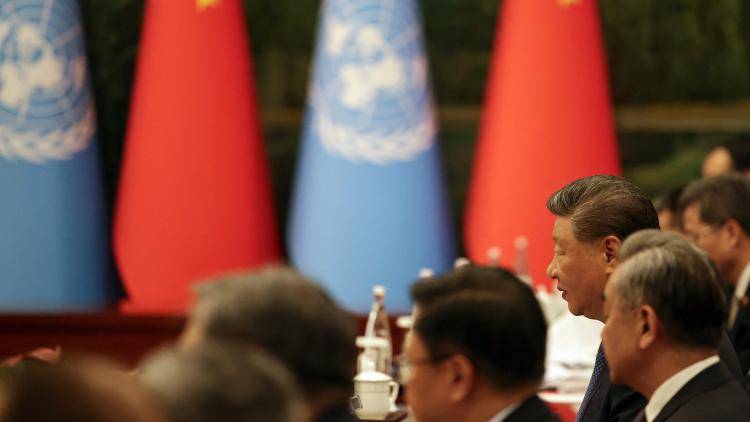
But by working in a collegial way with Global South partners to make the UN and other international organizations more representative and responsive to most nations and peoples in the world, the democracies of the West can provide a more attractive package than what Xi’s ‘common destiny for humankind’ promises.
To do so, the US and Europe will have to re-invest heavily in overseas development aid, with better arrangements to enable the recipients to play an active role in making good use of them as they see fit. They also need to jettison what, from the Global South’s perspective, amounts to hypocrisy: while rich democracies talk about human rights as universal, they tend to only defend the rights of their own citizens.
To counter China’s Taiwan pivot, the key is to exploit the overriding priority of Sino-centric party-state realism: that Xi will not do anything that jeopardizes his and the Communist Party’s hold on power. This means that however much Xi may want to take Taiwan, he will resist doing so if he knows an attempt will bring about a catastrophe likely to unleash forces within the party to unseat him.
This opens a way to deter China. But American military deterrence alone is insufficient as Xi’s purges of his senior military officers mean that no Chinese general would dare to advise Xi to act on US military deterrence. To succeed, it must be complemented by economic deterrence, something that Xi instinctively understands.
Nearly half of China’s economic ties in value terms are with the US, the European Union, Britain, Japan, Korea, Australia, Canada and New Zealand. For a highly externally oriented economy such as China’s, suddenly losing its ties with those countries would bring cataclysmic consequences, with potentially dire repercussions for the CCP.
The democracies could coordinate to threaten Beijing in private with a break in economic ties before China invades Taiwan. If they did, Xi would need to determine if the damage to China’s economy would result in moves within the CCP to oust him. A calculated risk-taker rather than a reckless leader, he could be deterred, especially if western diplomatic efforts included a reassurance to Beijing that, should it respond favourably to the deterrence, the democracies would ensure that Taiwan did not cross Beijing’s red line and assert de jure independence.