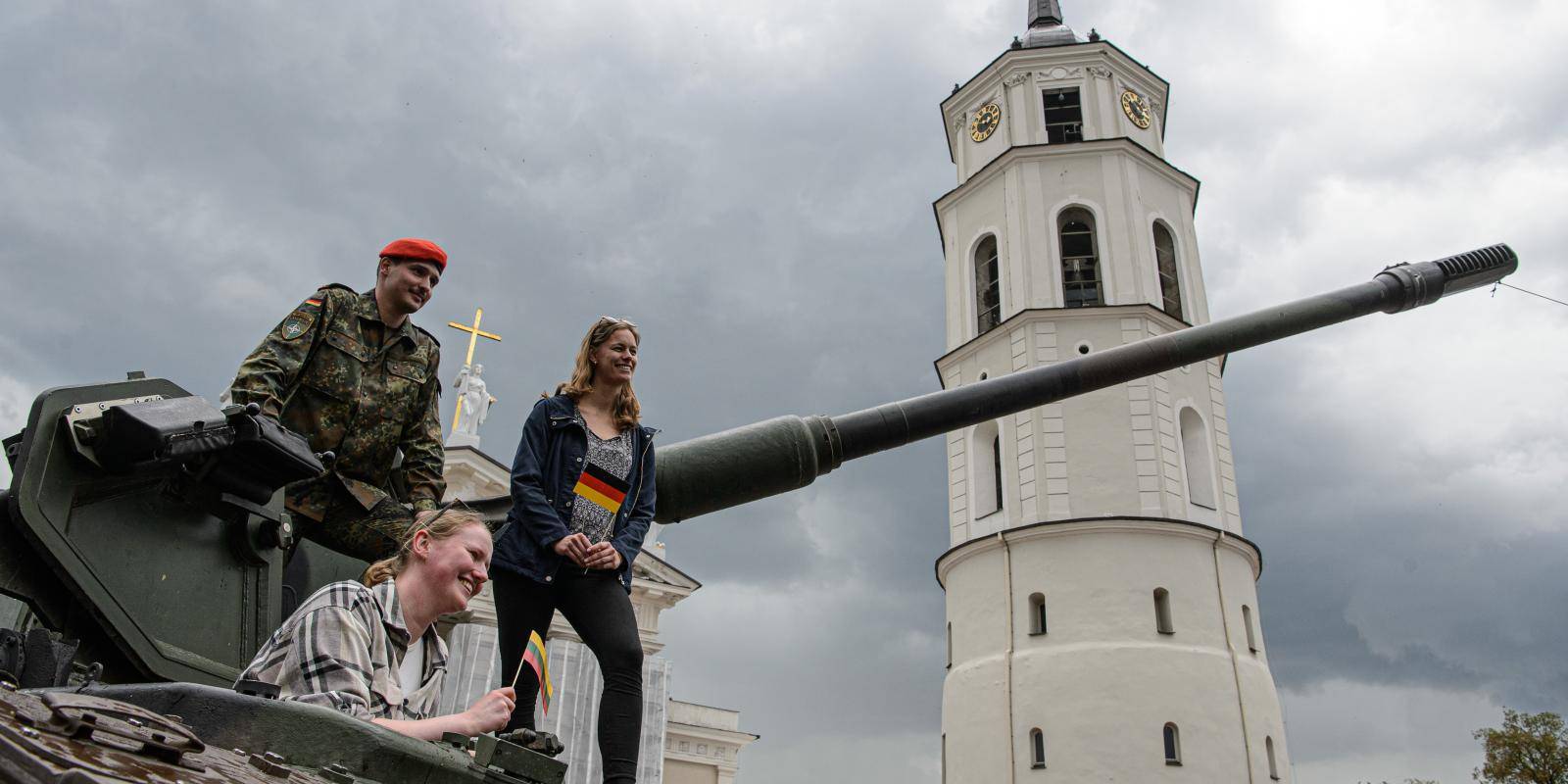

Germany is participating in a series of military exercises during August and September – training to defend NATO’s eastern flank. That follows May’s activation of a Bundeswehr armoured brigade that will be stationed long term in Lithuania as part of NATO’s Enhanced Forward Presence.
That deployment is perhaps the earliest visible manifestation of ‘Zeitenwende’ – loosely translated as ‘turning point’ – the security policy shift announced by German Chancellor Olaf Scholz in 2022. The full-scale Russian invasion of Ukraine that year was a wake-up call for all European NATO members. But for Germany, the invasion meant much more. Zeitenwende represents a transformational cultural and political shift for a country that was rebuilt on a pacifist and demilitarized legacy after the Second World War.
The attitude of other European countries towards Germany has also changed significantly following the invasion. Only 30 years ago other European governments worried about German reunification, concerned it might create an over-powerful nation. Now, in the context of US disengagement from European defence, the same countries are eager for Berlin to expand its armed forces.
Germany has made unprecedented strides in the three years following Scholz’s speech. But significant challenges lie ahead to make its rearmament effort efficient, effective, and enduring.
Initial success
Over the past three years, defence and security policy reform has been extensive. The consistent nature of these changes suggests that they are permanent and lasting.
There have been early successes. Berlin has committed to much higher investment in domestic production of defence equipment. Reform of the purposefully slow military procurement system is underway – with legislation also planned to speed up construction on military bases.
And greater cooperation between the armed forces and local communities is being encouraged to increase civil resilience. The Operational Plan for Germany is seeking to introduce a ‘whole of society’ approach to defence akin to that practiced in countries like Estonia. These are significant successes achieved in a relatively short time, suggesting that Germany is on its way to become a much stronger military power.
However, German defence still faces significant issues. The armed forces have frequently made headlines over the last decade for the poor shape of their equipment. Those deficiencies will need to be addressed. And many other challenges lie ahead.
Spending money well
Like many other European countries, Germany has agreed to massively boost its defence spending. According to the German Ministry of Defence, a budget of €108.2 billion is planned for 2026 – up from €86 billion in 2025. But how well it will spend that money is open to question. The German procurement process prior to the reforms was famously cumbersome. The German parliament was embroiled in a debate over the procurement of armed Heron drones for over a decade, from 2008–22.
Germany has also struggled with procuring exquisite bespoke systems that then ended up more costly and less reliable than expected. Examples include the Puma infantry fighting vehicle and famously, the spare parts shortage for the Eurofighter Typhoon: only four of 128 aircraft were operational for a time.
Traditional German foreign policy values are clearly visible in some of the country’s new defence projects. That includes a big emphasis on working in partnership with other countries. This has found its expression in cross-European defence projects, such as the European Sky Shield Initiative or the European Long-Range Strike Approach.
These two programmes exemplify the procurement dilemma that Germany and its European NATO allies face. Europe undoubtedly needs air defence and long-range strike capabilities. But European governments also have to strike a balance between maintaining a diversity of systems that is resilient to supply interruptions – and the need to benefit from economies of scale.
Across Europe there remains a philosophy that defence industry investments must benefit local economies. That risks duplication of effort within NATO, where groups of governments invest in rival weapons systems. Efforts to design a next generation fighter (GCAP and SCAF) and long-range missile strike capability (ELSA and updated Storm Shadow) represent such internal European competition. Considering the threat posed by Russia and the uncertainty over US security ties, it would often make more sense for European countries to focus on single projects. That should increase the number of units produced, and lead to cost benefits.