

A panel of five members of the Brazilian Supreme Court has handed down a guilty verdict to former President Jair Bolsonaro for leading a criminal conspiracy to overturn the 2022 elections. The decision was not unanimous, with one justice – Luiz Fux, appointed to the high court by current President Luiz Inácio Lula da Silva (Lula) – dissenting.
Seven of the former president’s advisors – past and current military officers – were also found guilty. Bolsonaro, the populist, right wing former army captain, will likely appeal the decision to the full 11-member Supreme Court. That will delay a resolution to a wrenching time in Brazil’s democratic politics and further divide the country.
Given Brazil’s political polarization in the Bolsonaro age, and growing solidarity among populists inspired by US President Donald Trump, the dissent will further inspire Bolsonaro’s supporters, domestically and internationally.
Legacy of the Junta
Other countries in Latin America that emerged from military dictatorship, such as Argentina, Guatemala, and Uruguay, created truth commissions to investigate human rights abuses committed under those governments. Brazil never did, despite the many allegations relating to the rule of its military junta, from 1964-1985.
Bolsonaro built his support in Brazilian politics in part by praising the junta for thwarting communism and defending conservative values. For many it was seen as a vindication of the military.
After Bolsonaro lost the 2022 presidential election his supporters, including a number of retired military officers, stormed government buildings on 8 January 2023 in a shocking attempt to overthrow Lula’s inauguration. Their raids on the Supreme Court and the Congress were a frightening attack on the institutions of Brazil’s post-military democracy.
Brazilian supreme court justice, Alexandre de Moraes, initiated and led an investigation that eventually indicted Bolsonaro and his seven advisors for inciting the insurrection.
Justice Moraes had previously drawn international and domestic criticism for his efforts to force social media companies to ban users accused of spreading disinformation. Many of those were Bolsonaro supporters who had attempted to spread popular distrust in the electoral system before the 2022 vote. (An independent audit of Brazil’s electronic voting system confirmed it to be ‘reliable, secure and transparent’.)
Moraes’ efforts brought him into conflict with Twitter/X. Owner Elon Musk initially refused to comply, citing freedom of speech, but was forced to bend after Moraes imposed a $900,000 per-day fine on the company.
Bolsonaro’s US allies
Defending freedom of expression has become a rallying cry for the supporters of US President Donald Trump, both at home and abroad. The new administration’s willingness to intervene on the issue in other countries was signalled in February by Vice President JD Vance, who used a speech at the Munich Security Conference to denounce European efforts to limit the rights of extremist groups such as the neo-fascist Alternative for Germany (AfD) party.
The US’s defence of populists extends to Bolsonaro and his unfounded claims of electoral fraud. Earlier this year, Bolsonaro used an interview with the Financial Times to call on the Trump government to come to his defence. In March his son, Eduardo Bolsonaro, moved to the US to lobby the White House to impose sanctions on Moraes and the Supreme Court for ‘cruelty…inflicted on innocent people’.
President Trump responded to support his ally Bolsonaro, in a demonstration of the fusion of private and public power. In February the Trump Media & Technology Group filed a lawsuit in US courts against Moraes for violation of freedom of expression. The alleged offense was Moraes’ demand that the company Rumble remove the account of a Bolsonaro supporter based in Florida accused of spreading disinformation and threatening judges.
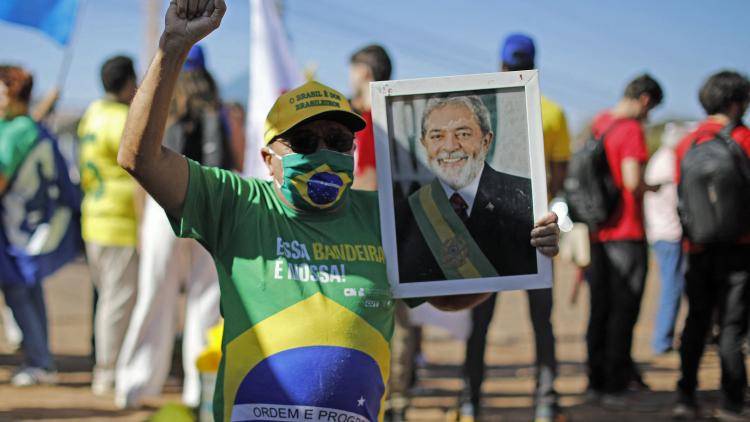
In late July, Trump announced 50 per cent tariffs on Brazilian exports to the US, accusing the Supreme Court of engaging in a ‘witch hunt’ by prosecuting the former president and his associates.
While the move will affect some Brazilian businesses – even with substantial carveouts for orange juice, natural resources and aircraft – the US market only accounts for 12 per cent of Brazilian exports (compared to China, which represents 28 per cent).
Trump’s actions prompted condemnation from a number of Brazilian pro-business, conservative newspapers and leaders, suggesting that Trump may have inadvertently bolstered President Lula’s standing before the 2026 presidential elections. (Lula is expected to run, for what would be his fourth term).
The US Treasury Department later slapped sanctions on Moraes and other Brazilian Supreme Court justices, yanking their US visas and freezing banking accounts in the United States. The authority used for the sanctions, the Global Magnitsky Act, was created to punish human rights violations or corruption.
What’s Up Next?
The non-unanimous decision by the five-person Supreme Court panel will almost certainly be appealed to the full court. In the meantime, the Trump administration will continue ramping up its rhetoric – and potentially sanctions – in the name of defending the man who has been called the ‘Trump of the Tropics’. As it stands, Bolsonaro faces a sentence of 27 years.