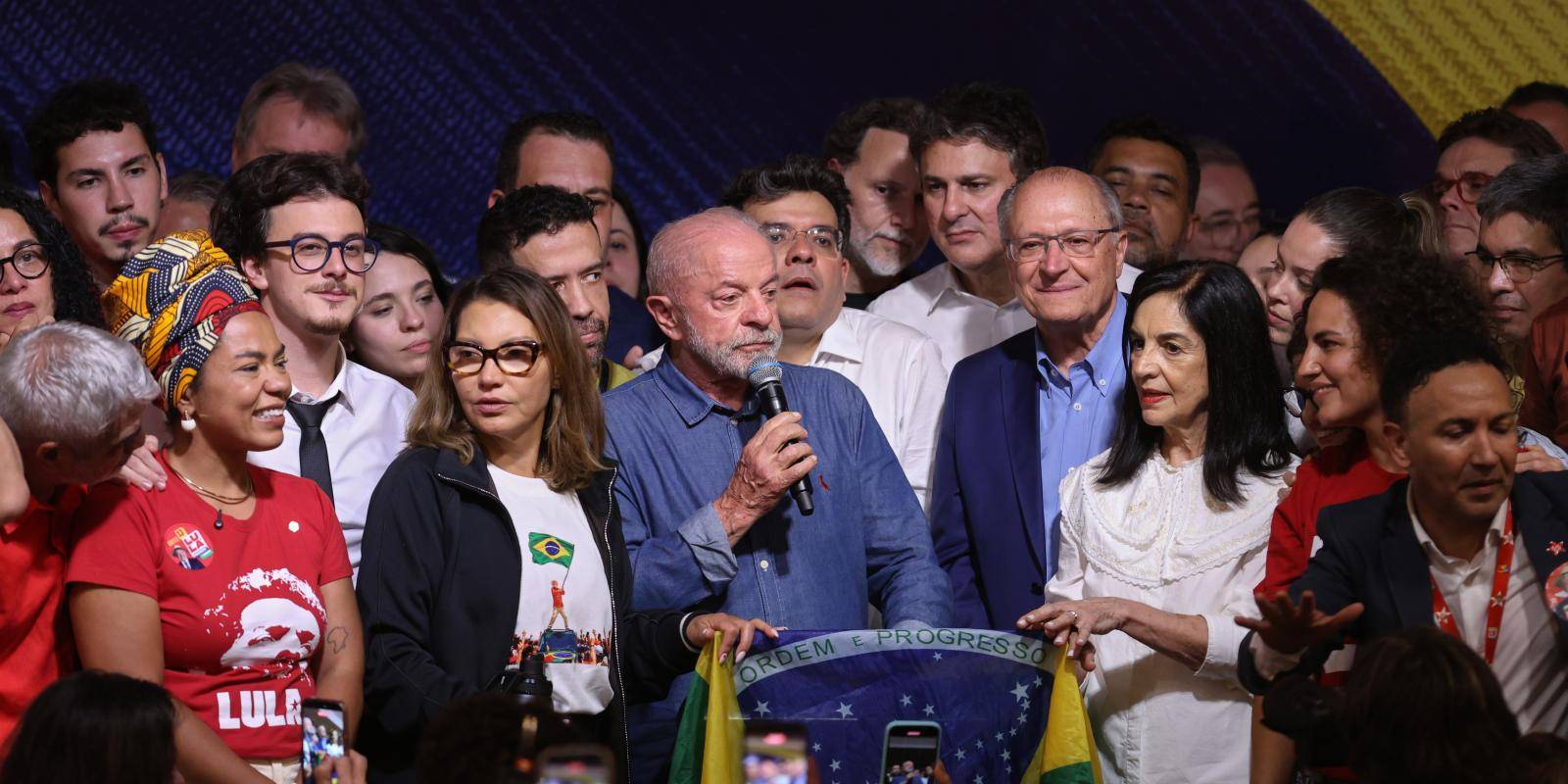


Luiz Inácio Lula da Silva, commonly known as Lula, has been re-elected president of Brazil for a fourth term. Lula secured 51.79 per cent of the vote against Bolsonaro’s 48.21 per cent.
The victory was a surprise: Lula’s opponent, Flávio Bolsonaro, led in the first round of the election held on 4 October. The result was announced after an unusual decision on Sunday by the country’s Supreme Court, which allowed polling centres to remain open longer than planned.
‘This, my fourth term, will be the best of any president in the history of this country’.
Defeated candidate Bolsonaro has refused to accept the result, saying:
‘It is impossible to recognize the election results, given the circumstances under which things unfolded.’
Below, Chatham House experts provide analysis of the meaning of the result for Brazilians, the region and the world.
1. Dr Christopher Sabatini on what next for US relations?
2. Dr Bruno Binetti on Brazil’s China policy
3. Vanessa Rubio Marquez on the left and right in Latin America
4. Luis Miguel Castilla Rubio on Lula’s policies and Brazil’s economy
What next for US relations?
Christopher Sabatini, Director of Chatham House’s Latin America Programme
As many waited for the administration of President Donald Trump to recognize President Luiz Inácio Lula da Silva’s unexpected second-round presidential victory, other heads of state rushed to congratulate the Workers’ Party president’s victory over conservative Flávio Bolsonaro.
French President Emmanuel Macron, Indian Prime Minister Narendra Modi and Canadian Prime Minister Mark Carney all publicly congratulated Lula on his victory. Even Brazil’s more conservative neighbours joined the chorus, including Peruvian President Keiko Fujimori, Ecuadorian President Daniel Noboa, Chilean President José Antonio Kast, and Paraguayan President Santiago Peña.
The White House’s hesitation is not surprising. It had been counting on the election of Bolsonaro to complete its bingo card of right-wing presidents in the Western Hemisphere, following a period of sustained electoral success for right-wing candidates stretching from Honduras to Argentina. But Latin American regional solidarity and respect for democratic institutions and the popular will trumped ideology and alignment with the US.
Adding Latin America’s largest democracy and economy would have represented a major victory for the self-proclaimed ‘Donroe Doctrine’. Instead, public support for Lula’s re-election may demonstrate that the bloc of Trump-aligned and Trump-adjacent presidents may not be as strong and ideological as many thought. (Only Argentine President Javier Milei has withheld congratulations for Lula.)
Meanwhile, Flávio continues to call for the annulment of the elections, claiming fraud – much as his father, Jair, did in 2022 when he lost to Lula. Part of his claim hinges on a Supreme Court justice who supported Lula’s Workers’ Party request to extend voting by two hours on Sunday.
That request was made originally by both parties to Brazil’s electoral court – in order to accommodate voters who struggled to make it to the booths due to heavy rains, and others allegedly affected by limited public transportation. But the decision to kick the request up to the Supreme Court after the electoral court failed to respond casts a pall over the results – and further threatens the reputation of a Supreme Court already under suspicion for being politicized.
Brazil’s modern, transparent voting system will be able to demonstrate the results – for those who want to believe them. But for core Bolsonaro supporters, trusting the results may be difficult. Flávio’s father also claimed unproven fraud in 2022. And father and son have baked distrust of the judicial and electoral system into their political DNA, polarizing politics and society in Brazil.
In the end, how far Flávio’s team decides to take its claims of fraud may depend on the White House and the US State Department. Both had a lot riding on a Bolsonaro victory. For Trump it would have been the crowning achievement for his support in the region, during this heavy year of presidential elections across the hemisphere.
For others the issue is more ideological and personal. Secretary of State Marco Rubio, like many Cuban-Americans, saw Lula’s Workers’ Party as complicit in upholding the communist regimes in Cuba and Nicaragua. Creating a ring of conservative, anti-communist governments across the hemisphere to stand with the US against those regimes has long been a dream of Republican administrations and Cuban-Americans in Florida. Their perspective will likely also help decide whether and when the Trump administration accepts a Lula victory.
With conservative majorities in both houses of Congress, Lula will have a difficult time attempting to tackle the economic and fiscal reforms necessary to keep the government solvent and address its looming sovereign debt. But the biggest loser in the election is social trust. The country’s voters are now almost evenly split between Bolsonaro and Lula (only 3.6 per cent separated the two leaders). And popular confidence in the Supreme Court may decline even more.
Will Lula change Brazil’s approach to China?
Bruno Binetti, Associate Fellow, Latin America Programme
Lula’s re-election, following a campaign in which he declared that Brazil was ‘nobody’s backyard’ and denounced foreign interference, will be welcomed in Beijing.
China retains a close partner in Latin America’s largest economy, at a time when most countries in the region have moved closer to the Trump administration. Lula shares China’s commitment to a multipolar international order with a stronger role for the Global South. That includes efforts within BRICS to reduce reliance on the US dollar in international trade, reform global financial institutions and expand climate finance for developing countries.
This partnership is underpinned by strong economic ties – ties so important they would have endured a Bolsonaro victory. China has been Brazil’s largest trading partner since 2009, driven by Brazilian exports of soybeans, iron ore and crude oil. In 2025, Brazilian exports to China reached $100 billion, compared with $38 billion to the US. This makes continued engagement with Beijing a priority for the powerful agribusiness sector, which is well represented in Congress and traditionally aligned with Bolsonaro and the political right.
Brazil was also the world’s largest recipient of Chinese investment in 2025, with Chinese firms expanding their presence in electricity infrastructure, manufacturing and mining. In the automotive sector, BYD and Great Wall Motor have established electric vehicle production facilities in Brazil, and Lula is pushing Chinese manufacturers to use more local suppliers and create jobs.
Brazil-China relations are likely to deepen during Lula’s fourth term, especially if the Trump administration continues to impose tariffs and other trade restrictions on Brazil.
Yet Lula is the ultimate pragmatist. He has always sought to maintain good relations with competing powers. Brazil and the US are already discussing a potential trade agreement that could include cooperation on critical minerals, a top priority for Washington as it tries to reduce dependence on China.
With the world’s second-largest rare-earth reserves, Lula is open to investment from both China and the US, provided it helps Brazil develop its own processing industries and move up the value chain,
What does this result mean for the left and right in Latin America?
Vanessa Rubio Marquez, Associate Fellow, Latin America Programme
With Lula’s clear victory in the presidential run-off on 25 October, the two largest Latin American economies, Brazil and Mexico, will be perceived as the remaining guardians of the left, in a region that has largely flipped to the right of the political spectrum in recent years. However, the more relevant question is whether being left or right in the Western Hemisphere – and the world – still means what it once did.
Traditionally, the distinction between left and right was relatively clear. The left favoured a stronger role for the state in reducing inequality and redistributing wealth. The right, by contrast, placed greater emphasis on individual responsibility, private enterprise and preserving existing economic and social structures, accepting inequalities as a natural feature of society.
Today, these boundaries are being blurred. For instance, under Jair Bolsonaro, Brazil increased minimum monthly welfare transfers by 50 per cent (R$400 to R$600), reaching over 20 million families ahead of the 2022 election. And the reduction of the working week from 44 to 40 hours also took place under his mandate. Similar measures to protect specific sectors in society were implemented in Ecuador, where right-wing Daniel Noboa introduced financial assistance for vulnerable entrepreneurs.
However, the left -wing Mexican government of Andrés Manuel López Obrador limited pandemic spending and direct budget support to 0.7 per cent of GDP, compared with over 3 per cent across G20 emerging economies. And Chile’s left-wing president, Gabriel Boric, oversaw a 23.1 per cent real reduction in government spending in 2022.

Ever more, the extremes of left and right converge in pragmatic, immediate and populist policies. The more important divide is how governments exercise power, respect democratic institutions and protect individual freedoms while they deliver for the people.
A very interesting case of a tension between democracy and tangible results in matters that people prioritise is seen in El Salvador. President Nayib Bukele’s crackdown on gangs has brought major security gains, but at a cost to civil liberties. Emergency powers have been extended 55 times since 2022, with over 93,000 arrests and restrictions on due process.
Being the ‘remaining two of the left’ matters less than how the countries that jointly produce more than 88 per cent of Latin America’s GDP are governed.
Lula’s victory reminds us of a broader, more concerning regional trend: the defining divide is increasingly between governments that preserve democratic institutions and individual freedoms and those willing to weaken them for ideological, political and electoral reasons.
Can Brazil afford Lula’s promised spending?
Luis Miguel Castilla, Associate Fellow, Latin America Programme
Lula returns for a fourth term to a Congress where the right and the Centrão hold the larger share of seats, and where the Centrão is expected to hold over 170. The agenda he promised, which includes a university stipend, a new round of household debt relief and a larger housing programme, will be hard to achieve: the president must negotiate with a majority whose incentives lie in protecting its own share of the budget.
Fiscal rigidities leave little room for any of Lula’s agenda. Barely 10 per cent of the budget is discretionary. Congress will resist new taxes. That will leave cutting expenditure. But that will also not be easy, when legislators will defend parliamentary amendments and indexed mandatory items.
Interest payments neared 7.7 per cent of GDP in 2024 and 8.05 per cent in 2025, claiming resources that might otherwise have been spent on Lula’s social agenda. On the authorities’ definition, Brazil’s gross debt will reach 86.6 per cent of GDP this year and 94.1 per cent by 2030. By the IMF’s broader measure it already exceeds 97 per cent. Moving the central government primary balance from a deficit of 0.2 per cent of GDP in 2026 to a surplus of 0.1 per cent in 2027 – as Lula has projected – will be unlikely without an understanding with the Centrão on those amendments and on indexation.
Brazil’s credit ratings are in the BB range, below investment grade, reflecting this picture. Agencies will judge the new government by its early decisions on the spending rule and the amendments: a rigid budget and heavy interest costs will limit any improvement in risk perception. A downgrade would raise borrowing costs and enlarge the interest bill, further shrinking the space for social programmes.
Growth would offer a route that will not depend on legislators’ preferences. Yet forecasts of about 2 per cent this year, slowing in 2027, fall short of what the debt requires when real interest rates are near 9.5 per cent. Higher potential growth depends on implementing VAT reform and raising productivity. Both take years to materialize.
Lula will argue that voters have endorsed his expansionary course, and that well-targeted social programmes can support growth. A mandate, however, leaves the interest bill and the preferences of Congress unchanged.
A workable course will need to pair a credible spending rule with a medium-term debt anchor, with transparent rules on amendments that give the Centrão predictable influence in return for restraint. Room for Lula’s social agenda will then lie in the quality of spending and in faster growth, within the limits that Congress and debt impose.